




Q&A: Yes, I could have done more
Former deputy premier and Parti Keadilan Rakyat adviser Anwar Ibrahim reveals where the country went wrong and his economic vision in this second of a three-part exclusive interview with malaysiakini .
Former deputy premier and Parti Keadilan Rakyat adviser Anwar Ibrahim reveals where the country went wrong and his economic vision in this second of a three-part exclusive interview with malaysiakini .
Malaysiakini: International Trade and Industry Minister Rafidah Aziz states that Malaysia is still an attractive destination as the first six months of 2006, the country has drawn in RM6.08 billion of FDI (foreign direct investment). But you claim otherwise.
 Anwar:
Rafidah is in a state of denial. This (information) is part of a propaganda. You can have commitments in the range of RM10 billion but the fact is, FDI can only be real when the foreign companies come and operate (in the country).
Anwar:
Rafidah is in a state of denial. This (information) is part of a propaganda. You can have commitments in the range of RM10 billion but the fact is, FDI can only be real when the foreign companies come and operate (in the country).
So a company comes in with RM10 billion, they start in 2007 and end in 2020. When can we apply this amount (to the statistics)? It should be distributed evenly over those years but instead you (the government) put the entire figure immediately in the statistics. That is why when you asked if I regretted joining the government, I said 'no' because I learnt the tricks of the trade. You can't fool (me) with figures anymore.
Another issue of concern is confidence. We are not talking only about competition with China or India as investment destinations but also Vietnam, Thailand and to an extent even Indonesia. Look at our market capitalisation, actual investments of FDI in the country, the capital flight out of Malaysia.
How do you assess the confidence in the system? By looking at the statistics in toto. You cannot simply pick three or four companies and make a conclusion.
I would suggest that Prime Minister Abdullah (Ahmad Badawi) looks at this because it is a serious problem. Unemployment is high, there is an inflation problem and FDI is not coming in. You are not only postponing (resolving the problems) but, probably even not accepting the fact that we are in trouble. They continue to say that we are one of the successful Muslim countries in the world compared to Mali and Bangladesh - I wouldn't deny that we are doing much better than them.
But to get Malaysians to understand and not get sucked in by the propaganda, I ask them to look at the countries in the region: Malaysia, Singapore, Thailand, South Korea. Look at their positions in the 1970s, then in the 1980s and then in 2006. They have gone way ahead. They have double the success that we have achieved.
Now if I was asked to deal with it, I would say: first, we must accept the fact that although we are generally better than the weaker counties, we are losing to our competitors in terms of FDI, technology, etc. Then, we chart a programme. The Ninth Malaysia Plan was an exceptional opportunity for Abdullah to recognise this problem and say that it's time we deal with it. On this, he has failed miserably.
What would Anwar Ibrahim's economic programme be like?
First, I would say look at the facts and deal with it. I am not suggesting that the country has totally failed. To the credit of past and present leaders, at least there is political stability. The country's economy is sluggish but not totally destroyed. But it is beginning to be quite critical for Malaysia now. If you accept that, the programme would be realistic.
Competition is a major issue to be addressed. Why did we lose our competitiveness? How do we regain it? One (of the problems) is the perception of the National Economic Policy (NEP). The perception is that everything has to do with (the) bumiputera (policy), which is not entirely correct. It has everything to do with corruption, not the bumiputera policy. It is an abuse of that policy because people use that to squander wealth ... to distribute billions for their family members and cronies.
So to my mind, the best way is to do away with it and have programmes that are more transparent. Do we then ignore the fate of the marginalised and poor? I say we don't. Countries that do not have affirmative action programmes do deal with these issues. These countries seem to be realistic in their policies, sustainable in their economy, which pave the way for poverty elimination, public housing, quality education for the urban and rural poor - these are issues I feel passionately about and I think we have to move (on them).
That would mean the dismantling of the current economic policy. But what did the Umno leaders - in particular the Umno Youth leaders - say to this? (They said) Anwar is getting too friendly with the Chinese, he is forsaking the very agenda that he (had once) supported. Of course, I supported the NEP in 1970 when I was 19. At that time, I saw that the Malays were so insecure. I saw that in my peers at the university. With the very few exceptions among the children of the bureaucrats, nobody had any success. So, (the NEP was) fair.
 But then things have changed... not that Malaysia has done exceptionally better but we have tried. We had been successful in some things like social mobility, education standard and scholarships, but here we have to make some amends.
I always recite this good example based on my experience in Penang where I met a 19-year-old Chinese girl who scored 9A1s but failed to get a place in the local university. We told her: 'Sorry, this was the policy and that the quota had been met'. But what about this poor girl whose father is a petty trader and can't afford to send her overseas? This is the basic principle of justice that should transcend race. We as Muslims must actually appreciate this more because we talk about justice irrespective of race.
By doing this, I don't mean that I am willingly sacrificing the poor Malays. Recently, I spoke on education - about the government's disbursement of funds on primary education which is close to (the level of) those sub-Sahara ... African countries. In one go, you sacrifice the country's future generations and at the same time you don't cater for the marginalised groups in the rural areas, including in Sabah and Sarawak where the vast majority of rural folks are.
When you talk about the quality of education, you also touch on the mediocre leadership in universities. I addressed this (issue) to some 50,000 people - majority were PAS supporters and ulama (Muslim religious scholars). I asked, is there something wrong against Malay interests, or Islam, when you have 20 public institutions in the country and you have five Chinese vice-chancellors, or three or two Indians, or one or two non-Muslim bumiputera?
These are qualified people, and I challenged them (the crowd) to make sure that the universities excel in academic standards. Make sure that the Chinese, Indians and Malays are treated equally ... These are the things that we should do because only then we are presenting the case that we trust each other - the Chinese, the Malays and the Indians. But we don't seem to be able to do that. Of course, you can't expect, MCA, Gerakan or MIC to say or articulate anything about this.
Why not?
It is not because they do not want to raise sensitive (issues) with Umno. My experience in the cabinet, (the non-Malay) leaders unfortunately don't take it (the issues) up ... even if the issues are not very sensitive to the prime minister. They won't say: 'We consider whether this brilliant Chinese academic could head this public university'. They wouldn't dare! But what will they ask for? (They ask) can we participate in the Klang Port privatisation?
But there were questionable decisions made by you while you were finance minister. For example, the Bank Negara's foreign exchange losses in 1992-1994 where we lost, some say, up to RM30 billion. You were also the Bakun chairperson and the (Umno-linked) MRCB (Malaysian Resources Corporation Berhad) takeover was also during your time.
The (Umno-linked tycoon) Tajuddin (Ramli) court case... I am glad that it had surfaced because it explained a lot of things about those who were involved and those who were covering up the story. I am inconsequential in that decision.
As to the forex losses, I had to table it to Parliament. Not convincing, of course, because there was a limit to what I could do... given the circumstances then. I then had to advise (former Bank Negara governor, the late) Tan Sri Jaafar (Hussein) and (Bank Negara assistant governor) Nor Mohamed Yakcop (now second finance minister) to resign.
Can you tell us exactly what happened then. Who told Bank Negara to go into forex speculation?
 The law is quite clear. Bank Negara had the option to protect its resources and this is normal - it is not speculation as such but only to use a small amount of fund to trade in order to protect the reserves. That was the standard reply I had given, at the advice from the governor.
But then, I realised that I was not informed by the bank. I only knew from friends overseas. In fact, I knew from a Switzerland friend who told me: 'Look Anwar, Bank Negara's ringgit speculation was huge'. I told him that couldn't be as we needed to protect our reserves. But he told me that you (Bank Negara) were one of the top three. One of the top! I said (it was) impossible that we could be among (the countries) which have billions of dollars to speculate on forex.
The week later, I was in Hong Kong where an editor of the Far Eastern Economic Review asked me very bluntly: 'Look, are you giving a political reply because we have our sources to say that you're deeply involved'. I replied that I was not giving a political reply and I was giving a policy decision that we allowed for a small amount (to speculate) to protect the reserves and it was done completely by the central bank, and the minister of finance was not privy to it...
Then after the interview, he confided in me and told me that it was time for me to call the central bank. So I called. The governor was on his way to Iran with the prime minister. I asked him: 'I was told that we have a big problem', and he, of course, denied it. Nor Mohamed said it was only a small amount. I told him I did not believe that the business editor of the Far Eastern Economic Review would lie to me, and neither would I believe that my Swiss friend was lying to me. I needed a report.
He (Jaafar) then promised to give a report after he returned from Iraq. So he checked with Nor Mohamed who again denied (the problem). Then he went to Dr Mahathir and he came back and told me that he met the prime minister (who claimed that there was) no such problem. He (Mahathir) accused the foreign media and foreign interests of trying to cause disruption and lack of confidence in the system. But I still (told) Tan Sri Jaffar (to) say (that) I was not satisfied. Then Jaffar started to confide in me and he swore to God that he knew nothing.
So it was Nor Mohamed who was responsible for the huge losses?
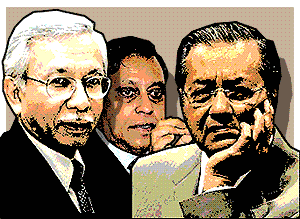 It was Nor Mohamad, Mahathir and Daim! That was the time I just came in (as finance minister). But I trusted Tan Sri Jaffar who did not know until I asked. He had genuinely thought that it was a small amount. By the time I got the picture, the problem was huge. We were talking about losses in the range close to US$10 billion. But, of course, the billions can still be saved because it is partly paper and partly real - you can never know until the audited account for that particular year comes out. So time was closing in for the accounts.
I got the figures and I told Dr Mahathir that I have no choice but to ask Nor Mohamed to leave. He said that it was not fair, this and that, but I persuaded him because under the circumstances Nor Mohamed could be charged. Mahathir said no, don't touch them, just let them go. I told him, I can't go on like this. How can I go and explain to the Parliament and say that these were the real losses and these were the people involved?
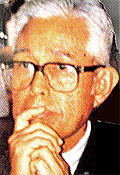 It is unfortunate for Tan Sri Jaffar (
right
) because I rated him highly. He was a man with high integrity, strict, honest, incorruptible and he used to confide in me a lot and had been very helpful to me in advising me. He was supportive.
It is unfortunate for Tan Sri Jaffar (
right
) because I rated him highly. He was a man with high integrity, strict, honest, incorruptible and he used to confide in me a lot and had been very helpful to me in advising me. He was supportive.
So they left. I had the then Bank Negara deputy governor meet me for an hour a day - solid briefing because this was too complex - (the) intricacies on forex trade, which was new to me. I had to really master the subject because I had to deal with Parliament. I called it the worst experience I have had. We had to cover the losses and I don't think Bank Negara was able to cover it.
Finally, when Dr Mahathir had the chance, he brought back Nor Mohamed (as economic adviser) because clearly they were in league (together). You are talking about a person who cost the country 10, 15, 20 billion ringgit of real losses and yet you (Abdullah) promoted him as (second) finance minister. Yes, we were good friends but we are talking about protecting the interests of the country.
Was there any decision that you regret making?
 Yes. You try your best but there were a lot of constraints. For example, if you look at the Education Act (1961). If you remember, once I had then (as the education minister) announced that I wanted to do a new education act. We had the draft bill ready. We invited the teachers' representatives - Malay teachers and (Chinese education movement) Dong Jiao (Zong) - everybody... they saw the draft because we wanted to repeal the controversial section 21(2) (the right of the education minister to close down vernacular primary schools), but I don't want to be seen as conceding to the Chinese.
Then Auku (Universities and University Colleges Act, 1971). The entire legislation was to be a new legislation. There was a draft and it was circulated. So people can't say that Anwar did not do it. It was there in the public domain. Then I was transferred to the Finance Ministry. (Subsequent education ministers) Sulaiman (Daud) and Najib (Abdul Razak) did not take it up.
Later, Najib took it up but then he had something else and kept the thing. I regretted because I could have pushed it (to be tabled and passed) faster. It was a controversial bill. Dr Mahathir didn't agree to repeal the Auku. He told me: 'Cannot, Anwar. It (Auku) is very important. Don't take it personally...' He was very kind in that sense... I had that advantage... in cabinet, he was never rough. He reserved (his iron fist) to the last...
What about decisions when you were at the Treasury?
Even at the Treasury, sometimes with the best of intentions, the Treasury gave strong advice but I was not able to do it, like the airport you said I was appointed chairman of the (Kuala Lumpur International) airport, but only because the prime minister appointed me.
But it was known in the Treasury that we were against the proposal to (move the airport) to Sepang. We wanted to expand the facilities in (the then international airport) Subang because the cost would be 10 times less. This is not something that I am only saying now. Because prior to the cabinet (meeting), there is the economic strategic plan meeting where I proposed the option but then he (Mahathir) said it was important (to move to Sepang). So that was it.
And the Bakun (dam project in Sarawak) - I said that it would proceed after the evaluation by the EIA (environmental impact assessment) but Mahathir announced it before the evaluation was made. Some said that I should have been more firm but I wasn't. But if I had done that, I would have been sacked in 1993.
Regarding the social and religious problems in Malaysia, you have suggested that the different racial and religious communities should start talking to each other. But there is no forum to provide that kind of necessary dialogue.
Yes. My worry is that the BN (Barisan Nasional) government tends to tolerate this conflict a bit because it serves to benefit them in the long run. If you look at the BTN (Biro Tata Negara) courses, which is under the Prime Minister's Department. It is clearly racist. Has any minister - Chinese minister - taken up this issue to re-look the curriculum?
Ask the students who attended these courses. Am I exaggerating or trying to mislead? Why do I take this up? It is just not another political (issue) for Keadilan, but we are talking about the next generation of this country. Anybody who does not seem to agree with them are American agents! Or pro-Chinese. You question the NEP - although I am very Malay and I want the Malays to succeed - I'm immediately put as pro-Chinese. Who does that? PM's Department professors!
Do you think the BTN should be dismantled?
 Either dismantle it or improve it. The intention was to get people trained in diplomacy, to understand the country. These are noble intentions. But it is then used as an Umno political apparatus. There are now racist messages! This is really dangerous. When I was in prison, I learnt from the prison guards who told me they cried because they were given facts on how much the Malays have lost and the Chinese are so greedy to make demands to dismantle everything that we Malays have.
This poor guy is innocent because he genuinely believed it. So I asked him who stole most of the APs (Approved Permits)? Was it Ah Chong or the Malays? Who decided to give Bakun to (tycoon) Ting Pek Khing? Then they started to realise that the (BTN) arguments were flawed. I don't know whether Abdullah is aware. I'd be surprised and disappointed if he doesn't. But if he knows, it is ethically and morally wrong for him to condone this.
I am not saying this because the BTN considers me public enemy No 1. There is no (BTN) course that had not abused me as to my alleged sexual misconduct - that is, of course, less now because the mufti (state religious adviser) have told them that they will go to hell if they make accusations without evidence - but I (continue) to be labeled as an American agent, CIA agent and also pro-Chinese.
Tomorrow: My future in the opposition
Part 1


