
D614G: The mutation that's causing Covid-19 to spread even faster
KINIGUIDE | While the mutation isn't new, it has recently been detected in samples collected from local cases.
KINIGUIDE | Virus mutations happen naturally and randomly all the time. Most mutations do nothing while some will cause harm to the host organism.
A rare few, however, may confer a decisive advantage to a particular virus strain, quickly making it become the dominant variant.
For the SARS-CoV-2 virus that causes Covid-19, the latter appears to be the case for a mutation that is known by its cryptic name D614G.
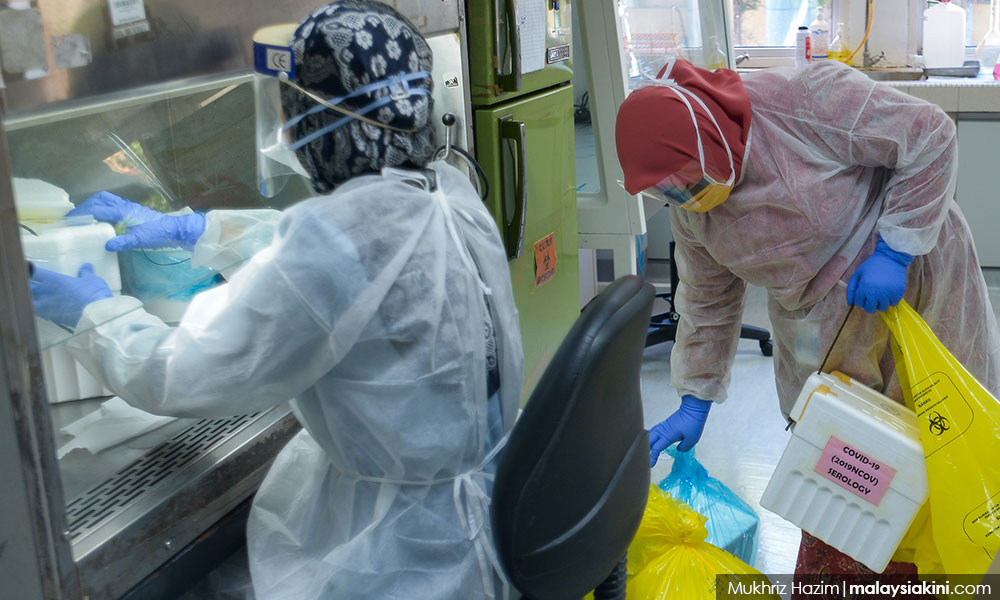
Early this morning, Health Ministry director-general Dr Noor Hisham Abdullah has announced that the mutation has been detected in virus samples collected from some patients in the Sivagangga and Bukit Tiram clusters.
He urged people to be more alert in preventing the spread of Covid-19, as the mutation makes the highly contagious disease even more infectious.
In this instalment of KiniGuide, we decode what is known about the mutation thus far.
D614G? What is in the name?
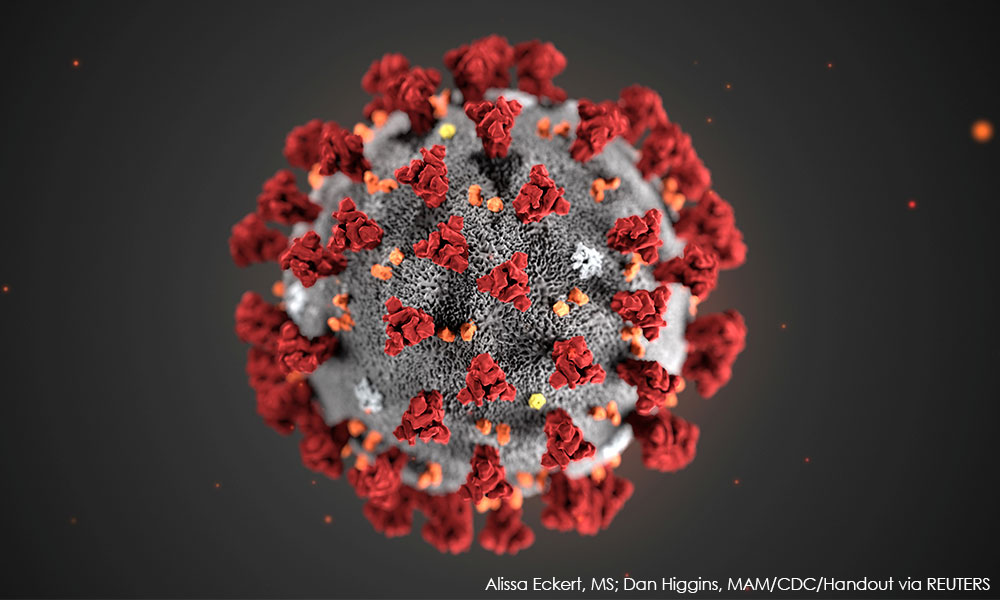
To infect a human cell and eventually cause the Covid-19 disease, the SARS-CoV-2 virus relies on spike proteins (S-protein) on its surface to latch onto the cell.
The protein is often depicted in 3D models of the virus as large, inverted-pyramid shaped objects (coloured red, below) protruding from the surface of the virus.
Once the virus becomes attached to a cell’s surface thanks to the S-protein, it may enter the cell and begin the infection process.
The number 614 refers to a specific location (i.e. “codon”) in the portion of the virus’ genetic code that programs the S-protein’s form and function.
In this case, Codon 614 originally codes for the production of an amino acid known as aspartic acid (abbreviated as “D”) to be produced in that particular location in the S-protein’s structure.
The D614G mutation swaps the code for aspartic acid into another amino acid known as glycine (abbreviated as “G”) instead.
The mutation appeared to have emerged soon after the virus made the jump late last year to infect human hosts and was noticed by scientists even early on.
However, its implications are only recently becoming clear as the D614G variant becomes increasingly prevalent around the world.
When did this mutation emerge?
Scientists around the world have published the genetic code of SARS-CoV-2 virus from samples collected all around the world since the beginning of the outbreak.
Based on this information, they were able to piece together a “family tree” of the virus as generations of the virus sweep across the globe.
At the beginning of the outbreak in late 2019 in China, samples of the virus had carried the 614D variant of the gene. However, at least one lineage of the virus switched to 614G around January this year.
Some of the earliest samples carrying the D614G mutation were collected as early as late January. These samples were taken from patients who had acquired the infections in places like China, Saudi Arabia, and Germany.
In Malaysia, one of the earliest known samples so far was collected from a 30-year-old woman on March 30, who had contracted the disease in Kuala Lumpur.
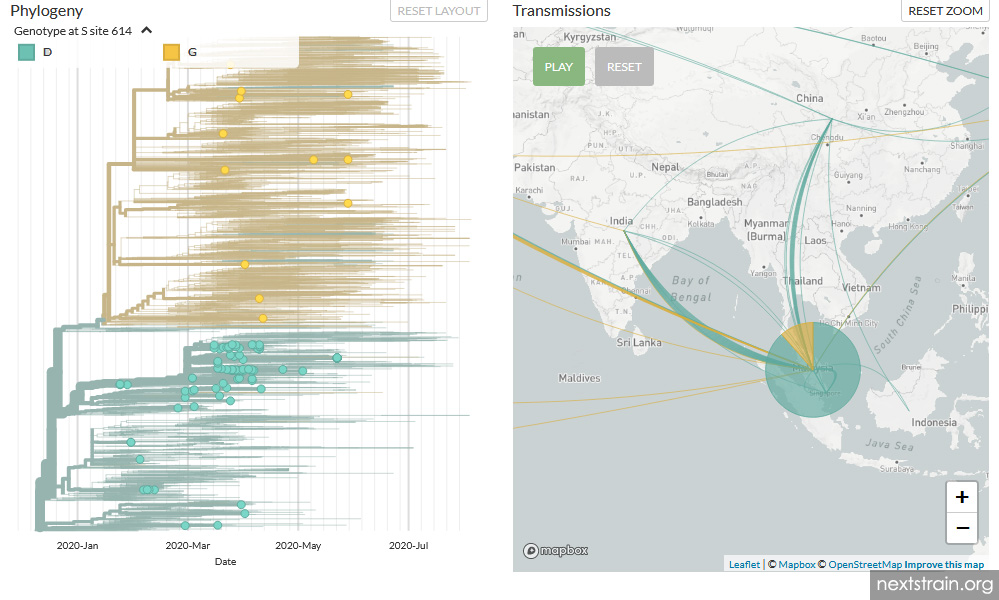
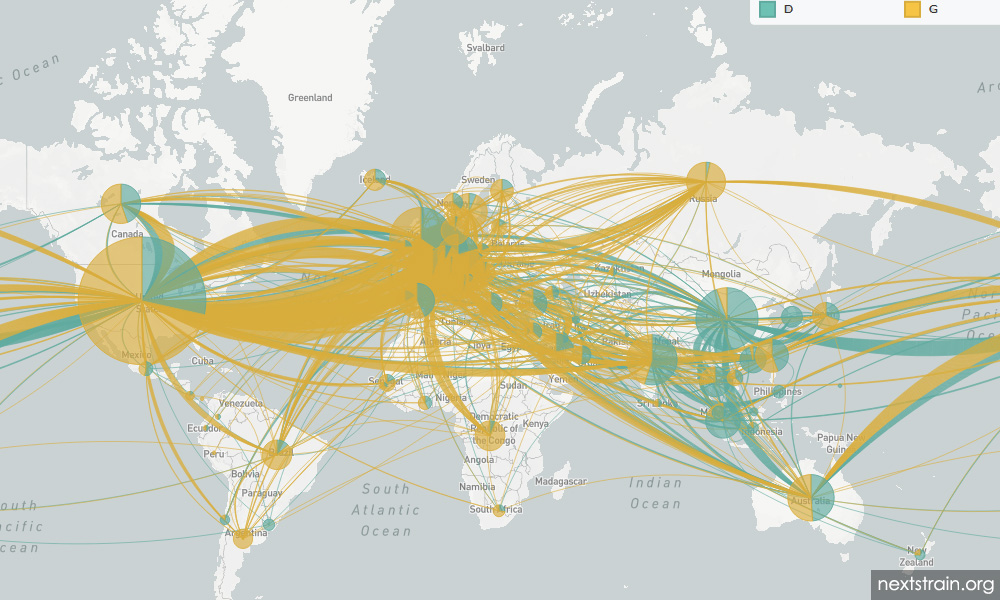
The sample was collected on March 30, though it was only incorporated in the publicly accessible nextstrain.org website last week. The website draws on a database of SARS-CoV-2 genetic sequences to trace its spread across the world.
Unlike the rest of the world, however, the D614G mutation has not become the dominant variant of the virus in Malaysia.
Based on the data on nextstrain.org, only about one in ten samples sequenced in Malaysia carry the D614G mutation, while the remainder still has the original 614D gene.
However, it should be noted that genetic sequencing for the virus is a painstaking endeavour and only a small portion of the 9,175 Covid-19 cases in Malaysia are sequenced and eventually incorporated into the website.
Hence, the data may not necessarily represent a complete picture of the genetic variants of Covid-19 in Malaysia.
What exactly does the mutation do?
Initially, the original 614D variant was the dominant strain of the virus, but the 614G variant that emerged later has become more prevalent in many parts of the world such as the Americas, Europe, and Africa.
There are two competing hypotheses on how this might have transpired.
The first is that, by chance, the 614G variant happened to be in the right place at the right time to be propelled into prominence by the large outbreaks in Europe early this year.
It then spread from Europe to other parts of the world and quickly established itself over the 614D variant by its sheer weight of numbers.
The other hypothesis is that the D614G mutation confers some kind of advantage that helps the virus become more infectious.
While there is still no definitive answer, there has been mounting evidence suggesting that the latter might be the case.
One draft paper on Aug 4 took a more careful look at the 614D and 614G variants and concluded that Covid-19 clusters linked to the latter do tend to grow larger.
Another draft dated June 12 found that the mutation made the S-protein more stable and more likely to be able to successfully latch onto a human cell.
A paper published in the journal Cell on July 2 found that patients carrying the 614G variant of the virus also carried a larger amount of the virus, making it more likely for the patients to infect others.
Reassuringly, none of these papers found that the mutation makes Covid-19 patients sicker or more likely to die.
However, it should be noted that a faster-spreading disease would put healthcare systems at greater risk of becoming overwhelmed, which will hamper their ability to care for all patients, including those who don’t have Covid-19.
Will current vaccines work against D614G?
When the D614G mutation was still gaining traction, some scientists have raised concern that the mutation could render vaccines currently in development useless against it.
Several months on, such concerns have not been borne out, as it appears that antibodies produced by various Covid-19 vaccines target a different part of the S-protein that remained unchanged by the mutation.
A paper published in Cell on July 17 compared over 100 variants of the SARS-CoV-2 virus and found that D614G is more resistant to antibodies, such as those that might be produced by a vaccine or a recovering patient.
A draft paper dated July 24 claimed that a vaccine candidate being developed by Pfizer and BioNTech can produce antibodies that are effective against 17 different variants of the SARS-CoV-2 virus, including those with the D614G mutation.
“In all cases, G614 spike pseudovirions were moderately more susceptible to neutralisation, indicating this is not an escape mutation that would impede current vaccines.
“Rather, the gain in infectivity provided by D614G came at the cost of making the virus more vulnerable to neutralising antibodies,” the authors wrote in the draft paper that is sponsored by BioNTech.
This instalment of KiniGuide is compiled by KOH JUN LIN.