




Conflict resolution role for Anwar
Parti Keadilan Rakyat (PKR) advisor Anwar Ibrahim has been appointed to the prestigious International Crisis Group (ICG), a non-profit organisation dedicated to preventing and resolving deadly conflict.
Parti Keadilan Rakyat (PKR) advisor Anwar Ibrahim has been appointed to the prestigious International Crisis Group (ICG), a non-profit organisation dedicated to preventing and resolving deadly conflict.
In a statement today, PKR said the appointment took effect on July 1.
ICG has provided crucial research and expert analysis on, among others, Indonesian political development; the rise of terrorism and implications for Islam; and the international community's role in Burma's transition to democracy.
Anwar will join the trustee board which includes former Chilean president Ricardo Lagos, ex-Philippines president Fidel V Ramos and ex-Canadian prime minister Kim Campbell, former Dutch prime minister Wim Kok and ex-Hong Kong Governor Chris Patten. The group is chaired by former Australian foreign minister Dr Gareth Evans.
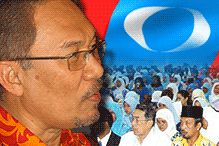 This is Anwar's second appointment to an international non-profit organisation since his release from prison in September 2004.
Earlier this year, he was appointed honorary president of the Institute of Social and Ethical AccountAbility (AccountAbility), which strives for social accountability and sustainable development.
He is said to be a potential candidate for the post of United Nations secretary-general. He recently acknowledged that several international leaders had approached him to consider standing for the post.
Anwar, however, claimed that he had not given any serious thought to this, adding that his commitment was to carry out the reformation agenda in Malaysia.
As incumbent Kofi Annan's term will expire on Dec 31, 2006, the UN Security Council is scheduled to begin discussing his successor this month. A vote by the UN General Assembly endorsing the Security Council's choice is expected by October.
Anwar, 58, was sacked as deputy prime minister in 1998 by then premier Dr Mahathir Mohamad and jailed after convictions for sodomy and corruption.
He was released in September 2004 when his sodomy conviction was overturned, and spent the following year as an academic in the US and Britain, as well as on the international lecture circuit.
He returned to full-time political life in Malaysia in May, building up the opposition party Keadilan and retaining a position as visiting professor with Georgetown University in the US.


