




Moscow, Washington tumultuous once again
The Shanghai Cooperation Organization (SCO) meeting this week marks an important milestone for the group that aims to enhance security and strategic coordination across the region of Central Asia.
To the chagrin of the United States, the Russians and the Chinese shrugged off the warning by the Americans and hosted President Mahmoud Ahmadinejad, whom the Americans believe to be a persona non grata at any international function.
Still, there is no denying that Washington is at the same time eagerly awaiting its sudden overture, made by President George W Bush on May 31 this year, to Tehran to be reciprocated after the SCO meeting in Shanghai.
The Shanghai Cooperation Organization (SCO) meeting this week marks an important milestone for the group that aims to enhance security and strategic coordination across the region of Central Asia.
To the chagrin of the United States, the Russians and the Chinese shrugged off the warning by the Americans and hosted President Mahmoud Ahmadinejad, whom the Americans believe to be a persona non grata at any international function.
Still, there is no denying that Washington is at the same time eagerly awaiting its sudden overture, made by President George W Bush on May 31 this year, to Tehran to be reciprocated after the SCO meeting in Shanghai.
This conundrum only points to a painful fact that the Bush administration has finally come to its senses and opted for dialogue rather than confrontation with the Iranian authorities. Or, in the words of Russian Foreign Minister Sergei Lavrov, Bush's U-turn on Iran is a "victory of common sense". As a New York Times editorial has argued, if the White House was willing to bury the hatchet and patch up with its sworn enemy Colonel Gaddafi, what was stopping it from engaging in direct talks with the Iranians?
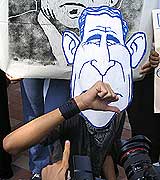 US' retreat from its initial hawkish rhetoric over the Iran nuclear issue also shows that an increasingly isolated superpower, frustrated at the hesitation of its European Union allies to up the ante in the showdown with Tehran, was left with no choice but to shelve its intention to create a unipolar world system for now.
Moreover, neither Russia nor China, the two most important non-EU powers, had unequivocally agreed to impose sanctions on Tehran should diplomatic avenues were exhausted, which finally prompted the US to step back from talking up another military adventure in the Middle East.
Although a New York Times report suggested that Bush had secured some sort of consent from President Vladimir Putin for an escalating series of sanctions against Iran eventually, this allegation has been flatly dismissed by the Russian foreign ministry.
Key partners now
The Chinese, meanwhile, adhere to ambiguity as usual, with President Hu Jintao assuring his American counterpart that China would be willing to "maintain contact and ordination with the US and play a constructive role in resuming negotiations at an early date". Such vagueness reminds one of the famous Cantonese saying that one need not sketch the bowels when drawing a human figure.
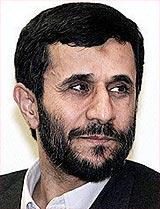 The presence of Ahmadinejad at Shanghai as an observer is therefore a tacit admission that, in addition to the US and the EU trio, Russia and China, too, have been "elevated" to be key partners in the negotiation over Iran, rather than watchers on the fringe. After Bush softened his stance, Lavrov immediately made it clear that unilateral demands would not work, and sued for a common position and approach among the six powers. Already finding itself in a cul-de-sac, Washington will surely see its room for maneuver shrink further if it is to come to terms with this scenario.
Be so as it may, the anxieties of the Bush government over an increasingly assertive Russia are too conspicuous to be ignored. After six years at the helm, Putin has managed to pull his country from the brink of bankruptcy and infused a new sense of hope and optimism in ordinary Russians. If the Yeltsin era was characterized by the preponderance and abruptness of the ailing leader that placed the erstwhile empire at the mercy of western financial assistance, the Putin presidency may very well be remembered for the economic revitalization and the resurgence of nationalism, much aided by the booming oil and gas exports.
No doubt, this new-found confidence worries the West in general, and the US in particular. Only recently, Defense Secretary Donald Rumsfeld chastised Moscow for its lack of respect for liberal democracy. Rumsfeld's strong words came sometime after Dick Cheney, the vice-president, had accused Moscow of using intimidation and blackmail in its energy policy.
But the seed of feud between the White House and the Kremlin was sown much earlier. Although the Russo-American relations were remarkably cordial following Putin's unreserved pledge to support Bush in the latter's fight against international terrorism, which of course would serve Russia's interests in the restive Dagestan and Chechenya as well, things began to take a drastic turn just prior to the Iraq War, as the US administration continued to be suspicious of the potential spillover of critical WMD technologies from the Russians.
The distrust of the US was further deepened by Russia's efforts to demonstrate its independence and global clout, such as Moscow's opposition to a military action against Iraq.
Self-evident agenda
Unfortunately, in the later controversy over Iran, Washington again found Moscow to be on the "wrong side" of a solution. The Russians certainly see a legitimate role for themselves in the non-proliferation issues, while the Americans can only feel irritated at the seemingly undue Russian support for an "irresponsible" regime.
As far as the SCO is concerned, it may be far-fetched to think of it as an Central Asian answer to Nato, but the agenda of the two biggest member states are self-evident. Naturally, Washington was not amused when the SCO summit last year called for US troops to be withdrawn from Uzbekistan and Kyrgystan, and saw it as yet another attempt by Moscow to block its influence in Central Asia.
But Beijing is more eager to portray the SCO as a close but unaligned partnership rather than a counter force against Washington. After all, the trade relations between the US and China are too vital to be upset. Although Beijing envisages a decline of US primacy in the long term, it is at present preoccupied with economic development and technological advancement, making the US too precious a partner to nettle. Whatever ambitions the Russians may be harbouring, this cautious consideration of the Chinese has rendered any talk of a more concrete military grouping in the region premature.
 Next month, Putin will make use of the G-8 Summit in St Petersburg to lay claim to his status as a world leader to be reckoned with. His esteem is further enhanced by the huge popularity that he is currently enjoying at home, in sharp contrast to the mounting domestic discontent that Bush, Tony Blair and Jacque Chirac are facing. Despite calls from the neo-conservative forces to boycott the event, Bush has decided against non-participation lest Putin dominate one of the most significant summits in the world today. Even Henry Kissinger, the father of the contemprorary realpolitik, has urged for US continued engagement with Russia.
Bearing in mind the abrupt death of the former Soviet Union, one cannot take Russia's present glories for granted. But it was the arbitrariness and adventurism of the Bush administration over the last five years that put paid to the credibility and goodwill of a benign superpower subsequent to the collapse of communism. Should the world see more errant states cosying up to Russia and China, the blame cannot be solely on the illiberal powers.


