




Q&A: Im disappointed, says Mahathir
exclusive Dr Mahathir Mohamad speaks on his differences with the present leadership over national carmaker Proton and the half-bridge to Singapore in this first of a three-part series.
Dr Mahathir Mohamad: There are some questions which I will not answer... I never liked Malaysiakini.com. It was very critical of me before.
exclusive Dr Mahathir Mohamad speaks on his differences with the present leadership over national carmaker Proton and the half-bridge to Singapore in this first of a three-part series.
Dr Mahathir Mohamad: There are some questions which I will not answer... I never liked Malaysiakini.com. It was very critical of me before.
Malaysiakini: We're just doing our job. We've also been very critical of the present government as well ...
Yes. You are critical of everybody. Wait until you become the government. Then others will have a chance to take potshots at you. Let's go on.
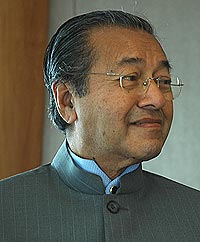 We'll start with the question that is on everybody's lips, which is regarding Abdullah Ahmad Badawi. You have handpicked him as your successor. Given that you were very much the master and he the apprentice, how do you rate his performance in his three years as prime minister?
I don't like to pass opinions on the present government's performance because that may have negative effects, so I just will miss out on that. That is my answer.
What about the fact that he (Abdullah) has made some changes to your policies. Was that a surprise to you or was that something that you had expected?
I expect some changes in style and all that, but the basic policies should remain the same because - I've been looking at my past record, of course, I'm trying to write something - I find that I had given assurance when I became prime minister that I would follow the basic policies of Tunku Abdul Rahman and Tun (Abdul) Razak and Tun Hussein (Onn) because this is a continuity of the same government. Different personalities, different prime ministers, yes, but the government is the same. It's the same party. While you can inject our own personality or your own style into the government that you head, because it is the government of the same party, it should be consistent. So, I believe I was consistent.
What I did was, of course, to enhance, for example, growth of the country. How do you achieve growth? Some people say, 'Well, you stimulate growth'. But it's all easy to say. The thing is, if the government cannot do it, you have to get somebody else to do it. That is why we decided on privatisation, for example, because the government just doesn't have the money to do everything that the public wants you to do. So privatisation was also the answer. Privatisation also afforded us the opportunity to bring in Malays, the bumiputeras, at that level of business. So it's not diverting from the original policy. Grow the economy, distribute the wealth, and develop the country and to be fair to all communities, things like that. The basic policies remain the same. The implementation, of course, if you have ideas on how to improve implementation, you do (it).
But with Proton and the half-bridge ... were you disappointed by the fact that there have been major changes to the basic policies that you conceived?
Yeah, I think that downgrading Proton ... is something I did not expect. Proton was a profitable company until they removed the CEO (chief executive officer). Today you see reports that they are not making money, but (on) the whole, the facilities are the same. People are different and I cannot understand that a company which was able to build a new factory for RM1.8 billion without borrowing from the bank, without getting any government aid, that is a remarkable thing for a government company. Normally you ask the government (for money).
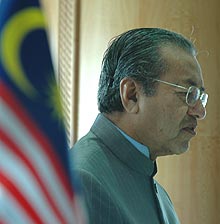 When the CEO left, it still has RM2.4 billion cash. Now, it seems to be losing money, and we are not hearing reports about its performance. How many cars does it sell? Is it making profit on the sale of its cars? Why is it unable to compete where before it was able to compete? One has to remember that even when the government allows in cheap cars into the country under-declared, Proton was still selling and it was still profitable. But now, it is not profitable. And, of course, when you sell Agusta, you'll give away both sides actually. Something that you bought for RM500 million, you give away to some people.
I still question - what is the name of the company which got it? As far as I can trace, this is a 2 euro company set up in 2005 and the only purpose for setting it up is to buy Agusta. Now, there must be some collaboration. Why are these Italians setting up this company to buy Agusta long before we know Agusta is up for sale?
So there's no track record...
There's no track record as far as we can make out. The name of the company is very peculiar. It is called Gevi SpA. There is a Gevi SpA listed in the Italian companies register, but that is a totally different company. It deals with manpower. You can get this on the Internet. It has nothing to do with the purchase of Agusta. This [...] is not a company that is normally registered, but it is a name given to it by a legal firm. The legal firm created this entity, and this entity bought Agusta for 2 dollars.
This is the question I keep on asking - how did they identify these people? How did they offer this company so much? Is this company involved in the automotive industry? All these things are not answered. So that is why, as advisor of Proton, I need to know. How (else) can I advise Proton?
And you're not getting any answers.
I am not getting any answer. Actually, it was stated that no more questions should be asked about this. Today, Proton, I don't know if it is doing well or not doing well. It published some losses before, but lately, we don't hear anything.
Are you disappointed in Abdullah Ahmad Badawi?
I am disappointed in what happened to Proton. And also to the half-bridge.
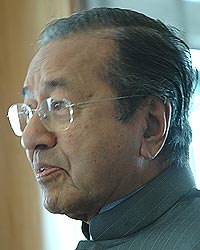 Let me tell you what happened with the half-bridge. It was approved - I can't spend money like that without the approval of the cabinet. Of course, the approval was, usually, very general, but it is not something that is approved (only) in principle. It is approved. And of course, the work on it had started. It had actually started. It was stopped in February 2004. That is to say, from October (Mahathir stepped down on Oct 31, 2003)) until February, work on the bridge was going on, as far as the piling (was concerned), work was going on, and then it was stopped.
Apparently, it was stopped because they wanted to have a straight bridge. To have a straight bridge, they need to have Singapore to agree. To build a half-bridge, or rather a bridge on our side that Singapore already said they have no objections, and I have the letters to show this. Of course, they are in government files, but the letters are published in Singapore, not by me. So to say I breached the OSA (Official Secrets Act), that is nonsense, because that is public knowledge, published by Singapore. So I took the extract from that. In order to get Singapore to agree to a straight bridge, Malaysia agreed to supply Singapore with sand to the amount of one billion square metres...
Malaysia offered?
Malaysia offered, at 50 million square metres a year for 20 years. That will make Singapore one-and-a-half times its present size. It will be suitable for a population of, maybe, 10 million.
Who offered, actually?
The offer comes from Malaysia, as far as I can make out. You see, there are many people from Malaysia's side - I think about 50 people - attended that meeting where the offer was made. From the Singapore side, also, about 50 people. This is public knowledge, actually. Lots of people who attended that meeting knew that the offer was made.
This was after 2003?
This was after the bridge was stopped in 2004. This is quite recent. Quite recent. The other offer was, of course, the air space, to be allowed.
So, it wasn't Singapore that demanded this ... it was offered (by Malaysia)?
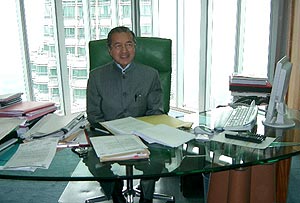 Well, from the records, I think, from the people who talked about this thing - I'm quite sure they talked from proper records - this is Malaysia's offer to persuade Singapore to build a straight bridge. Singapore doesn't want to build a straight bridge. They agreed.
The only problem was when Johor got to know about this offer, Johor protested. They did not want to supply sand to Singapore. They did not want their airspace full of warplanes from Singapore. Because of that, the government decided, that neither the straight bridge nor the crooked bridge should be built. So, if you decide not to build the straight bridge, it's OK. But when you decide not to build the straight bridge and not to build the bridge on our side, that is where we go wrong.
So you're saying that actually Malaysia has offered to sell sand and then because Johor protested, it's only then that the government decided not to go ahead ...
Yes. That is what I understand.
... (Malaysians) were offering what Singapore already had - that we give airspace and sand - until (this was) stopped in 1997.
Very true. Very true. I stopped this (air force) flights over Johor because Singapore was not cooperative in the question of solving all the other problems we had with them, like water, CPF (Central Provident Fund), this Batu Putih (island), and all that, so I stopped it.
 Secondly, I stopped the selling of sand, because this was done privately before. The quantity was not big but already we can see that they are using the sand to reclaim and the reclamation is affecting us. So, we cannot be helping them to do something that is not good for us - the sale of sand. The quantity was small. But when you talk of one billion square metres, it means you are going to scrape the bottom of the sea, of Mersing and the rest, it will kill all the fish breeding, it will destroy all the fish-breeding areas, it will cause the sand on the beaches to slide into the sea, it will cause a lot of environmental damage. We cannot afford to give them.
Also, we do not see why; (we) had been cheated by the British into selling Singapore for RM60,000 - that's what the British paid ... whereas in Penang, it was RM10,000. (It was supposed to be) 10,000 Spanish dollars every year. Of course, they cheated us again by not paying us 10,000 Spanish dollars, but RM10,000. Having been cheated once, we are not going to sell a part of Malaysia. That sand is still a part of Malaysia. It's in our sea.
You have strong words about this particular leader, who you said was selling out the interests of Malaysia regarding this offer to sell sand. Who were you referring to?
Generally.
No one in particular?
No one. You have the right to do things in your own territory and the so-called crooked bridge is in Malaysia and Singapore has not made any objection. In fact, the letters from (then prime minister of Singapore Goh) Chok Tong said he would accept it. Why stop the half-bridge?
Was this offer to sell massive amounts of sand based on commercial interests?
I'm not thinking of commercial interests and who makes money. Obviously, somebody will make money when you sell sand. The government will make money, collecting, maybe, royalties or whatever, but somebody will be involved, it cannot be all done by Singapore. It must be a joint venture, or whatever. I'm not interested in that aspect. What I'm interested in is that we should not build Singapore into a huge country and already it's not a very friendly country with us.
Photos by Jeremiah Foo
Dr M: He made some wrong moves
Tomorrow: Mahathir on PM's children doing business and press freedom


