




Risda: Orang Asli not 'shortchanged'
The Orang Asli community do not understand the nature and demands of rubber small-holding, said the Rubber Industry Small-holders' Development Authority (Risda) of Perak.
The Orang Asli community do not understand the nature and demands of rubber small-holding, said the Rubber Industry Small-holders' Development Authority (Risda) of Perak.
This has led many of them to make claims of being 'shortchanged', said Risda state deputy director Mohd Ghazali Abdul Majid,
"It is not just the Orang Asli community, but many others who do not understand how things work. Perhaps there have not been enough meetings (between Risda and the Orang Asli) to ensure the correct understanding is conveyed," said Ghazali when contacted.
He was responding to allegations that more than 500 Orang Asli families in Perak and Pahang participating in Risda's commercial rubber and palm oil replanting schemes were being fleeced.
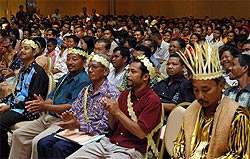 During the annual general meeting of the Peninsular Orang Asli Association of Malaysia (Poasm) last Sunday, several persons lamented that land schemes in other states enabled some families to earn about RM1,200 a month from the harvest of palm oil from their lands.
For a number of Orang Asli families in Perak and Pahang, however, whose 10-acre small-holdings are managed by Risda subsidiary Risda Small-holders Plantation Sdn Bhd (RSPSB), they see little more than RM300-RM400 a month.
Similar questions were also asked of the Federal Land Consolidation and Rehabilitation Authority's (Felcra) consolidated replanting schemes under which Orang Asli families owning rubber tree orchards are also participants.
Ghazali explained that a lot of capital and labour expenses went into the production of processed rubber or palm oil.
Although these currently fetch high market prices, a significant amount is deducted from the net total that would otherwise go to the Orang Asli families owning land under the scheme.
"There are fertiliser costs, mini-estate maintenance costs, draining and irrigation costs, wages for harvesting and other labour-intensive processes, transportation, marketing, distribution, as well as cleaning, processing, and cess costs.
"They all input into the final 'SMR' form, for example, in which rubber is sold," he said.
'It's not just the Orang Asli'
Ghazali added that while families elsewhere may earn more, this may be due to the usage of their own labour, capital, and management resources without having to go through RSPSB or other replanting scheme.
"Many of the Orang Asli are not significantly involved in the production process but merely wait for the monthly dividends. Even if they do want work as labourers, rubber-tapping requires skills that ordinary people, Orang Asli or not, do not readily have," he said.
Ghazali added that this explains why out of 18 RSPSB lands, only three employ Orang Asli labourers.
"However, we offer such employment to the Orang Asli as stipulated in our agreement with the Department of Orang Asli Affairs," he said.
In response to claims that Orang Asli families had for as long as 15 years received low dividends on account of loans taken out to participate in the scheme, Ghazali said this was understandable as the harvesting of palm oil could only be done after 15 years.
"Palm oil trees mature only after a 15-year period, only then can landowners reap the fruits of the replanting scheme," he said.
Until such time expires, many families participating in such schemes are dependent on the loans granted by such agencies.
"In fact, it's not just the Orang Asli but many Malay families who are also suffering," added Ghazali.


