
Court acquits Rafizi over disclosure of NFC banking data
The Shah Alam High Court this morning set aside convictions against PKR vice-president Rafizi Ramli and former Public Bank clerk Johari Mohamad for violating the Banking and Financial Institutions Act (Bafia) by a lower court.
Both men freed and discharged from their 30-month jail sentence.
Rafizi and a former bank clerk are freed and discharged from their 30-month jail sentence.
The Shah Alam High Court this morning set aside convictions against PKR vice-president Rafizi Ramli and former Public Bank clerk Johari Mohamad for violating the Banking and Financial Institutions Act (Bafia) by a lower court.
Both men were acquitted and discharged from their 30-month jail sentence.
High Court judge Mohd Yazid Mustafa delivered the decision at the end of Rafizi and Johari's appeal against the convictions by Shah Alam Sessions Court last year, which found them guilty over the disclosure of banking data from the accounts of National Feedlot Corporation (NFC) and its chairperson Mohd Salleh Ismail in 2012.
In acquitting Rafizi, Mohd Yazid ruled that he allowed the former Pandan MP's appeal as the High Court found that the prosecution had failed to produce original documents as evidence in the trial, which is a requirement under Section 61 of the Evidence Act.
He said the photocopy of a press release produced during the trial was "undoubtedly secondary evidence", and should only be admissible under combined provisions of Section 65 and Section 63(b) of the Evidence Act 1950.
It would not be available as evidence, Mohd Yazid added, if an explanation is not given to why the original is not produced in court.
"Thus, the prosecution should have called a witness to testify that a sufficient search for the original document of P4 was carried out.
"Moreover, the witness should offer an explanation as to how the original document of P4 was lost or could not be found.
"The prosecution had called bank officers to testify, however, the evidence of the witnesses failed to fulfill the above requirement in order for P4 to be admitted under the above requirements.
"Without this evidence, these document P4 and its attachments (marked) A to D are not admissible under Section 65(1)(c) of the Evidence Act," the judge said in his ruling.
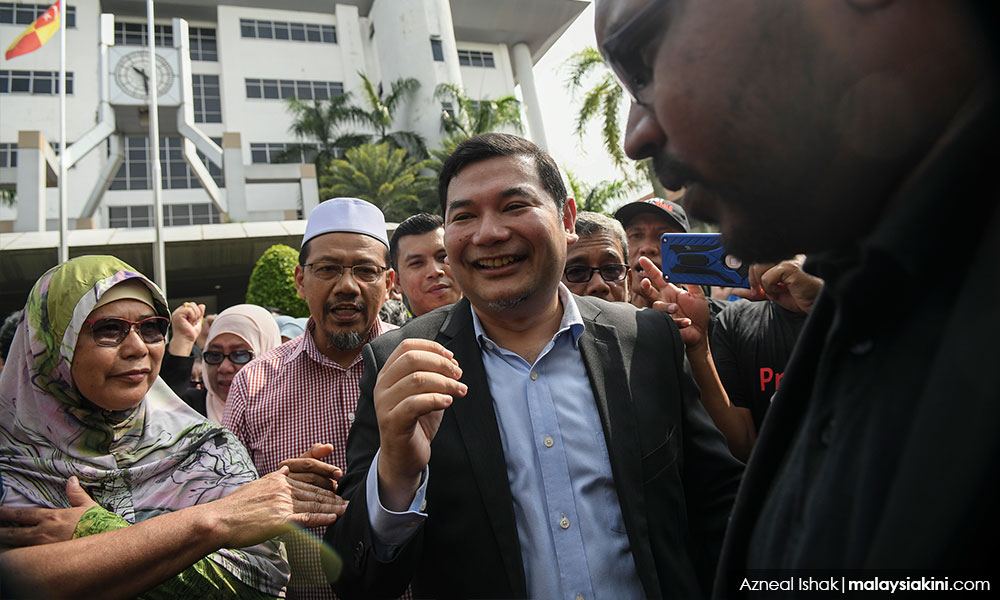
Rafizi (above) and Johari, was sentenced to 30 months jail by the Shah Alam Sessions Court on Feb 7, 2018 after Judge Zamri Bakar found them guilty of leaking banking data from the accounts of NFC.
Judge Zamri had in his judgement last year said the prosecution had proven beyond reasonable doubt that Rafizi and Johari had violated the Banking and Financial Institutions Act (Bafia).
For the record, Bafia was repealed in 2013.
The two were charged in 2012 for violating Section 97 of Bafia for the disclosure of four accounts belonging to NFC and its chairperson Mohd Salleh Ismail, who is the husband of former Wanita Umno chief Shahrizat Abdul Jalil.
In his judgement over Johari's appeal, Mohd Yazid said he found that the prosecution had failed to prove a prima facie to relate to the accused's involvement in the case.
He said the prosecution has failed to prove that Johari had intended or had knowledge that Rafizi had revealed the contents of the documents to commit the offence as charged.
"It is trite law that a prima facie case means that there is sufficient credible evidence to establish the elements of the said charge against the second appellant."
Joy in the atmosphere for Rafizi supporters
As Mohd Yazid delivered his judgement, Rafizi's supporters who were present in court could not hold back their joy and started cheering and clapping their hands in the courtroom.
This had led the judge to tell them that it is not appropriate for them to do so.
"You should have not clap your hands here. This is not the place to clap hands," said Mohd Yazid.
Speaking to reporters and addressing some 100 of his supporters who had gathered at the compound of Shah Alam Courts Complex later, Rafizi expressed his gratitude to those who have supported him in fighting the case.

He also thanked the court for considering the defence's argument and also his team of lawyers led by Ahmad Nizam Hamid.
Rafizi said that even during the trial, he had been confident that his appeal against the conviction would be successful, citing that the defence had a strong point.
"I had been super confident. Because Nizam and our team had produced a strong argument based on point of law, which is whether the evidence that did not satisfy requirement under the Evidence Act can be admissible and taken by a judge.
"Because the Sessions Court judge had used the evidence to arrive at a conviction," he said.