




Decency by whose standard?
From now on, parents, teachers, community patriarchs and religious clerics of all faiths need no longer worry about the virtue of our youths. The numerous city and town councils can now enact by-laws to regulate sexual relations in public places.
Hoards of morality Gestapo agents will prowl public parks and shady corners, to ensure that our youths will not stray into what their elders consider as debauchery.
In one fell swoop, a court judgement has pronounced ex-cathedra a legal edict governing our concept of decency. We are Asians, and what is accepted as normal expression of affection in London and elsewhere, will not necessarily be accepted in the morally rarefied stratosphere of Malaysia.
From now on, parents, teachers, community patriarchs and religious clerics of all faiths need no longer worry about the virtue of our youths. The numerous city and town councils can now enact by-laws to regulate sexual relations in public places.
Hoards of morality Gestapo agents will prowl public parks and shady corners, to ensure that our youths will not stray into what their elders consider as debauchery.
In one fell swoop, a court judgement has pronounced ex-cathedra a legal edict governing our concept of decency. We are Asians, and what is accepted as normal expression of affection in London and elsewhere, will not necessarily be accepted in the morally rarefied stratosphere of Malaysia.
Western tourists found hugging and kissing publicly in joyful greeting will be hauled before the court of course, for not respecting our local standard of decency, and polluting the moral fibre of our young. This, after all, is Malaysia, truly Asia!
Artistes and members of the high society who have adopted the corrupting influence of the west by hugging and kissing on the cheek must now repent their wayward ways, and go back to a mere handshake, or a deep bow, with a hand to the chest naturally, as prescribed by our political leaders.
Our excellent athletes can hug each other in celebration after winning gold medals, even if they are of different gender, but only in a foreign land like Melbourne, over which our local government has no jurisdiction. Nevertheless, the verdict has been proclaimed: their public behaviour may be unAsian and therefore, indecent!
Fortunately, there are dissenting voices.
Morality and law
 The letter writer Jeffery, in his piece published by the
NST
on April 10, opines that the issue is not one of whether hugging or kissing are nascent to Asian tradition, but rather it is about whether the law should enforce morality in the context of our Constitution.
The letter writer Jeffery, in his piece published by the
NST
on April 10, opines that the issue is not one of whether hugging or kissing are nascent to Asian tradition, but rather it is about whether the law should enforce morality in the context of our Constitution.
I agree, recalling the teaching of a philosopher from ancient Greece proposing that ethics and morality can neither be taught nor legislated. It is an idea which cannot survive the modern era, since our concept of law has changed. As an instrument of social engineering required by the modern nation-state for the purpose of "nation-building", it would be a surprise if the law is not manipulated to produce standard codes of good and bad behaviours.
This is not to say that morality ought to be separated from the law though. The relationship between morality and law is one that has been hotly disputed for centuries, culminating in the chasm in the 20th century between legal positivism and proponents of Natural Law theory.
Apparently, the politico-legal system in Malaysia has always tended towards legal positivism that does believe in the separation between morality and law. A law is a law, as long as it is enacted through a legitimate process. It is binding on the citizens, irrespective of whether it is a good or bad law in the eyes of the public. As one former prime minister observed, some Malaysians are guilty of corruption morally, but not legally.
In contrast, there are those who believe in the difference between man-made laws (with a lower case "l") and higher moral/religious/cosmic Law (with an upper case "L"). A law passed by the legislature is not just a law; it is either a good or a bad law, in comparison to some kind of transcendental concept of justice. Why, if it is a very unjust law, it is morally justifiable for a good citizen to disobey it in a peaceful manner.
The term "morality" is the real problem here. Very often, the two schools of thought involved in the above argument mean different things with the term "morality". (Naturally, "Law" also means different things to the contending parties.) This debate, though not entirely irrelevant to the question of hugging and kissing in public, is not the central issue here.
The "morality" involved in whether hugging and kissing in public is indecent behaviour can perhaps be more aptly called the sexual mores of any community. This refers to generally acceptable standards of relation and public demeanour between the sexes. They are more like unwritten social rules, which change from time to time, and from place to place, unlike some universal immutable principles of good and bad conduct that we associate with the concept of justice.
Every community, and every nation for that matter, will have some minimum standards of public decency of course. Some of these social norms may perhaps even be universal. For instance, public nudity is out. And so is fornication in public places.
The trouble starts when one tries to codify these minimum standards of public decency, or when any particular incident is brought to court for a judgement.
A case in point can be found in the publication of literature. D H Lawrence' Lady Chatterley's Lover was banned because of some sexually explicit description in the book; a court eventually lifted the ban. The same tortuous fate also befell upon James Joyce's masterpiece, the Ulysses.
'Community standard'
Since then, in court cases involving the publication of allegedly pornographic materials, the publishers have always appealed to some kind of "community standard" which may be either tolerant or intolerant of such materials. As we all know, the real difficulty begins with defining this community standard.
 This is particularly problematic in multi-racial, multi-cultural and multi-religious Malaysia. We do not have one homogenous Asia here; we have a dazzling collection of Asian traditions. One man's indecency is another man's social norm.
Who has the moral and legal authority to enact laws to define for all the standards for public decency?
The DBKL and all other city and town councils certainly lack this moral authority. They are not elected, and do not in any way, represent the general will of the people under their jurisdiction. The cynical will simply wonder aloud what a bunch of career bureaucrats and their minions know about morality anyway. Will their awesome power over public behaviour not give them ample opportunity for corruption?
The outcry of dismay and opposition must have alarmed political leadership at the highest level though. Apparently, a cabinet meeting has decided that all local councils are now instructed to suspend their decision and action on the matter. We hear the usual noises produced by the officialdom that the government wants to seek views from a wide cross-section of the populace on what constitutes indecency, as if a uniform standard code of public behaviour is in the pipeline.
Even if the government is elected democratically, after a fashion, the letter writer Jeffery's point is still valid. The government has no business in legislating morality on a personal level.
One has indeed to recognise the plurality of the system of sexual mores in Malaysia to see that a uniform set of codes governing public conduct will do more harm than good.
Varied ways
 The varied ways of life in our country is such that, what is normal behaviour on Jalan P Ramlee in KL on any weekend evening will be an affront to rural people in Kelantan. Likewise, what is indecent among conservative Muslims will not necessarily be so abnormal among more liberal urban Muslims. Yet, so far, they exist together, under one roof so to speak, because of a spirit of tolerance and mutual respect, despite the occasional tension. This is one good common Asian tradition.
Part of this fine Asian tradition is also the general understanding that people, by and large, know what is offensive to others and they practise a great deal of self-restraint and good sense in showing their sensitivity to other value systems.
This pervasive civilised understanding of most Malaysians that come from voluntary and reasoned consciousness of what constitutes decency is far more legitimate and effective than some formally codified standards of personal behaviour in public. Voluntary reasoned acquiescence to moral standards is always more meaningful than external coercion in any society aspiring towards the Rule of Law.
It is even sadder when we think that perhaps this whole business of hugging and kissing in public in a KL park should not have become a contentious issue in the first place. It is not as if the phenomenon is excessive, abusive, and widespread, to the extent of disrupting social order and public respectability.
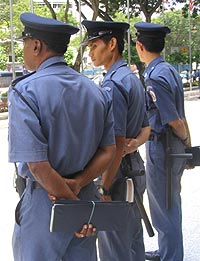 The real issue hangs over the performance of the DBKL enforcement officers who arrested those endearing young couple for hugging and kissing in the park.
What were these officers thinking and feeling? What are their qualification and modes of training? Were they really asking for a bribe, under the pretext of enforcing laws on public decency? How do they see themselves as servants of the public? Have they gone through any psychological assessment as to their perception on sexuality in general and their own sexuality in particular?
Obviously, something is seriously wrong with our "delivery" of public service. It will require a Royal Commission of Enquiry to put matters right, so that our public officials under the employ of the rakyat in service to the rakyat will not act like overlords dictating to you and me what is and is not decent, when their very own decency is in doubt.


