




History of the Malay Left
It is now politically fashionable to assume that all local scholars and academicians are timid and careerist apologists of the establishment.
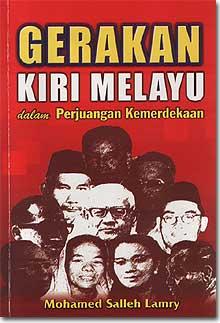
However, there are always admirable and commendable exceptions like UKM's former Assoc Prof Dr Mohamed Salleh Lamry who authored the recently released general history of the Malay Left - Gerakan Kiri Melayu Dalam Perjuangan Kemerdekaan. (Bangi, Penerbit UKM, 2006).
 Besides the wealth of information gathered, chronicled and interpreted in a coherent, systematic and intelligible manner, the 203-page
Gerakan Kiri Melayu Dalam Perjuangan Kemerdekaan
also makes a moral or psychological breakthrough by consciously refusing to label communists as 'terrorists' or 'communist terrorists' like the colonialists, fascists and their indigenous clones, ex-mercenaries, cultural agents and ideological proxies did and have still been trying to do.
Besides the wealth of information gathered, chronicled and interpreted in a coherent, systematic and intelligible manner, the 203-page
Gerakan Kiri Melayu Dalam Perjuangan Kemerdekaan
also makes a moral or psychological breakthrough by consciously refusing to label communists as 'terrorists' or 'communist terrorists' like the colonialists, fascists and their indigenous clones, ex-mercenaries, cultural agents and ideological proxies did and have still been trying to do.
According to its author, it is 'now no longer appropriate'.
It is now politically fashionable to assume that all local scholars and academicians are timid and careerist apologists of the establishment.
However, there are always admirable and commendable exceptions like UKM's former Assoc Prof Dr Mohamed Salleh Lamry who authored the recently released general history of the Malay Left - Gerakan Kiri Melayu Dalam Perjuangan Kemerdekaan. (Bangi, Penerbit UKM, 2006).
 Besides the wealth of information gathered, chronicled and interpreted in a coherent, systematic and intelligible manner, the 203-page
Gerakan Kiri Melayu Dalam Perjuangan Kemerdekaan
also makes a moral or psychological breakthrough by consciously refusing to label communists as 'terrorists' or 'communist terrorists' like the colonialists, fascists and their indigenous clones, ex-mercenaries, cultural agents and ideological proxies did and have still been trying to do.
Besides the wealth of information gathered, chronicled and interpreted in a coherent, systematic and intelligible manner, the 203-page
Gerakan Kiri Melayu Dalam Perjuangan Kemerdekaan
also makes a moral or psychological breakthrough by consciously refusing to label communists as 'terrorists' or 'communist terrorists' like the colonialists, fascists and their indigenous clones, ex-mercenaries, cultural agents and ideological proxies did and have still been trying to do.
According to its author, it is 'now no longer appropriate'.
The author also states at the outset that he intends the book to only provide an intellectual framework for the now 'marginalised' participants or actors in the history of the struggle for Merdeka to narrate their experiences and viewpoints from 'their own perspectives'.
These participants and actors include prominent and legendary communist veterans like Abdullah CD, Rashid Maidin, Suriani Abdullah (a k a Eng Ming Ching), Abu Samah bin Mohamad Kassim and Ibrahim Chik whom he met and interviewed and whose writings he cited and quoted extensively.
As the book was written after the publication of the memoirs of the secretary-general of the Communist Party of Malaya (CPM), namely Alias Chin Peng: My Side of History (Singapore, Media Masters, 2003), it is also used to fill in the gaps and lacunas, especially those pertaining to decisions of high politics and broad strategies of the communist struggles, both peaceful and armed.
However, it also relied on traditional sources provided by veteran historians like Anthony Short, Cheah Boon Kheng and CF Yong, as well as former nemeses of the communists like former Special Branch officer Aloysius Chin to build up the structure or framework for the narratives and discourses.
Balance and objectivity
Seen in this light, the author certainly achieved a high degree of scholarly balance and objectivity avoiding the pitfall of ideological judgment although the book's conclusion seemed to be sympathetic to the argument that the armed struggle launched by the CPM was an objectively and positively critical factor in the acceleration of the process of de-colonisation of Malaya because the 12-year anti-colonial armed struggle had upset British colonialists' cost-and-benefit calculation of holding on to its 'dollar arsenal'.
The book also has an excellent summary of the histories of the CPM as well as organisations, major personalities, ideas and activities of anti-colonial and leftwing Malay nationalism such as Kesatuan Melayu Muda (KMM), Parti Kebangsaan Melayu Malaya (PKMM), Angkatan Pemuda Insaf (API) and Angkatan Wanita Sedar (Awas).
The PKMM, whose inauguration in Ipoh on Oct 17, 1945 as an anti-colonial Malay nationalist party preceded the May 1946 formation of the original pro-British Umno by Onn Jaffar by six months. PKMM's first president was in fact a communist and veteran of CPM's Malayan People's Anti-Japanese Army (MPAJA), Mokhtaruddin Lasso.
There were many other personal connections and official liaisons between the CPM and the anti-colonial leftwing Malay originations even in the prewar era. For example, it is now recorded in the book that Sutan Jenain, an Indonesian Marxist and a member of CPM's central committee in 1936, acted as a liaison between the top leadership of CPM and KMM. Sutan Jenain attended the inauguration of KMM in Kuala Lumpur in April 1938.
The author also quoted USM historian Cheah Boon Kheng and other sources to suggest that Malay participation in the CPM-led armed resistance to Japanese occupation was extensive. This aspect of the hidden history of Malaysia is now slowly surfacing with publications of the memoirs of veteran Malay members and leaders of CPM such as Abdullah CD, Rashid Maidin and Abu Samah. It is understood that the two-volume Chinese-language regiment-by-regiment history and chronicles of engagements of MPAJA, first published in Hong Kong, is in the process of being translated into the Malay-language.
The multi-ethnic anti-colonial struggle in its peaceful form after the end of the Pacific War reached its apex with the formation of the Putera-AMCJA to oppose the draft constitution of the British-inspired Federation of Malaya with its own People's Constitution.
According to the author, while Umno under the leadership of Onn Jaafar still struggled for Malay ethno nationalism, the leftwing PKMM 'did not see the Chinese and Indian as a threat to the Malay race' and 'it stated that in the struggle to create a democratic Malayan state, the Malays have to cooperate with other races which live in this country', premising its politics on Malayan nationalism that includes the Chinese and Indians. (p 66). Seen in this light, it was most probably under the political pressures of PKMM and the broad left of all races that Onn Jaafar later proposed the opening up of Umno to non-Malays.
Of course, the peaceful struggle from 1945 to 1948 failed as the result of increasing repression on the part of British colonialism. The book revealed that, the idea of switching from peaceful to armed struggle for Merdeka was discussed and agreed upon, not only by the CPM, but also non-communist leftwing Malay nationalists like Dr Burhanuddin Al-Helmy and Ahmad Boestamam.
It is also now known that, even upper-class non-Malay youths like William Kuok (Hock Leng @ Peng Cheng) - an elder brother of billionaire Robert Kuok - were frustrated with the British intransigence and repression in the 1947-1948 period.
William later left his wealthy family and joined the CPM's Malayan National Liberation Army (MNLA) to fight the anti-colonial guerilla war. He was martyred in the jungle of Pahang in October 1953.
Malay dimension
At this point, Gerakan Kiri Melayu Dalam Perjuangan Kemerdekaan zooms into the Malay dimension of the road leading to the anti-colonial armed struggle and Pahang's Temerloh becomes a focus because it was there that a strongly anti-colonial revolutionary tradition and legend existed in the Malay civil society.
The jungles, rivers and mountains of Pahang were also judged by CPM's and leftwing Malay nationalists' strategists to be an ideal location to launch and sustain a guerilla war.
It coherently recollects how Abdullah CD, Rashid Maidin, Kamarulzaman Teh and other anti-colonial Malays, both communists and non-communists, were detained by the British after the proclamation of the so-called 'Emergency'. It also reconstructs the process of the regrouping of hundreds of Malay youths in Pahang, especially Temerloh who organised themselves into anti-colonial armed bands which later integrated into the all-Malay 10th Regiment of the Malayan National Liberation Army (MNLA) on May 21, 1949 under the political and strategic command of the central committee of the CPM.
It then further reconstructs with considerable amount of detail the ups and downs as well as the twists and turns of the all-Malay 10th Regiment in its engagements and later, strategic retreat and 'Long March' to the Malayan-Thai border in 1953-1954, as well as the 34 years of its military and political activities in Southern Thailand.
The book also reveals the hitherto under-publicised contacts and secret correspondences between CPM chairperson Abdullah CD and the then deputy premier Ghafar Baba in 1985-1988. Ghafar , according to the author, was in fact a member of the leftwing PKMM and his political secretary Mokhtar Mahmud Baginda is a brother-in-law of CPM's central committee member Abu Samah whose wife Siti Norkiah Mahmud Baginda @ Minah is also a communist and former leader of Awas.
It is also now publicly recorded in the book that Ghafar personally met Abdullah CD in an emotional meeting in Sungai Golok's Genting Hotel on March 2, 2003 to reminiscence their good old days in PKMM.
Gerakan Kiri Melayu Dalam Perjuangan Kemerdekaan has, above all, debunked the 'Communists = Chinese' propaganda myth of British colonialists, Japanese fascists and rightwing Malay nationalists, as well as the 'only-Chinese-fought-Japanese' calumny perpetuated by real Chinese chauvinists in the not very glorious tradition of rightwing Kuomintang in Malaysia and Singapore.
It is a great contribution to a mature understanding of how Malayan/Malaysian history was shaped, for good or for ill, by international events and transnational ideas even in the eras when there was no television, mobile phone or Internet.
The book should be translated into Chinese and English for the intellectual and moral benefits of younger generations in Malaysia, Singapore, China, Taiwan and the Anglosphere of Britain, Canada, United States, Australia and New Zealand.
JAMES WONG WING ON is chief analyst of Strategic Analysis Malaysia. He is a former DAP member of Parliament for Kampar (1990-1995) and a former columnist for the Sin Chew Jit Poh Chinese daily (now Sin Chew Daily). He read political science and economics at Monash University in Melbourne, Australia


