


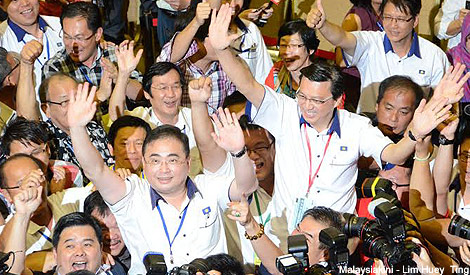

Broken trust: The Chinese community’s frustration with MCA
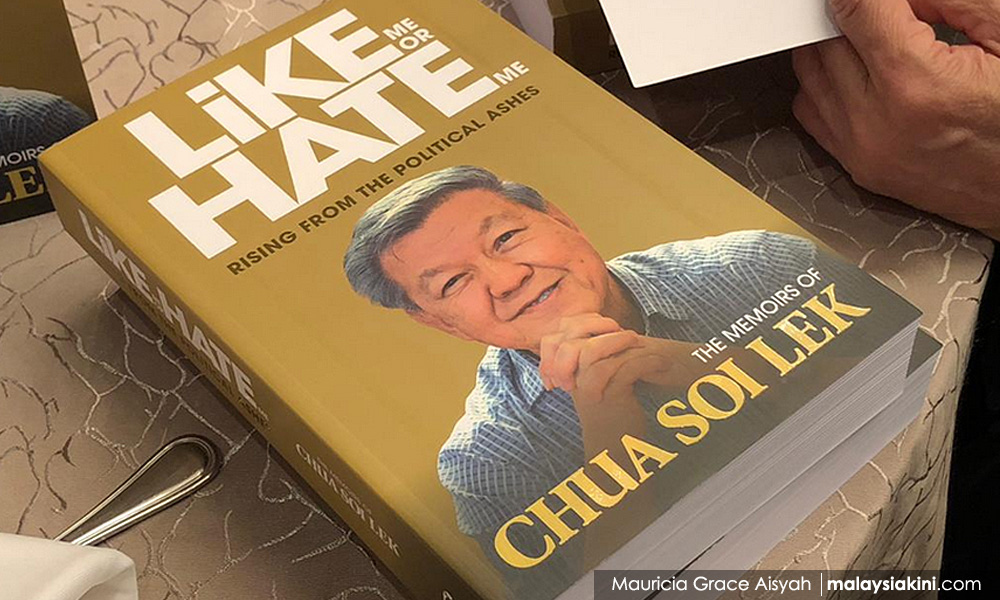
Editor’s note: This is the 11th of a 12-part series from former health minister and MCA president Chua Soi Lek’s book, ‘Like Me or Hate Me: Rising from the Political Ashes’.
BOOK EXCERPT | This chapter contains my thoughts on issues primarily of relevance to the Chinese community.
Suqiu and the 17-point Election Appeal
On 10 August 1999, the Dong Jiao Zong (the United Chinese School Committees’ Association of Malaysia and United Chinese School Teachers’ Associations of Malaysia) joined with the KL-Selangor Chinese Assembly Hall to draw up an important memorandum.
The document, which came to be known as Suqiu (Malaysian Chinese Organisation Election Appeals Committee), was subsequently endorsed by more than 2,000 other Chinese associations in August 1999.
To be fair, the Suqiu cannot be regarded as promoting Chinese interests to the exclusion of other races. Many of the principles it advocated were of universal values that cut across race and religion.
These included good governance, human rights and justice, a crackdown on corruption, the repeal of the Internal Security Act (ISA), press freedom, the eradication of poverty irrespective of race, and a review of the government’s privatisation policy.
But there were also many demands that were aimed at redressing grievances specific to the Chinese community.
It referred, for example, to the need to develop Chinese education (including providing Chinese schools with adequate funding), and improve Chinese new villages.
The document also advocated the abolishment of the long-standing official distinction between Malays and non-Malays and advocated basing affirmative action policies on needs rather than on race.
It also wanted promotion in the government service to be based on meritocracy rather than race and religion.
The fact that the Suqiu was announced just months before the general elections created a lot of excitement within the Chinese community.
So much so that the MCA, Gerakan and SUPP – the three Chinese-based parties in the Barisan Nasional coalition – felt they had little choice but to support it.
Almost immediately, there were protests from Umno Youth, Malay NGOs and the Malay press.
These critics alleged that the Suqiu threatened Malay special rights. The Federation of Peninsular Malay Students (Gabungan Pelajar Melayu Semenanjung or GPMS) responded by drawing up 100 demands focusing on Malay interests.
In reality, however, Suqiu never questioned Malay special rights. Instead, it focused on excesses identified during the implementation of the New Economic Policy.
Suqiu was subsequently discussed in the cabinet. According to MCA president Dr Ling Liong Sik (photo), none of the demands in the document were rejected outright.
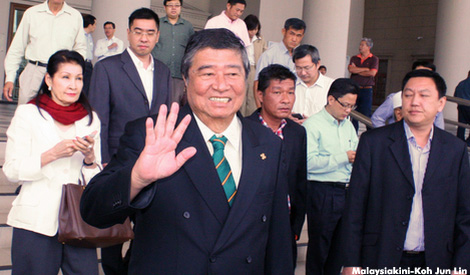
Instead, the cabinet decided that Ling should look into its demands. As a result, Suqiu generated a lot of hope and expectation within the Chinese community.
When the general elections were held on 29 November 1999, the contents of the Suqiu document and the sensational events following the sacking of Anwar Ibrahim created a lot of uncertainty.
Apart from a promise that the MCA president would look into them, the demands listed by Suqiu were never addressed. However, the Reformasi movement and the huge street demonstrations associated with it in Kuala Lumpur generated a lot of media attention.
Soon, the Chinese began to fear that these demonstrations would get out of hand and take on racial overtones.
As a candidate in the election, however, I was more worried that Anwar’s supporters in Umno will not support Barisan Nasional candidates. Fortunately, the Chinese community gave overwhelming support to MCA and Gerakan candidates.
Umno candidates, on the other hand, suffered as the Anwar factor caused Malay voters to reject the party. It was largely thanks to Chinese support that the Barisan Nasional was able to retain the coveted two-thirds majority in Parliament.
After the 1999 election, however, the Chinese community became frustrated and disillusioned with both Mahathir and Ling. This was because they appeared to be backtracking on what they said before election about Suqiu.
In fact, Mahathir subsequently likened the supporters of the Suqiu document to the communists who attempted to destroy the country soon after independence.
Ling advised the Chinese community to listen to Mahathir because he was an experienced and wise leader. But the Chinese community was also upset with MCA. Having supported Suqiu before the election, the party had sung a different tune soon afterwards...
Editor’s note: This is the 11th of a 12-part series from former health minister and MCA president Chua Soi Lek’s book, ‘Like Me or Hate Me: Rising from the Political Ashes’.
BOOK EXCERPT | This chapter contains my thoughts on issues primarily of relevance to the Chinese community.
Suqiu and the 17-point Election Appeal
On 10 August 1999, the Dong Jiao Zong (the United Chinese School Committees’ Association of Malaysia and United Chinese School Teachers’ Associations of Malaysia) joined with the KL-Selangor Chinese Assembly Hall to draw up an important memorandum.
The document, which came to be known as Suqiu (Malaysian Chinese Organisation Election Appeals Committee), was subsequently endorsed by more than 2,000 other Chinese associations in August 1999.
To be fair, the Suqiu cannot be regarded as promoting Chinese interests to the exclusion of other races. Many of the principles it advocated were of universal values that cut across race and religion.
These included good governance, human rights and justice, a crackdown on corruption, the repeal of the Internal Security Act (ISA), press freedom, the eradication of poverty irrespective of race, and a review of the government’s privatisation policy.
But there were also many demands that were aimed at redressing grievances specific to the Chinese community.
It referred, for example, to the need to develop Chinese education (including providing Chinese schools with adequate funding), and improve Chinese new villages.
The document also advocated the abolishment of the long-standing official distinction between Malays and non-Malays and advocated basing affirmative action policies on needs rather than on race.
It also wanted promotion in the government service to be based on meritocracy rather than race and religion.
The fact that the Suqiu was announced just months before the general elections created a lot of excitement within the Chinese community.
So much so that the MCA, Gerakan and SUPP – the three Chinese-based parties in the Barisan Nasional coalition – felt they had little choice but to support it.
Almost immediately, there were protests from Umno Youth, Malay NGOs and the Malay press.
These critics alleged that the Suqiu threatened Malay special rights. The Federation of Peninsular Malay Students (Gabungan Pelajar Melayu Semenanjung or GPMS) responded by drawing up 100 demands focusing on Malay interests.
In reality, however, Suqiu never questioned Malay special rights. Instead, it focused on excesses identified during the implementation of the New Economic Policy.
Suqiu was subsequently discussed in the cabinet. According to MCA president Dr Ling Liong Sik (photo), none of the demands in the document were rejected outright.
Instead, the cabinet decided that Ling should look into its demands. As a result, Suqiu generated a lot of hope and expectation within the Chinese community.
When the general elections were held on 29 November 1999, the contents of the Suqiu document and the sensational events following the sacking of Anwar Ibrahim created a lot of uncertainty.
Apart from a promise that the MCA president would look into them, the demands listed by Suqiu were never addressed. However, the Reformasi movement and the huge street demonstrations associated with it in Kuala Lumpur generated a lot of media attention.
Soon, the Chinese began to fear that these demonstrations would get out of hand and take on racial overtones.
As a candidate in the election, however, I was more worried that Anwar’s supporters in Umno will not support Barisan Nasional candidates. Fortunately, the Chinese community gave overwhelming support to MCA and Gerakan candidates.
Umno candidates, on the other hand, suffered as the Anwar factor caused Malay voters to reject the party. It was largely thanks to Chinese support that the Barisan Nasional was able to retain the coveted two-thirds majority in Parliament.
After the 1999 election, however, the Chinese community became frustrated and disillusioned with both Mahathir and Ling. This was because they appeared to be backtracking on what they said before election about Suqiu.
In fact, Mahathir subsequently likened the supporters of the Suqiu document to the communists who attempted to destroy the country soon after independence.
Ling advised the Chinese community to listen to Mahathir because he was an experienced and wise leader. But the Chinese community was also upset with MCA. Having supported Suqiu before the election, the party had sung a different tune soon afterwards.
A by-election in the Kedah state assembly seat of Lunas in November 2000 showed just how upset the Chinese community was.
Lunas was a mixed constituency, consisting of 43 percent Malay, 37 percent Chinese, and 19 percent Indian. The constituency had previously been regarded as a safe seat for the government. However, in the by-election, the MIC candidate representing the Barisan Nasional lost by 530 votes to a candidate from Anwar’s PKR.
This was a sharp reversal from the 4,700-vote majority enjoyed by the government candidate in the previous year.
The future of the MCA
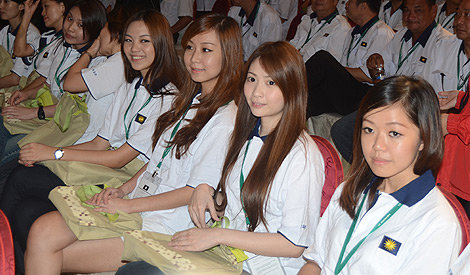
If an MCA leader claims that the party is still attracting a lot of young talented Chinese to join the party, he is lying.
How do you explain the fact that out of four deputy ministers, three made it into the cabinet through the back door?
One of the three was rejected twice, once in the 2013 general elections and then again in a by-election.
Yet the party leadership still describes this particular leader is an invaluable asset. Perhaps they think voters do not know how to appreciate talent!
To enhance their chances of winning, such leaders are moved to new constituencies in the hope that voters will accept them. These are the privileged few whom the leadership tries by hook or by crook to ensure that they retain influential positions in the party and government.
If a candidate is rejected in general elections and is still appointed as senator or deputy minister, it speaks volumes about the lack of talent in the party.
In Malaysia, business is always associated with politics. Those with power often practise the politics of patronage. Those who cling to the powers-that-be are often rewarded with projects.
I am not arrogant when I say, in general, that the quality of our MCA leaders, both in intellect and oratory skills, is slowly deteriorating.
The best and the brightest Chinese youth shun politics in general, and MCA in particular.
I hate to admit it, but the fact is that the DAP, despite all its deficiencies, has attracted a lot of talented and dedicated young leaders.
Senior MCA leaders should be honest and admit that it is difficult to recruit new MCA members. The Chinese are disillusioned and disappointed with the party.
We have squandered a lot of goodwill and support to the point where we have lost the trust and respect of the Chinese community. Recovering from this position will be very difficult.
MCA-Gerakan merger
Merging the MCA and the Gerakan Rakyat (People's Movement Party) has often been suggested as the way forward for these two component parties of the ruling Barisan Nasional coalition.
The MCA, set up in 1949 as an exclusively ethnic Chinese political party, has about one million members.
Gerakan was established in 1968 as a multiracial party, but it has always been clear that the vast majority of Gerakan's supporters are ethnic Chinese. The party has about 300,000 members.
In Malaysia, mono-ethnic parties are often regarded as being out of touch with the aspirations of the people.
In a multiracial country like Malaysia, people hope to see the development of multiracial parties that advocate policies that do not consciously promote the interests of a particular ethnic group.
Of course, mono-ethnic parties are widely regarded as having served their purpose in the early stages of the country's history.
It was through the cooperation of parties representing the three major races – Malays, Chinese and Indians – that Malaya achieved its independence on 31 August 1957.
Even so, many among younger generation believe that mono-ethnic parties have outlived their purpose and become political dinosaurs.
When I was the president of MCA, I commissioned an online survey by an independent body to inquire about the role of race-based parties in the country.
The results were revealing. Chinese youths were supportive of multiracial parties, but the majority also felt that there was still a role for Chinese-based parties like the MCA.
While Chinese youths wanted to see Malaysia adopt more multiracial and inclusive policies, they also felt that mono-ethnic parties should continue to be part of the political landscape.
The MCA-Gerakan merger has been discussed often in various forums at different times. However, the first serious discussion by both the MCA and Gerakan that I was aware of took place in early 2004.
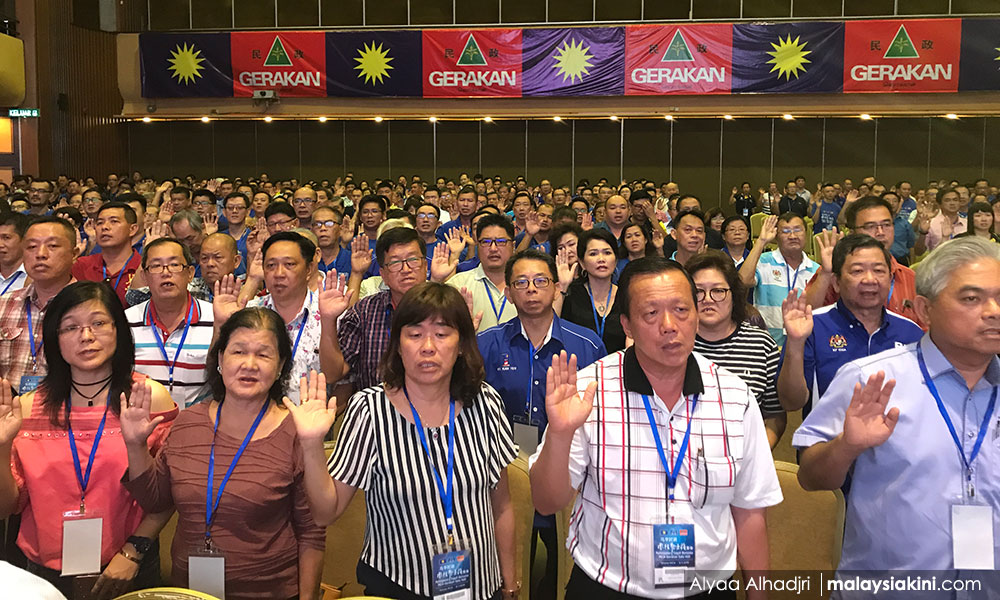
Ong Ka Ting, the MCA president at the time, tabled the proposal at an MCA central committee meeting on 6 January 2004.
After a lengthy discussion, it was decided that an MCA-Gerakan merger was a long-term objective. In the short term, it was more important to improve the ties between the two parties.
The MCA also set up a committee headed by the then-deputy president Chan Kong Choy to look into the matter. However, nothing concrete came out it.
Improving relations with Gerakan was certainly important. When Dr Ling Liong Sik was MCA president, the relationship between the party and Gerakan (then under the late Dr Lim Keng Yaik) was cold.
When I became the president in 2010, Dr Lim Keng Yaik (then retired), urged me to take the initiative to talk to his successor, Dr Koh Tsu Koon, about the possibility of reviving the merger talks.
Dr Koh was enthusiastic. Subsequently, we had two very low-key meetings.
When I brought up the proposal of the merger in MCA presidential council and central committee meetings, however, I could sense that the majority of the members were not in favour.
Most felt that the MCA should continue as a Chinese-based party, while embracing a multiracial outlook. The older generation of MCA members in particular wanted the MCA to maintain its identity as a Chinese-based party.
I therefore concluded that in view of this lukewarm support there was little point in pursuing the merger proposal.
What was important, I believed, was that the MCA, in striving to achieve its political objectives, should be issue-centric and not look at developments through the lens of race-based politics.
Land swap with Mah Sing Group
Sometime in early August 2012, Kuala Kubu Bharu State Assemblyman Wong Koon Mun, who was also an MCA central committee (CC) member, informed me that a well-known developer, the Mah Sing Group, was interested in purchasing some land from the MCA.
The land, consisting of about eight acres, was located in Bangi, Selangor. On checking the party records, I discovered that the land was donated to the MCA by Boon Siew Group Bhd in the early 1990s.
The original plan was to build a cadre centre. However, it was never implemented, probably because construction would require a high investment by the MCA in infrastructure since there was no development in the surrounding area.
I brought up the issue for deliberation at the central committee (CC) meeting held on the 16 August 2012. The committee unanimously agreed to my suggestion that we appoint Chor Chee Heung, the minister of housing and local government at the time, to negotiate a suitable price with the Mah Sing Group.
On 11 September 2012, Chee Heung reported to the presidential council (PC) that he had met with Mah Sing Group Bhd managing director Tan Sri Leong Hoy Kum to discuss the price.
Mah Sing, he said, did not agree with our offer price of RM8 million. Instead, they offered RM5.2 million in cash plus a building constructed by the company in Klang, Selangor. This property was valued at RM2.8 million.
The council unanimously agreed that Chee Heung and MCA treasurer-general Tan Chai Ho should visit the building before the CC made a decision.
At its meeting on 2 October 2012, the CC decided against accepting the building in Klang.
It was also at this meeting that the CC agreed in principle to the sale of the land to Mah Sing for RM5.5 million in cash, plus a building (Lot 2-G-01 & Lot 2-1-01 in Oxford Tower at Garden Plaza) constructed by the company in Cyberjaya worth RM2.5 million.
The CC agreed that the sales and purchase agreement was to be signed by the MCA secretary-general or treasurer-general with Mah Sing Group Bhd.
Subsequently, on 16 October 2012, Chee Heung was able to report to the PC that he would organise a luncheon meeting with Mah Sing. The luncheon meeting was to be attended by myself and Chee Heung (MCA vice-president). Kong Cho Ha (secretary-general) and Tan Chai Ho (treasurer-general) would also be present to finalise the sale with the managing director of Mah Sing Group.
From the aforementioned, it can be seen that the sale was considered at two CC and two PC meetings.
However, after the May 2013 general elections, as part of a strategy to force me to retire before the party election scheduled that November, my political opponents alleged that the property was actually worth RM20 million and that I very likely profited from the sale.
But the whole transaction with Mah Sing Group was conducted by Chee Heung. Politically, he was closely aligned to Ong Ka Ting and later Liow Tiong Lai.
If I was trying to profit in some way from the sale, surely it would not have made sense for me to arrange things through him.
In reality, my only role was to ensure that the sale was done in a transparent manner. That was why the proposed sale was tabled at the CC and PC meetings.
I have highlighted this point to illustrate the way in which politicians sometimes have intentional lapses of memory to pursue their respective political agendas.
When Liow Tiong Lai was elected MCA president in November 2013, he pledged that he would try to renegotiate a better deal for MCA regarding the sale of the aforementioned land.
He said this despite the fact that the sale had already been completed. I am still waiting for this better deal to be delivered by Liow and his cronies.
Of course, such declarations should not be taken seriously. They are merely examples of the operation of factional politics.
Elsewhere in this book, I suggested that MCA will face increasingly greater difficulty attracting talented young Chinese leaders in future years. Most prefer to join the commercial sector rather than become involved in MCA politics, where factional politics ensures that genuine talent is not appreciated.
Part 1: My resignation and its aftermath
Part 2: The sex DVD - who were the culprits?
Part 3: Finding my replacement for GE13 and the PKFZ scandal
Part 4: Opponents’ attempt to bury me made me work harder
Part 5: How MCA came to own The Star
Part 6: I ensured transparency in MCA's purchase of office tower
Part 7: ‘Avoid factionalism, embrace unity’ - Soi Lek’s parting words to MCA
Part 8: Setting aside personal feelings in 2013 MCA elections
Part 9: 'Muhyiddin told MCA to make a stand on 1MDB'
Part 10: The eclipse of Najib's achievements by 1MDB scandal
Part 11: Broken trust: The Chinese community’s frustration with MCA
Part 12: The hypocrites in the MCA
CHUA SOI LEK is a former health minister and MCA president. Like Me or Hate Me: Rising from the Political Ashes is now available in all good bookstores at RM59 (paperback, English and Chinese) and RM99 (hardcover, English only). It is also available at MPH Online.
The views expressed here are those of the author/contributor and do not necessarily represent the views of Malaysiakini.


