




Abolishing death penalty: Time to send clear message
Putrajaya's plan to abolish the death penalty has been lauded by human rights groups and earned the country international praise.
However, the government is also facing some pushback, particularly from families of murder victims, which has been prominently highlighted in the Chinese press – which even prompted MCA deputy president Wee Ka Siong to call for more consultation.
Among these was Chee Ah Sau, whose 25-year-old daughter Chee Gaik Yap was raped and murdered in 2006...
Putrajaya's plan to abolish the death penalty has been lauded by human rights groups and earned the country international praise.
However, the government is also facing some pushback, particularly from families of murder victims, as highlighted prominently in the Chinese press – which even prompted MCA deputy president Wee Ka Siong to call for more consultation on the matter.
Among these was Chee Ah Sau, whose 25-year-old daughter Chee Gaik Yap was raped and murdered in 2006.
Ah Sau had tried to jump off the court complex building in Alor Setar after the High Court acquitted the suspect, Shahril Jaafar, the son of a "datuk," on grounds that the prosecution failed to prove a prima facie case.
However, the Federal Court found Shahril guilty last year and sent him to the gallows.
Minister in the Prime Minister's Liew Vui Keong (photo) had said Putrajaya is committed to the "total abolition" of the death penalty and announced a moratorium on all death sentences.

"I can understand that for the families of victims, it's very painful, but it is the government's intention to abolish the death penalty in total.
"We cannot do it half-heartedly like abolishing the death penalty for one offence and keeping it for another. We want to abolish all death penalties," Liew had said.
A number of studies have found that the death sentence may not be an effective deterrent, but the issue is nevertheless emotive.
To gauge public sentiment, Malaysiakini conducted a poll on its English, Malay and Chinese language Facebook pages.
The results showed that there remains substantial resistance to the abolition of the death penalty. Note that this is not a scientific poll, but is intended to give a general idea of readers' sentiment on the issue.
Some 20,600 respondents participated in the poll across three languages, but there was strong interest among Chinese language readers in particular, which contributed almost half the votes.
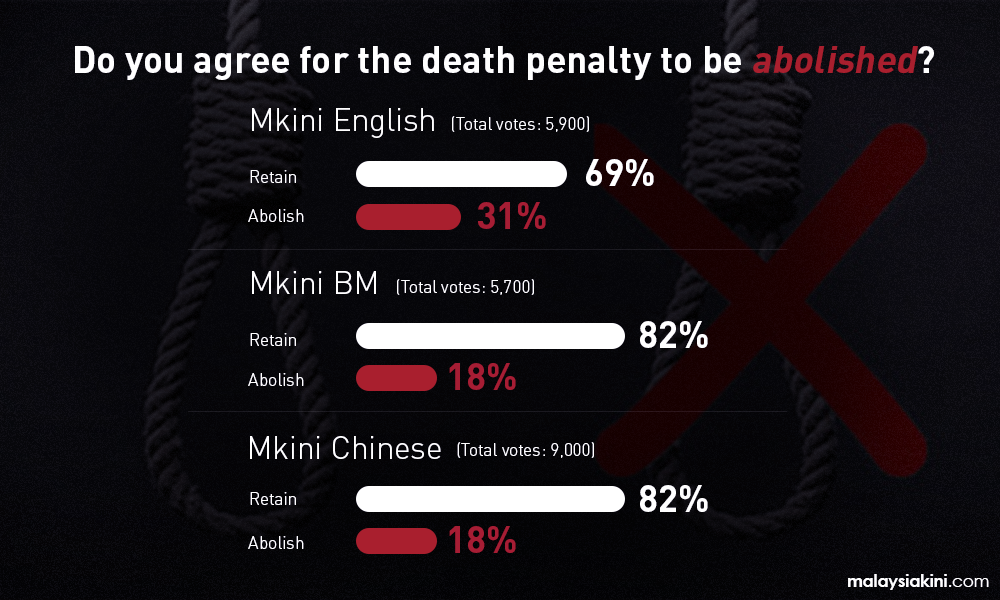
The poll found that among both Malay (around 5,700 respondents) and Chinese (around 9,000 respondents) language readers, 82 percent wanted to retain the death penalty.
This was lower among those who responded to the English-language poll, with 69 percent favouring the death penalty compared with 31 percent who want it to be abolished. About 5,900 respondents participated in this poll.
'Time to abandon an eye for an eye'
Lawyers For Liberty adviser N Surendran, who has worked on many death penalty cases, said the government must provide moral leadership.
"It is common for opinion polls to suggest majority support for capital punishment. That was the situation historically in most countries which went ahead to abolish it despite public opinion.
"After abolition, it is found that public support for the death penalty becomes much reduced. So abolition itself can mould public opinion. And moral leadership must be provided by the government," he said.
Surendran said polls can oversimply a complex issue, especially if it involves innocent lives.
"If those being polled are confronted with the indisputable fact that the death penalty has never been proven to be a deterrent, would they vote the same way?
"Or if they are confronted with the fact that innocent persons may be executed, and given examples of such cases," he said.
These facts, Surendran said, must be clearly explained to the public and discussion should be encouraged.
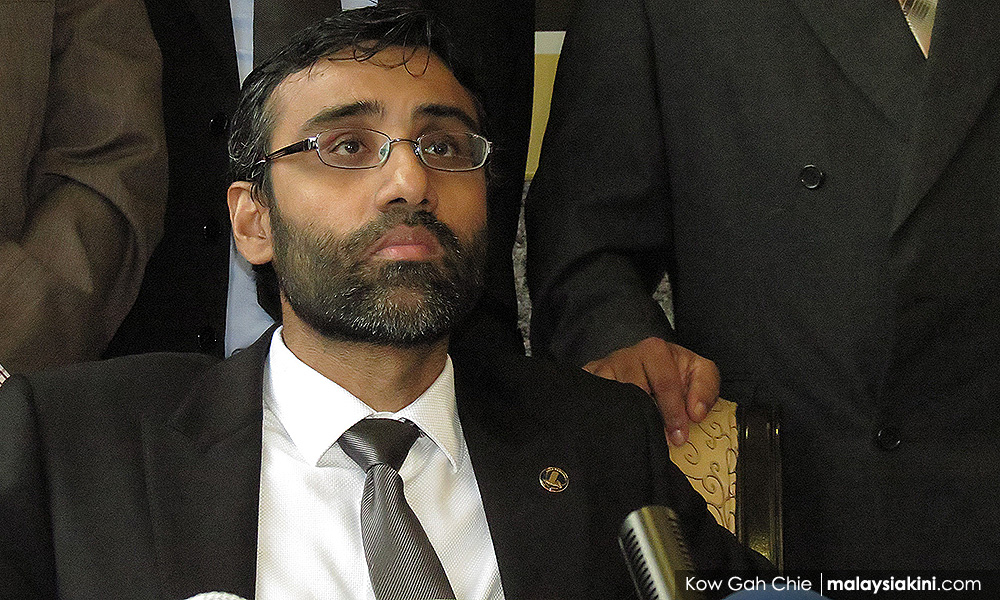
Surendran (photo) also pointed out that countries that abolished the death penalty have not seen a rise in serious crimes.
"This may seem counterintuitive, but there are many reasons for this, including the fact that the potential offender rarely considers the penalty when deciding to commit the offence; most offenders bank on the fact that they will not be caught.
"This is why so many drug mules continue to smuggle drugs despite the much-publicised death penalty for traffickers," he said.
Human Rights Commission (Suhakam) commissioner Jerald Joseph said the opposition to the abolition of the death penalty was based on an unfounded fear and old cultural norms that promote an eye for an eye.
"We need to move to a more compassionate response that also serves justice for victims but without the need for the death penalty.
Joseph added that lengthy prison sentences are still a deterrent against crime.
"It is time for the government to speak with a clear message and help people to understand about countries that don't practise the death penalty but still have low crime rates and vice versa.
"The managing of crime does not only depend on serious penalties like the death penalty.
"The more important part is effective counter-crime measures and professional policing as well as resolving root causes that push people into criminality."


