


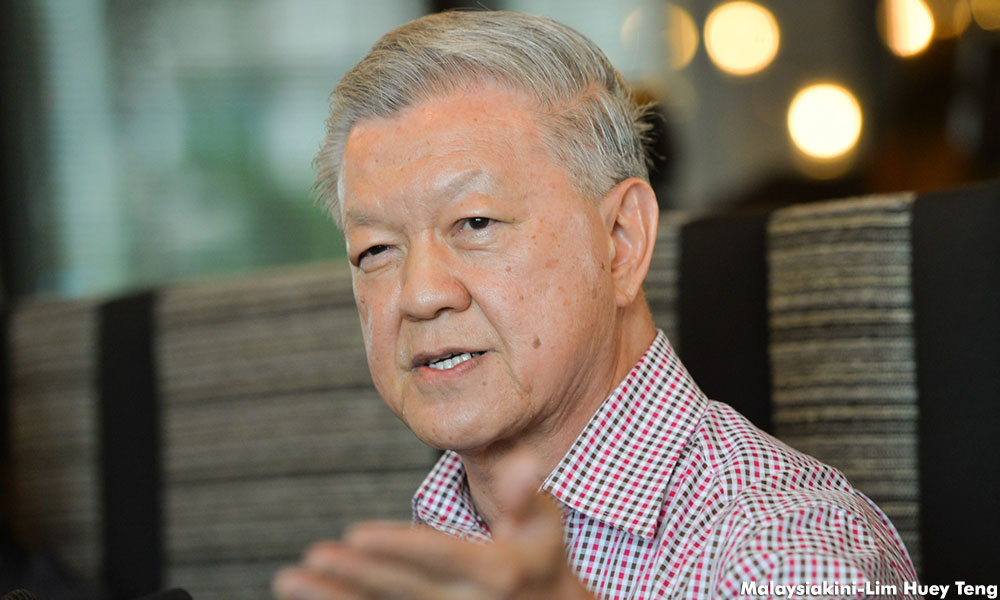

Soi Lek: My resignation and its aftermath
Editor’s note: This is the first part of a series of excerpts from former health minister and MCA president Chua Soi Lek’s book, ‘Like Me or Hate Me: Rising from the Political Ashes’.
BOOK EXCERPT | Besides my work at the Ministry of Health, I also officiated at many NGO and MCA functions. In fact, this period was the busiest in my life. I was on the road almost every day, and almost constantly in the news.
At the time I did not realise the extent to which all this activity was causing uneasiness among senior MCA leaders. It was not long before all my hard work and dedication was construed as being motivated by political ambition.
Within two years of becoming a minister and an elected vice-president, my relationship with the president and his deputy began to deteriorate. Perhaps I was so busy that I neglected the public relations aspect of the job when it came to dealing with senior party figures. As a result, I came to be regarded as arrogant, proud and ambitious.
In early 2004, when I came to Kuala Lumpur to serve as Minister of Health, there was an understanding between the new MCA president (Ong Ka Ting) and myself that I should become the party’s secretary-general.
However, I was not keen on the offer. Although it was an important and powerful position in the party, it was not an elected post. Instead, the secretary-general served at the pleasure of the president. Hence, in the 2005 party election, I opted to stand for one of the party’s four vice-presidential positions instead.
My fatal mistake was not to consult the president and the deputy president beforehand. I felt that my temperament and general tendency to call a spade a spade would not be a good attribute of a secretary-general of the second largest party in Barisan Nasional.
Malaysians are by nature courteous, and often do not like to hear the truth spoken plainly. This certainly appeared to be true of President Ong (below). He was a very courteous man, both in speech and action.

Generally, he tried to avoid direct confrontation on major issues in the hope that the problem would resolve itself over time. I, on the other hand, preferred to take the bull by the horns.
Soon, colleagues began to warn me that there were people who were unhappy that I was working hard and getting a lot of media exposure. This, I think, was the real cause of my downfall in 2008.
Several of my colleagues who viewed me with suspicion seemed to have the ear of the MCA president. Thus, what began as a very cordial relationship between President Ong and myself was put to the test.
Some of these people are still walking in the corridors of power in the party. These are leaders who, despite being rejected more than once by the voters, managed to project themselves as the public face of the MCA.
An unexpected phone call
On Friday, 28 December 2007, I was in Kota Kinabalu to attend a belated national Christmas celebration officiated by the then-deputy prime minister, Najib Razak.
After the function, I was resting in my hotel when I received a call from the chairman of an NGO that was closely associated with me. I used to help the organisation raise funds and attend its annual dinner. My wife also made frequent anonymous donations to this association to help its staff provide free medical treatment for the poor. In short, everybody in town knew I was closely associated with the organisation.
The chairman informed me over the phone that the NGO had received two DVDs in its mailbox. The DVDs contained pornographic material involving me and a woman. He said he would pass one of the DVDs to one of my close friends in Batu Pahat.
I asked my Batu Pahat friend to inquire whether the media and other NGOs had received similar DVDs. Later that night, he called to inform me that the Chinese vernacular press had also received copies. Some were also believed to be available in popular coffee shops and hawker centres. In other words, the distribution had been done in a way designed to achieve maximum effect.
I returned to Kuala Lumpur the next day. After viewing the DVD, I had a discussion with a senior retired Umno politician. He asked me point-blank for my thoughts. I told him I would admit that I was the person in the DVD. In short, I was prepared to take the bull by the horns.
My Umno colleague advised me to lay low, take leave from work and avoid the press. He argued that if anyone suggested that I was the person in the DVD, I could take legal action to restrain them from talking.
I consulted a senior lawyer to find out if I could, in fact, do this. The lawyer replied that proving the identity of a person featured in a DVD involved a tedious legal process. First, the defendant had to prove that the DVD was original. Then, he had to produce the person responsible for producing the DVD as a witness. Often, this was difficult.
However, rather than seeking this form of legal protection, I felt I should be brave and honest enough to admit my mistake. To me, it was a question of having the moral courage to confront the issue...
BOOK EXCERPT | ‘The DVD issue came like a political tsunami that ended my political career abruptly.’
Editor’s note: This is the first part of a series of excerpts from former health minister and MCA president Chua Soi Lek’s book, ‘Like Me or Hate Me: Rising from the Political Ashes’.
BOOK EXCERPT | Besides my work at the Ministry of Health, I also officiated at many NGO and MCA functions. In fact, this period was the busiest in my life. I was on the road almost every day, and almost constantly in the news.
At the time I did not realise the extent to which all this activity was causing uneasiness among senior MCA leaders. It was not long before all my hard work and dedication was construed as being motivated by political ambition.
Within two years of becoming a minister and an elected vice-president, my relationship with the president and his deputy began to deteriorate. Perhaps I was so busy that I neglected the public relations aspect of the job when it came to dealing with senior party figures. As a result, I came to be regarded as arrogant, proud and ambitious.
In early 2004, when I came to Kuala Lumpur to serve as Minister of Health, there was an understanding between the new MCA president (Ong Ka Ting) and myself that I should become the party’s secretary-general.
However, I was not keen on the offer. Although it was an important and powerful position in the party, it was not an elected post. Instead, the secretary-general served at the pleasure of the president. Hence, in the 2005 party election, I opted to stand for one of the party’s four vice-presidential positions instead.
My fatal mistake was not to consult the president and the deputy president beforehand. I felt that my temperament and general tendency to call a spade a spade would not be a good attribute of a secretary-general of the second largest party in Barisan Nasional.
Malaysians are by nature courteous, and often do not like to hear the truth spoken plainly. This certainly appeared to be true of President Ong (below). He was a very courteous man, both in speech and action.
Generally, he tried to avoid direct confrontation on major issues in the hope that the problem would resolve itself over time. I, on the other hand, preferred to take the bull by the horns.
Soon, colleagues began to warn me that there were people who were unhappy that I was working hard and getting a lot of media exposure. This, I think, was the real cause of my downfall in 2008.
Several of my colleagues who viewed me with suspicion seemed to have the ear of the MCA president. Thus, what began as a very cordial relationship between President Ong and myself was put to the test.
Some of these people are still walking in the corridors of power in the party. These are leaders who, despite being rejected more than once by the voters, managed to project themselves as the public face of the MCA.
An unexpected phone call
On Friday, 28 December 2007, I was in Kota Kinabalu to attend a belated national Christmas celebration officiated by the then-deputy prime minister, Najib Razak.
After the function, I was resting in my hotel when I received a call from the chairman of an NGO that was closely associated with me. I used to help the organisation raise funds and attend their annual dinner. My wife also made frequent anonymous donations to this association to help its staff provide free medical treatment for the poor. In short, everybody in town knew I was closely associated with the organisation.
The chairman informed me over the phone that the NGO had received two DVDs in its mailbox. The DVDs contained pornographic material involving me and a woman. He said he would pass one of the DVDs to one of my close friends in Batu Pahat.
I asked my Batu Pahat friend to inquire whether the media and other NGOs had received similar DVDs. Later that night, he called to inform me that the Chinese vernacular press had also received copies. Some were also believed to be available in popular coffee shops and hawker centres. In other words, the distribution had been done in a way designed to achieve maximum effect.
I returned to Kuala Lumpur the next day. After viewing the DVD, I had a discussion with a senior retired Umno politician. He asked me point-blank for my thoughts. I told him I would admit that I was the person in the DVD. In short, I was prepared to take the bull by the horns.
My Umno colleague advised me to lay low, take leave from work and avoid the press. He argued that if anyone suggested that I was the person in the DVD, I could take legal action to restrain them from talking.
I consulted a senior lawyer to find out if I could, in fact, do this. The lawyer replied that proving the identity of a person featured in a DVD involved a tedious legal process. First, the defendant had to prove that the DVD was original. Then, he had to produce the person responsible for producing the DVD as a witness. Often, this was difficult.
However, rather than seeking this form of legal protection, I felt I should be brave and honest enough to admit my mistake. To me, it was a question of having the moral courage to confront the issue.
Accompanied by my wife and a Chinese businessman who was close to the prime minister, I went to consult Prime Minister Tun Abdullah Badawi (Pak Lah). I told him I was indeed the person in the DVD. I also explained that I would be holding a press conference to announce this fact.
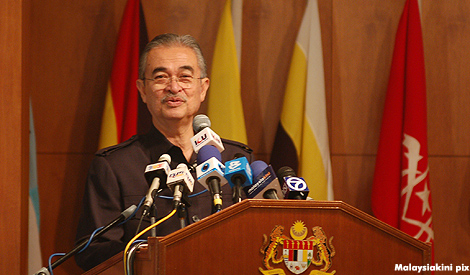
He was very understanding, and even jokingly suggested that I should convert to Islam so that I could marry the woman concerned legally. His only concern was whether the woman was a member of the staff in the Ministry of Health, or had any business dealings with Ministry. I told him this was not the case. He suggested that I should take two weeks’ leave. We even discussed the content of the press statement.
Pak Lah then enquired whom I suspected could have done this. As I was not involved in any business matters, there were no business rivals to consider. More likely, it was an attempt to destroy my political career. In other words, it was gutter politics in its worst form. The prime minister assured me he would direct the inspector-general of police to investigate the matter from all angles.
On the same day, I went to consult the MCA party president, Ong Ka Ting, at his house in Kuala Lumpur. I told him what I had told the prime minister. Like Pak Lah, he commented that I was brave to admit the facts and face the public. I left with these words ringing in my ears: “You are an important leader in the party and my close friend. I will protect you.”
In the following days, however, I noticed that one of the Chinese-language newspapers with close connections to the MCA president was giving particularly extensive coverage to the speculation regarding the DVD.
After meeting Ka Ting, I decided to consult Deputy Prime Minister Najib Razak as well. I informed him I would be holding a press conference in my constituency the next day. I even showed him a draft of my press statement. Like the other leaders I consulted, he was sympathetic and wished me well. He also expressed dismay and was upset that I had become the victim of such a vicious political tactic.
News gets out
On 1 January 2008, I made a previously scheduled visit to Segamat Hospital. By then, the Chinese vernacular press and the English newspapers were giving full coverage to the DVD without naming those involved.
After the hospital visit, I decided that I should have a press conference at the MCA service centre in my constituency of Labis. Below is the text of my press statement:
“I am the man in the tape. The girl is a personal friend. I want to emphasise that I did not make the tape. Who has done it is not important. What is important is that my wife and my children have accepted my apology and my lapses of judgement.
“I have consulted and apologised to the prime minister, the deputy prime minister and my party president. I also want to apologise to my colleagues, comrades, supporters and fellow Malaysians. I appeal to the press to give me and my family some space in this difficult time.”
My wife’s statement:
“My husband, Dr Chua Soi Lek, has apologised to me and to the family. We have accepted his apology and regret. It has been a tiring and difficult time.
“He has been a good husband, father and family man. We have accepted his lapse of judgement. We know it will be difficult, but we want to see this through together as a family.”
Although neither the prime minister nor his deputy explicitly asked me to resign, I knew it would be expected. Hence, I was mentally prepared for the worst.
In the early hours of Wednesday morning, the day of the regular cabinet meeting, a senior MCA party leader called to say that he had just had a big argument with Ka Ting. The president, he said, had decided to convene an emergency MCA disciplinary committee meeting with the intention of suspending me on moral grounds.
Surprisingly, the DVD was not discussed in the cabinet that Wednesday morning. However, as the meeting progressed, one of my secretaries sent me an SMS to inform me that the Nanyang Siang Pau was running an online poll asking the public to vote on whether the nation should accept my apology.
My secretary told me my supporters were complaining that they were unable to use the portal to vote in my favour. Hence, by the time the cabinet meeting finished around lunchtime, the poll showed a large majority rejecting my apology.
It was obvious that somebody with influence in the party and direct access to the management of this particular vernacular newspaper had been busy.
Resignation
At 2.30pm the same day, I was summoned to see the then deputy prime minister Najib. When I reached his office, Ka Ting was also there.
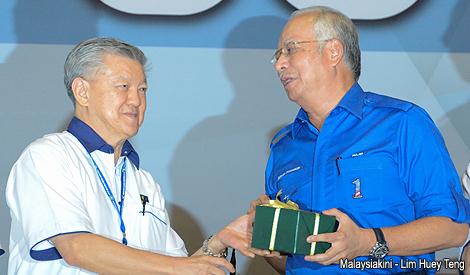
The deputy prime minister said that public reaction had been very negative, and the public did not appear willing to accept my apology. The MCA president then told me that I had to attend an emergency meeting of the presidential council as well as a disciplinary board hearing.
It was obvious that President Ong was trying to use the party as a sort of moral police. I told him I would not be attending.
When he asked for the reason, I explained that I intended to resign from all government and party positions. He seemed stunned by my reply and told me I should not act rashly.
I then left to conduct the regular post-cabinet meeting with staff at the Ministry of Health (MoH). I was cool and calm, having made up my mind what I had to do.
There is a Chinese saying that we rise because of opportunity, but to step down it is necessary to use wisdom. I was fully aware that it was through the party that I was appointed to government positions. It was, therefore, better to go gracefully and with dignity than be suspended.
When I reached the MoH’s office, I told my personal staff, the secretary-general (KSU) and the director-general (DG) that I would be resigning after the meeting. They were shocked.
Afterwards, I held the usual press conference. I then announced that I was resigning as the minister of health and as vice-president of the MCA. I also intended to resign as a member of parliament for Labis, member of the presidential council, chairman of the Johor state liaison committee and the chairman of the MCA Batu Pahat division. A by-election to replace me as MP was not needed since Parliament had completed over three years of its five-year tenure.
Supporters react
I must admit that before making these announcements, I did not consult my wife or my immediate family members. When my wife contacted me at 5.30pm, I told her I was sorry but I had decided to resign from all positions.
That night, I was swamped with calls and text messages asking me why I resigned. My standard reply was that one must have the moral courage and integrity to admit one’s mistakes. It was, I said, up to the public and my fellow MCA members to judge me.
The deputy chairman of the MCA in Johor, Tan Kok Hong, came out strongly to say that both he and the MCA state liaison committee supported me. The Johor MCA, he said, would continue to support me if I was the candidate of the parliamentary seat for Labis in the next election. He said that I was a victim of gutter politics. He believed I should continue to serve the rakyat.
At the same time, the Umno divisional chairman of Labis, the late YB Datuk Sulaiman Taha, told the media he had no problem in supporting me if I wanted to defend my parliamentary seat. According to him, the rakyat could see my integrity and sincerity in admitting to the indiscretion.
My resignation as a minister and from all party posts was regarded as unprecedented. The thinking then by my supporters was that the issue of the DVD would fade away.
However, I felt if I did not face up to the problem, the incident would haunt me for the rest of my life. Admitting the error would end my political career, but at least I could start life on a new page. I did not like the idea of suing anyone as it only served to prolong the issue and cause unnecessary suffering to my family. A public admission was like delivering a quick surgical cut to cancerous tissue.
One day after my admission and resignation, my wife received a call from an anonymous woman who tried to provoke my wife by claiming that the woman in the DVD had actually borne a child with me. My wife’s reply was to thank her and said that she would look after the child.
I interpreted the telephone call as an attempt to cause even more friction between my wife and me. Some people apparently could not stomach the idea that my wife had forgiven me. Perhaps they believed that triggering a family break-up would deliver the coup de grâce to my political career.

Thus it was that almost overnight I became an ordinary MCA member. Many MCA members nevertheless continued to telephone me or send text messages. However, there were hardly any phone calls from senior MCA party leaders, including the president and his deputy, the party secretary-general or fellow cabinet colleagues.
While many politicians project a public image of a caring personality, in practice they can be very heartless. These are the same politicians seen holding babies when visiting their constituencies.
Some commentators in the Chinese vernacular press predicted that my resignation would be the end of me politically. Other journalists, however, begged to differ and suggested that my strong grassroots support might help me stage a comeback.
Political tsunami
I had a smooth rise politically from 1986 when I first became a state assemblyman until my resignation as a minister in 2008. In all those 22 years, I had many ups and downs, but the DVD issue came like a political tsunami that ended my political career abruptly.
I was disappointed with myself, but I was also determined not sink into depression and despair. I had not stolen the rakyat’s money. I had only hurt my family and myself. And I had nobody to blame except myself. But hiding in the house and doing nothing was not an option. Wallowing in self-pity made no sense either.
My wife and children, who had been with me through thick and thin in my political career, continued to be steadfast in their support. They left it to me to decide whether I should retire for good or continue to be active politically. It is to their credit, wisdom and vision that at the later stage, I made a successful comeback.
There were also supporters who felt that I should resign from the MCA. They felt it was meaningless to remain in the party because it had too many hypocrites. It is a party in which even senior leaders are not interested in extending a helping hand to a colleague who has become a victim of gutter politics.
The oath of the MCA (oath No 5) that we recite at every major party function - Love Thy Comrades - is a delusion. Some politicians stand on the high moral ground and appear to be kind and courteous in the public, but they are cruel and heartless. To them, any mean justifies the end.
But I felt that if I resigned from the party, I would be a deserter. Walking away from the party would be like falling into the trap of those who practised gutter politics.
 The crisis quickly made me wiser and more cautious when choosing friends. Overnight, I found that some of those I regarded as good friends stopped calling. Perhaps they dismissed me as a person not worth having as a friend.
However, I consoled myself with the fact that my core supporters did not desert me. Rather, they became a source of inspiration and strength. In politics, there are many fair-weather friends. But I was lucky to be blessed with many faithful supporters. I am eternally grateful to them.
When I became the president of the MCA in 2010, some fair-weather friends who deserted me during the crisis tried to contact me again. I forgave them, but I did not forget that they deserted me in my hour of need.
For those comrades who never liked me, there were minor celebrations that a thorn in the flesh had finally been removed. Like all politicians, I had enemies within the party. These were basically the same group of comrades that were close confidants of the president.
For them, my resignation seemed to imply that they could continue to occupy top posts in MCA unchallenged for many years to come. In reality, their political Waterloo came during the political tsunami of 2008 and the party elections of that year and 2010. So, there is a lot of truth in the saying that “man proposes, God disposes”.
Part 1: My resignation and its aftermath
Part 2: The sex DVD - who were the culprits?
Part 3: Finding my replacement for GE13 and the PKFZ scandal
Part 4: Opponents’ attempt to bury me made me work harder
Part 5: How MCA came to own The Star
Part 6: I ensured transparency in MCA's purchase of office tower
Part 7: ‘Avoid factionalism, embrace unity’ - Soi Lek’s parting words to MCA
Part 8: Setting aside personal feelings in 2013 MCA elections
Part 9: 'Muhyiddin told MCA to make a stand on 1MDB'
Part 10: The eclipse of Najib's achievements by 1MDB scandal
Part 11: Broken trust: The Chinese community’s frustration with MCA
Part 12: The hypocrites in the MCA
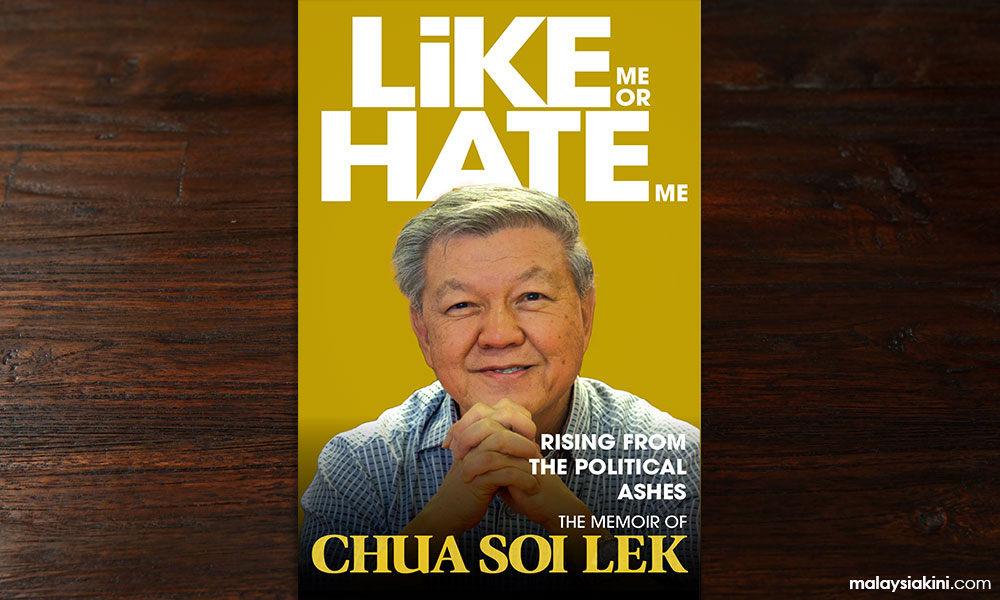
CHUA SOI LEK is a former health minister and MCA president. Like Me or Hate Me: Rising from the Political Ashes is now available in all good bookstores at RM59 (paperback, English and Chinese) and RM99 (hardcover, English only). It is also available at MPH Online.
The views expressed here are those of the author/contributor and do not necessarily represent the views of Malaysiakini.


