




How the government can cover that RM22 billion GST hole
QUESTION TIME | While the government can’t do much in terms of reducing debt right now, there are some workable options available in terms of raising revenues and cutting costs, which will cover the RM22 billion hole from the abolition of the goods and services tax or GST.
During Prime Minister Dr Mahathir Mohamad’s previous term of 22 years between 1981 and 2003 ending 15 years ago, one of the cornerstone policies he implemented was privatisation - hiving off government operations and government-owned companies to the private sector to reduce the size of the government.
Now, some 25 years after privatisation began - the cynical call it “piratisation” for the extraordinary profit opportunities they gave these private investors through lopsided contracts - Mahathir is talking about asset sales yet again and raising taxes to reduce what he says is the over RM1 trillion debt, a call that has been echoed by other ministers.
Nevermind that the debt is actually RM687 billion and increases to RM1.087 trillion only with the inclusion of government guarantees/contingent liabilities as well as lease payments for public-private partnerships, as pointed out in this article.
So far no one has said by how much the government wants to cut the debt level. For simplicity, let’s take the debt at RM1 trillion and you want to cut it down to RM687 billion, the official debt figure. That means the government has to raise RM313 billion.
What kind of asset sales and taxes will help raise that kind of money? The total assets of Khazanah Nasional Bhd, wholly owned by the government, only comes up to RM160 billion, while national unit trust scheme operator Permodalan Nasional Bhd only has assets of RM280 billion.
Even if Khazanah sold half of its assets, it would only raise RM80 billion. But who will have even that kind of money in Malaysia to buy those assets in one go? If you open it up to foreigners, Malaysians lose wealth in addition to opening themselves up to extreme volatility in assets prices, especially if these were listed assets.
PNB’s assets can’t be touched because most are in the unit trust schemes and only those which have not been transferred to the unit trusts can be sold. That, of course, goes too for the over RM800 billion worth of assets the Employees Provident Fund has. It invests on behalf of its members, not the government.
And then there is land. But can we sell RM313 billion worth of land in a short time? Which developer or developers want so much of land?
Even Daim Zainuddin, head of the disbanded Council of Eminent Persons or CEP, does not seem to be advocating large sales of government companies. Here’s what he said in an interview with Channelnewsasia recently: “One option to help shore up finances could be listing some of the government’s assets on the stock market. At the CEP, we have studied the proposal submitted to us on monetisation. We don’t advise to sell these assets directly to the market. Where companies are profitable, we recommend them to go for an initial public offering (IPO), create value and let Malaysians invest in these companies."
It seems like a large-scale sale of government-owned listed assets has been effectively ruled out. In any case, it will make little impact on the debt level...
QUESTION TIME | While the government can’t do much in terms of reducing debt right now, there are some workable options available in terms of raising revenues and cutting costs, which will cover the RM22 billion hole from the abolition of the goods and services tax or GST.
During Prime Minister Dr Mahathir Mohamad’s previous term of 22 years between 1981 and 2003 ending 15 years ago, one of the cornerstone policies he implemented was privatisation - hiving off government operations and government-owned companies to the private sector to reduce the size of the government.
Now, some 25 years after privatisation began - the cynical call it “piratisation” for the extraordinary profit opportunities they gave these private investors through lopsided contracts - Mahathir is talking about asset sales yet again and raising taxes to reduce what he says is the over RM1 trillion debt, a call that has been echoed by other ministers.
Nevermind that the debt is actually RM687 billion and increases to RM1.087 trillion only with the inclusion of government guarantees/contingent liabilities as well as lease payments for public-private partnerships, as pointed out in this article.
So far no one has said by how much the government wants to cut the debt level. For simplicity, let’s take the debt at RM1 trillion and you want to cut it down to RM687 billion, the official debt figure. That means the government has to raise RM313 billion.
What kind of asset sales and taxes will help raise that kind of money? The total assets of Khazanah Nasional Bhd, wholly owned by the government, only comes up to RM160 billion, while national unit trust scheme operator Permodalan Nasional Bhd only has assets of RM280 billion.
Even if Khazanah sold half of its assets, it would only raise RM80 billion. But who will have even that kind of money in Malaysia to buy those assets in one go? If you open it up to foreigners, Malaysians lose wealth in addition to opening themselves up to extreme volatility in assets prices, especially if these were listed assets.
PNB’s assets can’t be touched because most are in the unit trust schemes and only those which have not been transferred to the unit trusts can be sold. That, of course, goes too for the over RM800 billion worth of assets the Employees Provident Fund has. It invests on behalf of its members, not the government.
And then there is land. But can we sell RM313 billion worth of land in a short time? Which developer or developers want so much of land?

Even Daim Zainuddin (photo), head of the disbanded Council of Eminent Persons or CEP, does not seem to be advocating large sales of government companies. Here’s what he said in an interview with Channelnewsasia recently: “One option to help shore up finances could be listing some of the government’s assets on the stock market. At the CEP, we have studied the proposal submitted to us on monetisation. We don’t advise to sell these assets directly to the market. Where companies are profitable, we recommend them to go for an initial public offering (IPO), create value and let Malaysians invest in these companies."
It seems like a large-scale sale of government-owned listed assets has been effectively ruled out. In any case, it will make little impact on the debt level.
How can the government get itself out of this predicament, caused mainly by the abolition of the GST, as I have pointed out a number of times before in these columns?
There are only some answers: Impose new taxes, cut subsidies, control procurement costs, scale back contract values, and yes, sell assets. But note that debt cannot be easily cut so fast. But you can raise more money for paying interest on debts and put a cap on future borrowings.
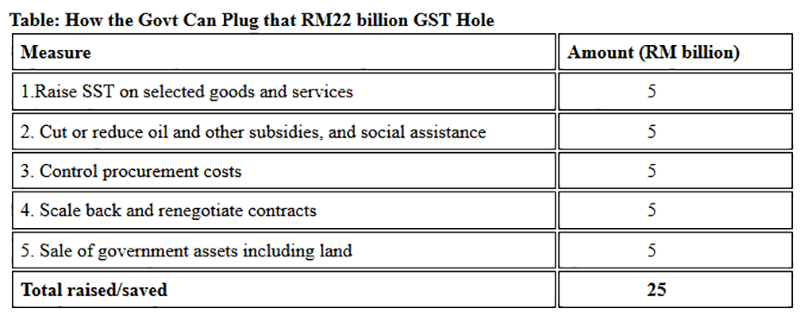
Let’s take each, in turn, to see how that RM22 billion GST hole can be plugged (see table). Imposing new taxes to compensate for a RM22 billion shortfall from GST abolition is impossible. But some recovery may be possible by imposing selective sales and service taxes or SST on a wider range of goods that are more likely to be consumed by those who are well off, sparing the poor. Let’s say the government recovers RM5 billion here.
The second move is to cut or reduce oil and other subsidies. These will increase as oil prices increase. Considering that the projected costs of these for this year is RM26 billion, cutting by a fifth should pose no problems. Just letting pump prices partially reflect oil price increases will easily net some RM5 billion with little impact on the low-income group, as the high-income group consumes far more fuel on a per capita basis.
The third measure is controlling procurement costs for supplies and services, estimated to account for some RM34 billion in 2018. If these are cut by some 15 percent, the savings will come to around RM5 billion. Given the notorious rate of overpayment here in the past, that should pose no problems.
The fourth is scaling back and renegotiating contract costs. Considering massive infrastructure development and contract overpayments, an average of RM5 billion saving a year over the period of Harapan’s term in government should be quite easy to do.
And finally yes, we can sell assets and land to the tune of RM5 billion a year quite easily, although not for RM313 billion.
Those measures alone can raise or save RM25 billion a year, more than offsetting the RM22 billion lost in GST revenue. The government’s finances are not that bad if the right measures are taken, going forward.
At this stage, the government should not be over-obsessed with debt - the debt donkey has been flogged enough to extract the maximum possible political mileage. Further whipping will only kill the beast. It is enough that the debt is serviced through the interest payments for now.
If no further debt is incurred during the term of the Harapan government, then borrowings will automatically fall off over the next five years when repayments fall due. As the economy expands and the GDP - the sum of goods and services produced yearly - rises, it will further help bring down the debt-to-GDP ratio to acceptable levels. Debt management takes years.
What Harapan must realise is that it has to tone down the rhetoric on how high the debt is and why the government has no money. Instead, focus on the revenue and expenditure accounts and explain clearly how that can be changed to improve national finances.
Then, it will not only gain much more wiggle room in the next few years ahead but improve the confidence of Malaysians, the financial community and foreign investors in the economic management of the country. That would also lend more confidence to international ratings, the currency and the stock market.
The task is not that tough with proper management.
P GUNASEGARAM says a penny saved is equivalent to a penny raised. E-mail: t.p.guna@gmail.com
The views expressed here are those of the author/contributor and do not necessarily represent the views of Malaysiakini.


