



Put the fun back into learning
COMMENT | If you are one the many who went to primary school in the 50s or early 60s, you would have read about the exploits of Francis Drake, Captain Cook, Ferdinand Magellan and Christopher Columbus. We learnt about leaders like George Washington ( and his chopping of the cherry tree), Abraham Lincoln, Mohammed Ali Jinnah, Jawaharlal Nehru, Winston Church and many others.
We also learnt about Prophet Muhammad and his journey from Mecca to Medina; how Jesus Christ rose from the dead; Sun Tze, Guru Gobind Singh and Lord Shiva. We also learnt about inventors like the Wright Brothers, Thomas Edison and Henry Ford. For a good measure, we learnt the medical achievements of Louis Pasteur and Marie Curie.
Parameswara, Hang Tuah, Admiral Cheng Ho and Princess Hang Li Poh featured when we studied the history of Malacca. Munshi Abdullah and Yap Ah Loy also featured in our history books.
We also learnt about the ancient kingdom of Langkasuka, which is now being disputed, The latest we heard, there is a concerted effort to re-write history.
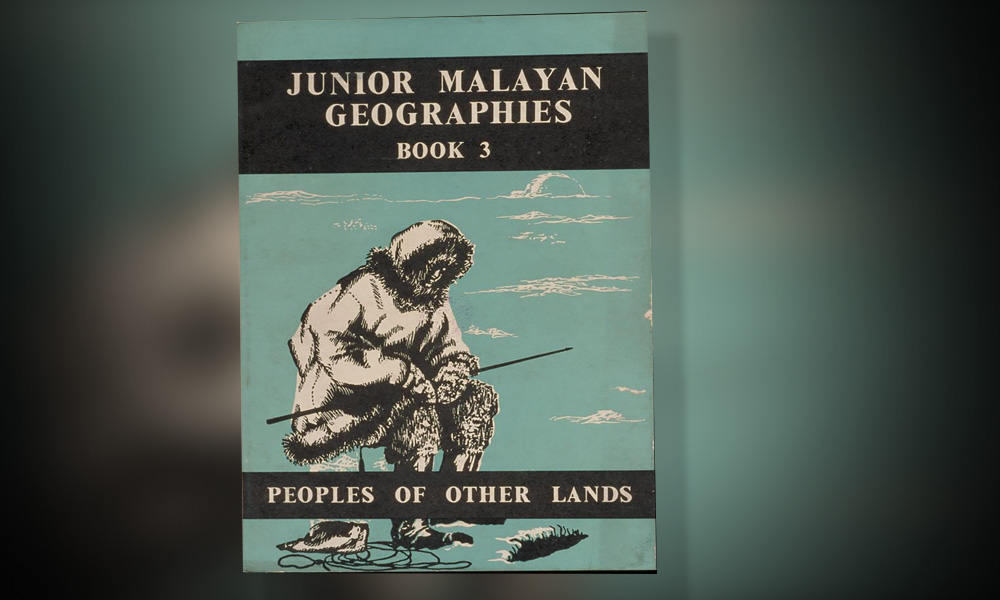
In Geography, we learnt about Awang the fisherman from Terangganu and how he nets and prepares ikan bilis. We learnt about Ramasamy the dock worker and Ah Chong the vegetable farmer.
In Standard Six, we understood the meaning of entrepot and how Singapore survived and thrived on such trade. We knew the capitals of all the countries in our atlas. That’s because, on and off, there was a quiz competition and we were prepared for it.
These days, if you ask a 10-year-old if he knew what Walter Raleigh was famous for was, he would probably say Raleigh bicycles. The children should not be blamed for this state of affairs.
Our primary school education prepared us for a demanding struggle but yet sounded so easy. We persevered with my Malay friends who took an extra year in the Special Malay Class and my Chinese and Indian friends who spent a year in reserve class.
Throughout secondary school we used a series of books by CV Durrel (Mathematics) and GED Lewis. Our Literature teacher made everyone read a book a week; write a synopsis and identify 10 new words we had picked up and their meanings. Our guide was the Oxford Dictionary, which is now missing from the book list, as is the world atlas...
COMMENT | If you are one the many who went to primary school in the 50s or early 60s, you would have read about the exploits of Francis Drake, Captain Cook, Ferdinand Magellan and Christopher Columbus. We learnt about leaders like George Washington ( and his chopping of the cherry tree), Abraham Lincoln, Mohammed Ali Jinnah, Jawaharlal Nehru, Winston Church and many others.
We also learnt about Prophet Muhammad and his journey from Mecca to Medina; how Jesus Christ rose from the dead; Sun Tze, Guru Gobind Singh and Lord Shiva. We also learnt about inventors like the Wright Brothers, Thomas Edison and Henry Ford. For a good measure, we learnt the medical achievements of Louis Pasteur and Marie Curie.
Parameswara, Hang Tuah, Admiral Cheng Ho and Princess Hang Li Poh featured when we studied the history of Malacca. Munshi Abdullah and Yap Ah Loy also featured in our history books.
We also learnt about the ancient kingdom of Langkasuka, which is now being disputed, The latest we heard, there is a concerted effort to re-write history.
In Geography, we learnt about Awang the fisherman from Terangganu and how he nets and prepares ikan bilis. We learnt about Ramasamy the dock worker and Ah Chong the vegetable farmer.
In Standard Six, we understood the meaning of entrepot and how Singapore survived and thrived on such trade. We knew the capitals of all the countries in our atlas. That’s because, on and off, there was a quiz competition and we were prepared for it.
These days, if you ask a 10-year-old if he knew what Walter Raleigh was famous for was, he would probably say Raleigh bicycles. The children should not be blamed for this state of affairs.
Our primary school education prepared us for a demanding struggle but yet sounded so easy. We persevered with my Malay friends who took an extra year in the Special Malay Class and my Chinese and Indian friends who spent a year in reserve class.
Throughout secondary school we used a series of books by CV Durrel (Mathematics) and GED Lewis. Our Literature teacher made everyone read a book a week; write a synopsis and identify 10 new words we had picked up and their meanings. Our guide was the Oxford Dictionary, which is now missing from the book list, as is the world atlas.
V Murugasu was the headmaster of the Victoria Institution and he later served Unesco. He had this to ask: “When the British left our shores, they left behind the same education system for Malaya and Singapore, Look at Singapore and how they have progressed and we are left in the dumps.”
Tweaking our system to appease 'nationalists'
What went wrong? The answer is simple – we kept tweaking our system to appease the “nationalists”, ignoring the need to have an educated and skilled workforce for the future. I agree that emphasis must be given to the Malay language as it is the official language. But ignore the others at your own peril, as we have discovered a bit too late.
Besides, too much emphasis is being given to Islamic studies with the students not understanding other faiths and their values. This gives rise to looking at each other differently. The colour of their skin or their place of worship is used to judge values of each other.
Last week, a friend who has retired and settled in Kelantan is teaching poor children, sent me the timetable for Kelas al-Quran dan Fardu Ain (Kafa) in schools in Kelantan. “Kelas Kafa yang di wajibkan untuk murid murid Tahun 2, 3, 4 dan 5 setiap Hari Ahad, Isnin dan Selasa mula dari 2 petang hingga 5 petang.” (Kafa classes recommended for pupils in Standards 2, 3, 4 and 5 every Sunday, Monday and Tuesday, from 2pm to 5pm.) The total hours, including the learning of Arabic, Jawi and other related subjects, is 14.5 hours.
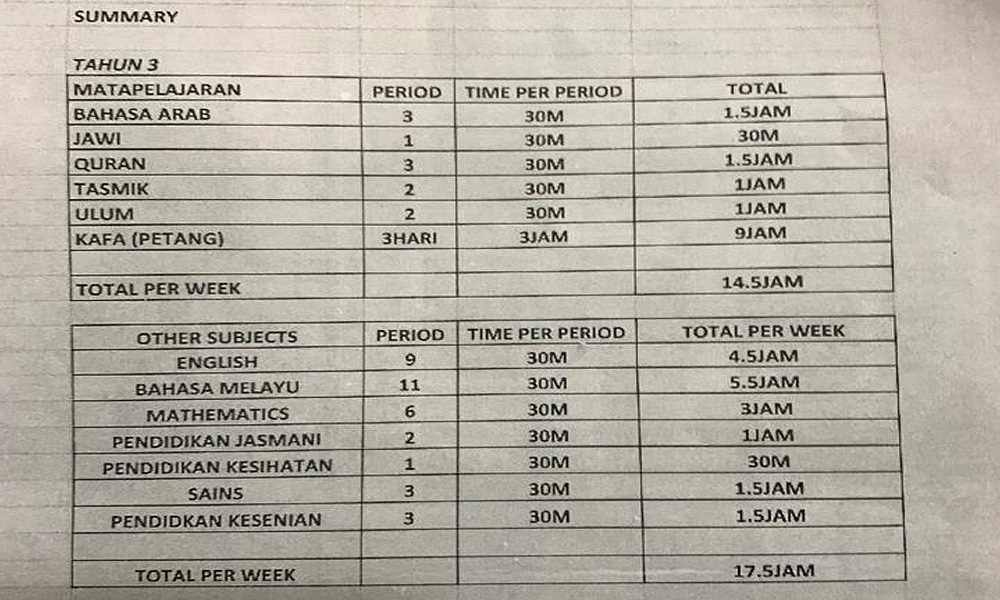
As a comparison, 17.5 hours is spent on other subjects like English, Bahasa Melayu, Science, Mathematics, etc. The result of such a system is telling indeed. Unable to string two sentences in English, they move to secondary school, where there is another gamut of leanings to religion.
English, Science and Mathematics take a back seat. At the end of the day, who suffers? Today, the students are paying the price for this strategy. They are given places in public universities without knowing the outside world.
Entry levels to universities and colleges were dropped in the eagerness to make education as part of the affirmation policy. There was a two-tier marking system. In the good old days, to get into university, you needed good grades in the Higher School Certificate (HSC or STPM these days) to get in.
With the proliferation of colleges (there are over 430 of them), education became big business, especially with ready money from the PTPTN loans. Even a single credit at Sijil Pelajaran Malaysia (SPM) level entitles entry to a course in aeronautical engineering.
These days, so much of time, effort and money have been wasted – first on the colour of the shoes and later the colour of the socks. So much so, the Education Minister has now been referred to in the social media as “Mentri Kasut and Stokin”. Now, swimming lessons have come into the picture. By the way, does the minister know how many schools have swimming pools or the number of public swimming pools?
Yet another review committee has been formed and my plea is that learning be made fun again. In our days, we walked to school with a satchel or a rattan bag, drank water from the tap during breaks and enjoyed the company of one another.
Despite a couple of strokes of the cane for tardiness, being mischief or poor grades, we never saw going to school as a chore. We looked forward to continuing our fun the following day. We had no inhibitions of going to one another’s houses. We knew one another’s beliefs and the common values they practised.
We were all asked to go and spend an hour for “vernacular classes” or Islamic studies; we had to go to the school field for sports activities and yet, we all survived together as a cohesive group.
This is the first step in nation-building and unity. If, from young, a semblance of togetherness is created, it will grow over the years. Friendship and kinship are contagious, so to speak, and segregation is a discordant and divisive factor.
When warga tua (senior citizens) gather these days, their conversation inevitably turns to school days. I am no Cikgu (teacher), but having dealt with children at tuition classes, I say that we have to bring back the innocence in kids by making them understand the universe and that there are other worlds and philosophies, other than their respective religions.
R NADESWARAN says the fun must be brought back into learning with emphasis on subjects that will get students into good courses in reputed universities. Comments: citizen.nades22@gmail.com
The views expressed here are those of the author/contributor and do not necessarily represent the views of Malaysiakini.


