




Suckers! That's what we are
Malaysians are suckers for advertisements! And that's the cold hard truth. Tongues wagging, we enter a hypnotic state at the mere sight of words like 'Cheap Sale' and 'Discounts'.
Not only are we gullible, Malaysians are also ignorant, according to the National Consumer Complaint Centre (NCCC).
Malaysians are suckers for advertisements! And that's the cold hard truth. Tongues wagging, we enter a hypnotic state at the mere sight of words like 'Cheap Sale' and 'Discounts'.
Not only are we gullible, Malaysians are also ignorant, according to the National Consumer Complaint Centre (NCCC).
 "Most of them do not know their rights are protected by provisions of laws. They simply rely on whatever information fed to them by advertisers," according to its manager Darshan Singh.
In an interview with Bernama , he said the housing industry is one area which generated many complaints.
"I noticed that majority of purchasers have not even heard of the Housing Development (Control & Licensing) Regulations which were drafted to protect their rights.
"They don't even know that it's illegal for developers to collect booking fees. They don't know that they may even terminate the Sales and Purchase Agreement for any unforeseen reason they fail to secure a loan and the developer would have to refund 9% of the deposit paid," he explained.
Extravagant lifestyle
As for ERA Consumer Malaysia, television commercials ignore good values and promote a lifestyle of being status conscious and overspending.
"There are claims made by advertisers which are extreme and do not make sense, preaching imbalance diet and instilling a culture of extravagance among youngsters," said its deputy secretary-general Ismail Abdul Aziz.
According to Darshan, advertisements, like it or not, play a vital role in our daily lives.
"Almost all of us rely on information provided by advertisements before we make a decision on purchases. It helps us make decisions. It's also an important tool for businesses to publicise their products.
"Advertisements today are much more advanced and creative. One good thing about advertisements in Malaysia is that you don't find obscene ones. This is probably due to the fact that our government is closely monitoring the situation," he added.
Misleading information
However, problems arise when information contained in an advertisement misleads consumers.
"Guarantee rental schemes where purchasers are promised guaranteed rental if they buy a certain property but at the end of the day the promises are not delivered.
 "Slimming products advertising is another area where many unsuspecting consumers are misled. Just look at the advert on TV, it says you rub some cream on your belly and you will loose fat," said Darshan.
He also urged the government to pay closer attention to advertisements targeting children using toys as "baits" and formulate a special code for such advertisements.
He revealed that most of the complaints received by NCCC were basically on misleading information.
NCCC receives as many as 30 calls per month on advertisements alone, he said, adding that most of them were on housing, cars, slimming centres/products, colleges, banking and tour agencies.
"From our statistics, the trend is definitely increasing. NCCC has to a certain extent managed to check and monitor the situation and will continue to do so," he added.
NCCC's statistics showed that as at the end of October this year, it received a total of 530 complaints. In September alone, there were 120 complaints.
The bulk of the complainants, noted Darshan, came from the middle class and the poor. "These are the people who actually require protection," he added.
NCCC, he said, did not receive many complaints from professionals.
"Probably, they are more aware of their rights and able to digest information thrown at them. If you look at businesses, they also don't normally shortchange this class. Probably, they anticipate in advance that these people are capable of defending themselves effectively.
"Professionals are normally well-to-do people and probably don't care if they lose certain amount of money. The loss may not affect them financially," he added.
Duped in a mega way
Come festive seasons, come cheap and mega sales. Subsequently followed by complaints of being duped.
"After each mega sale, NCCC will be flooded with complaints and our phone rings non-stop. If these sales are properly monitored, we will never get these many complaints.
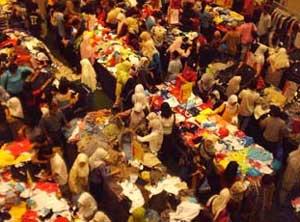 "We have clear guidelines which regulate cheap sales/mega sales which are under the purview of the Ministry of Domestic Trade and Consumer Affairs. Take these guidelines with you and take a walk in the store where the sale is being carried out. Start inspecting and you will know what I'm talking about. How many violations and how many prosecutions?" he asked.
Ismail of Era Consumers explained that supermarket or any premise wanting to hold cheap sales must adhere to the Regulations on Cheap Sales stated under the Trade Descriptions Act 1972.
The items to be offered during the cheap sales must have been put up for sale at the said premises 30 days before, then only the premises can advertise for 'Cheap Sale' or 'Festive Sale'.
"Nowadays, too, many premises pile up new clothes of inferior quality and sell them at the so-called cheap price. We were not able to act accordingly to complaints on this matter as consumers failed to attach the sales receipts and other details," he said.
Health products
Even the Malaysian Medical Association (MMA) receives complaints about misleading information.
"These are thought to be either untruthful or bordering on touting or canvassing for patients. About 30 percent of the complaints received each year are about advertising by doctors," its president Dr Teoh Siang Chin, was quoted as saying.
As a remedy, he prescribed better consumer education to make them more discrening.
 "Advertisements are mainly to tout or canvas for patients. Many do not serve to provide more information.
"Advertisements by doctors, clinics and hospitals have to be screened by the Lembaga Iklan Ubat (LIU) or Medicines Advertisement Board before they can be published.
"However, there are no regulatory mechanisms for advertisements regarding health or medical matters by non-doctors example traditional medical practitioners," he said.
He stressed that advertisements by non-doctors will need to be more clearly scrutinized, adding that the MMA would support the formation of an agency to vet all health-related advertisements.
Teoh also noted that people are most vulnerable when they are ill.
"Any suggestions for a quick cure are easily believed. Before the public indulge in any health-related activity, they should consult the doctors and obtain a professional opinion.
"Sometimes, the public think nothing of spending RM5,000 on anti-aging treatment or placental injections.," he said.
 Meanwhile, Darshan urged consumers to spend wisely and according to their needs because of the unstable global economic climate.
"We should have a decent saving for our future. One question which we must always ask ourselves when spending is do we really need what we are buying?" he said.
Last year alone advertisers spent RM4.4 billion as advertising expenses (AdEx) and this is expected to grow to RM4.53 billion.


