




Haul up ambassador to India too
Just as Beijing summoned Malaysia's ambassador after an allegedly Chinese national was believed to have been abused in a Malaysian police station, India should do the same in respect of its own nationals working here, said the Penang Office for Human Development (POHD).
Just as Beijing summoned Malaysia's ambassador after an allegedly Chinese national was believed to have been abused in a Malaysian police station, India should do the same in respect of its own nationals working here, said the Penang Office for Human Development (POHD).
 POHD case officer Joachim Xavier (right) said Beijing had taken this step after the allegation that one of its citizens was claimed to have been humiliated by being forced to strip and perform ear squats in front of a policewoman.
"But the number of (abused) Indian migrant workers is a lot more ... I think our ambassador in India should be hauled up as well," he said during a joint press conference with the Consumers' Association of Penang (CAP) today.
"I don't see why this is not as serious as other nationals being abused," said Xavier at the press conference held at the Archdiocesan Office for Human Development in Kuala Lumpur.
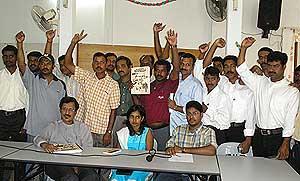
The press conference was organised to highlight the plight of Indian migrant workers, particularly the case of 48 Indians who were found by the Penang High Court to have been "cheated, degraded and denied food and basic amenities."
Penang High Court Judge RK Nathan's 2003 decision in the workers' favour was upheld in September this year by Court of Appeal Judge Augustine Paul. Their employer, Chin Well Fasterners, have since filed an appeal to the Federal Court.
Unlike the former Chin Well workers, however, countless more cases of abused migrants will not even see the light of day as the problem is "systemic," said Xavier.
"It is not simply an act of individuals, whether by police or immigration. It is a systemic problem," he said.
"The system is such that migrant workers who come into the country will get abused. The fact is, the system we have in this country abuses foreigners," Xavier added.
'Allowed' to exploit
 Explaining major problems faced by migrant workers, CAP vice-president Mohideen Abdul Kader (right) said the roots lay in the lack of transparent and effective recruitment, labour and immigration policies and practices that ensure "fairness and justice for workers."
Many recruitment agencies are 'allowed' to exploit migrant workers largely because there are no guidelines strictly regulating the process of recruitment, he said.
"If they (private agencies) are necessary for recruitment, then there should be stringent regulations governing the levy they can charge for foreign workers," said Mohideen.
He cited the case of the Chin Well workers, 91 of whom were charged a total of Indian Rs100,000 (RM8,000) by their recruiting agent for securing the job.
"The government should stand united and take action against those people who violate the laws in this country. If the laws are not there, we should put in place stringent laws to control the activities of these recruitment agencies," he said.
In the case of employers, many cases had been reported of various deductions made from migrant workers' already meager salaries, which are often lower than both of that promised by their agents and the minimum wage of RM600 agreed upon by the Malaysian and Indian governments.
Often, said Mohideen, the workers also are made to pay for the levy, Mohideen said. Another problem was the lack of enforcement pertaining to compulsory medical coverage for migrant workers, he said.
Furthermore, many migrant workers who have been terminated face little prospect of even seeking justice or fair compensation on account of immigration policies, said Mohideen.
While the Employment Act of 1955 provides for workers to seek justice with the labour or civil courts, the immigration laws take away that right by ruling that working permits are automatically annulled 24 hours after termination.
"Where are they to go? How do they survive while they're here?" he asked.
"When employers terminate their foreign workers and the matter is disputed and comes before the court, the authorities should give them the necessary permission to stay in the country and work so they can support themselves," he said.
Situation critical
Even the 'special permits' provided by the immigration authorities for migrants who no longer have work permits are not a source of much assistance as these cost RM100 monthly, said Mohideen.
 "If they're not working, there's no way they can pay," he said, adding that a worker who finds a job and earns RM500 has to fork out 25 percent of his income for the special permit.
"This is not the way we should be treating those who are actually contributing to the economy of the country," he said.
A former Chin Well employee, who has found work with a restaurant in Kuala Lumpur, took the opportunity to urge the media to address the plight of migrants.
"We would like your generous support to bring this issue to the public sphere where many of the Indian migrant workers like me are suffering. The situation is widespread and critical in Malaysia," he said.


