


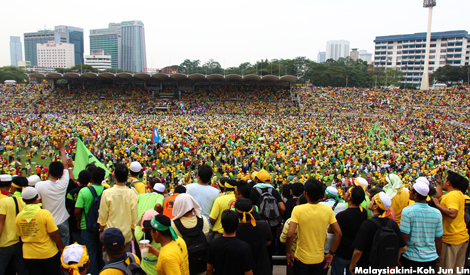

Malaysia can lose its democratic momentum...
COMMENT | The jingle "Malaysia is truly Asia," does not have to be completely real or empirical. Asia, with its many indigenous cultures and people, is hard to qualify through the prism of one country anyway, let alone Malaysia.
Malaysia is diverse but not that diverse. This is a fact. India has more ethnic groups and sub-groups. Then, there is China. Another behemoth.
Officially, China has 55 ethnic groups, for instance. While the Han Chinese form 90 percent of the Chinese population, Beijing has the claim to be a truly Asiatic power by virtue of its ability to protect the rights of all ethnic minorities too.
Yet, not unlike India, China is unable to do well on all fronts, as Beijing's struggle with Tibetan and Uyghur nationalism seems to be showing. In fact, one might add that China is already wrestling with its governance of Hong Kong too, since many locals resent the surge of the mainland Chinese in an already crowded city.
Since neither China nor India can be truly representative of Asia, what more can one say about Malaysia? Nothing. But then, what is the main characteristic of the region? The issue comes down to one.
The lack, or, the absence of democracy. This is why Malaysia should seize the democratic opening on May 9 to advance its unique profile as a democratic country in Asia.
To be sure, only 4.5 percent of people live in full democracies. Of the 15 million Malaysians who went to the polls on May 9, billions more are trapped in a world where "life is short, brutish and violent", as the classic British political philosopher Thomas Hobbes once put it.
Invariably, Hobbes argued that a strong state, one based on rule of law, which he called a "Leviathan", was needed to maintain (equitable) structure and order.
Indeed, of the 165 countries studied by The Economist Intelligence Unit (EIU) in 2017, 89 experienced a fall in their democratic experience and score.
Only 27 democracies improved, while the rest stagnated. In the EIU score in 2018, Malaysia's standing is bound to improve too. Why?
To begin with, Malaysia has had one of the most dramatic turnovers in democratic governance. The government of Pakatan Harapan, as DAP veteran Lim Kit Siang put it, had ended the reign of "kleptocracy" and "kakistocracy"...
COMMENT | The jingle "Malaysia is truly Asia," does not have to be completely real or empirical. Asia, with its many indigenous cultures and people, is hard to qualify through the prism of one country anyway, let alone Malaysia.
Malaysia is diverse but not that diverse. This is a fact. India has more ethnic groups and sub-groups. Then, there is China. Another behemoth.
Officially, China has 55 ethnic groups, for instance. While the Han Chinese form 90 percent of the Chinese population, Beijing has the claim to be a truly Asiatic power by virtue of its ability to protect the rights of all ethnic minorities too.
Yet, not unlike India, China is unable to do well on all fronts, as Beijing's struggle with Tibetan and Uyghur nationalism seems to be showing. In fact, one might add that China is already wrestling with its governance of Hong Kong too, since many locals resent the surge of the mainland Chinese in an already crowded city.
Since neither China nor India can be truly representative of Asia, what more can one say about Malaysia? Nothing. But then, what is the main characteristic of the region? The issue comes down to one.
The lack, or, the absence of democracy. This is why Malaysia should seize the democratic opening on May 9 to advance its unique profile as a democratic country in Asia.
To be sure, only 4.5 percent of people live in full democracies. Of the 15 million Malaysians who went to the polls on May 9, billions more are trapped in a world where "life is short, brutish and violent", as the classic British political philosopher Thomas Hobbes once put it.
Invariably, Hobbes argued that a strong state, one based on rule of law, which he called a "Leviathan", was needed to maintain (equitable) structure and order.
Indeed, of the 165 countries studied by The Economist Intelligence Unit (EIU) in 2017, 89 experienced a fall in their democratic experience and score.
Only 27 democracies improved, while the rest stagnated. In the EIU score in 2018, Malaysia's standing is bound to improve too. Why?
To begin with, Malaysia has had one of the most dramatic turnovers in democratic governance. The government of Pakatan Harapan, as DAP veteran Lim Kit Siang put it, had ended the reign of "kleptocracy" and "kakistocracy".
The former was the rule of the 'crime minister-in-chief', as some pundits colourfully put it; while the latter was the misgovernance derived from the worst leaders available. With or without any external validation, Malaysians should be proud of that historic day.
People want a functional government
Be that as it may, the EIU score is based on the scale of 0 to 10. According to Forbes, which tracked the EIU study: "Its criteria encompass civil liberties, the electoral process and pluralism, government functionality, political participation and political culture." The EIU study is sufficiently telling to give one a hint of what Malaysia can achieve if it aspires to it.
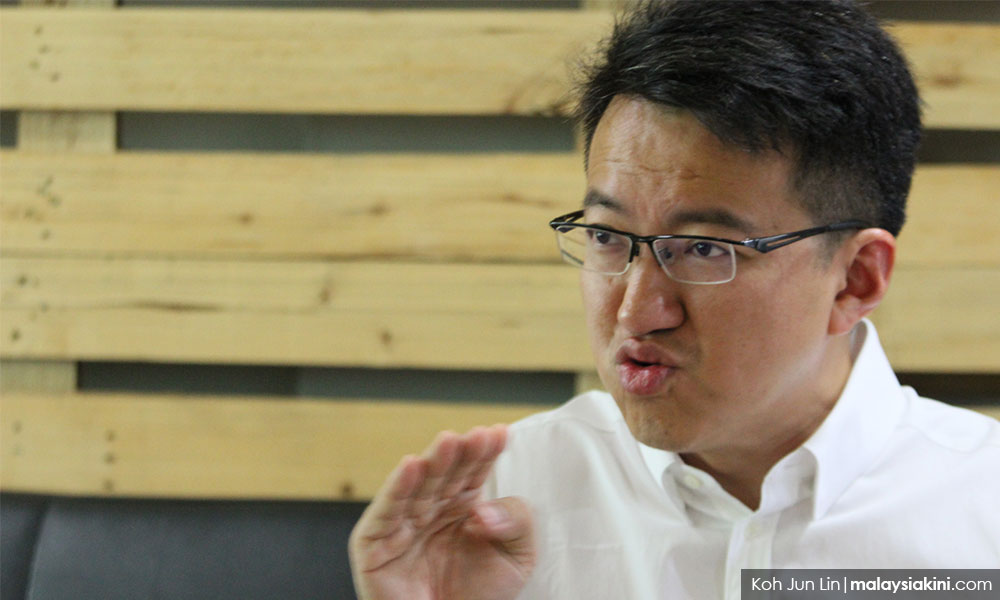
Being a new coalition, Pakatan Harapan is by no means perfect. In fact, Liew Chin Tong (photo), one of the many electoral strategists of the DAP, is right to warn that the voters now demand a functional government, not a dysfunctional one.
If Pakatan Harapan lends itself to being a flawed government, the voters would have no qualms to throw it out since the peaceful transition of government has now been seen, and expected by the majority of Malaysians, as a "norm".
Besides, loose electoral pacts appear to be the new norm as well. The relationship between Pakatan Harapan and Warisan in Sabah, for instance, is the benchmark of how Malaysian federalism can work.
Members of Parliament (MPs) from Umno who have dropped out of their party appear adept at becoming "independents"; a phenomenon that will continue as MPs swivel to Putrajaya as a matter of ensuring their own relevance.
In 2017, Norway was ranked the world’s best democracy, recording the highest score across the above criteria, 9.87. Two other Northern European countries, Iceland and Sweden, came second with scores of 9.58 and 9.39 respectively.
In last year’s study, the United States was downgraded from a “full democracy” to a “flawed democracy” and in the 2017 edition, it only came 21st overall, with a score of 7.98.
Malaysia lacks all the financial and institutional resources of Norway, Iceland, Sweden and the United States. Thus Malaysia is starting at a deficit when it comes to touting our democratic credentials.
For example, Malaysia has not become a non-permanent member of the United Nations Security Council again. Thus, it cannot promote itself on the world stage.
Nor is Malaysia the chair of Asean, unlike Singapore currently. Next year the chairmanship will go to Thailand, after which Vietnam will be the chair in 2020.
Not unless Malaysia requests Hanoi to give way, which was a privilege exercised by Indonesia in 2005, in order to serve as a catalyst of Asean Community. Malaysia will lack such region-wide events to promote itself as a "new democratic model of Asia."
Whatever Malaysia does between 2018-2020 will be vital. First, Prime Minister Dr Mahathir Mohamad would begin to have the world wondering if the promised handover to Anwar Ibrahim would happen as what had been scripted?
Second, Malaysia would almost be at the halfway line of its five-year tenure. Would it manage to balance the book in order to reduce the national debt? These are unknown unknowns.
But Malaysia now belongs to the top five percent of the global population that enjoys some semblance of democracy. Malaysia is not perfect but it is now a precocious model that can combine the best of Islam and democracy.
Therefore, it must find a way to promote and position itself as the best Asian democracy bar none, combining the best of Islamic political practices that emphasise the importance of honesty and accountability.
PHAR KIM BENG is a Harvard/Cambridge Commonwealth Fellow, a former Monbusho scholar at the University of Tokyo and visiting scholar at Waseda University.
The views expressed here are those of the author/contributor and do not necessarily represent the views of Malaysiakini.


