



Human rights group urges Harapan, let students speak
Human rights group Fortify Rights has urged the federal government to immediately amend the Universities and University Colleges Act 1971 (Auku) to remove restrictions on students’ freedom of expression, peaceful assembly and association.
Human rights group Fortify Rights has urged the federal government to immediately amend the Universities and University Colleges Act 1971 (Auku) to remove restrictions on students’ freedom of expression, peaceful assembly and association.
This comes after the group’s research of nine case studies of Malaysian universities disciplining students under Auku and their internal disciplinary rules.
In the nine case studies, students were disciplined for participating in off-campus public rallies, raising placards at university events and organising press conferences to discuss issues of concern to university students.
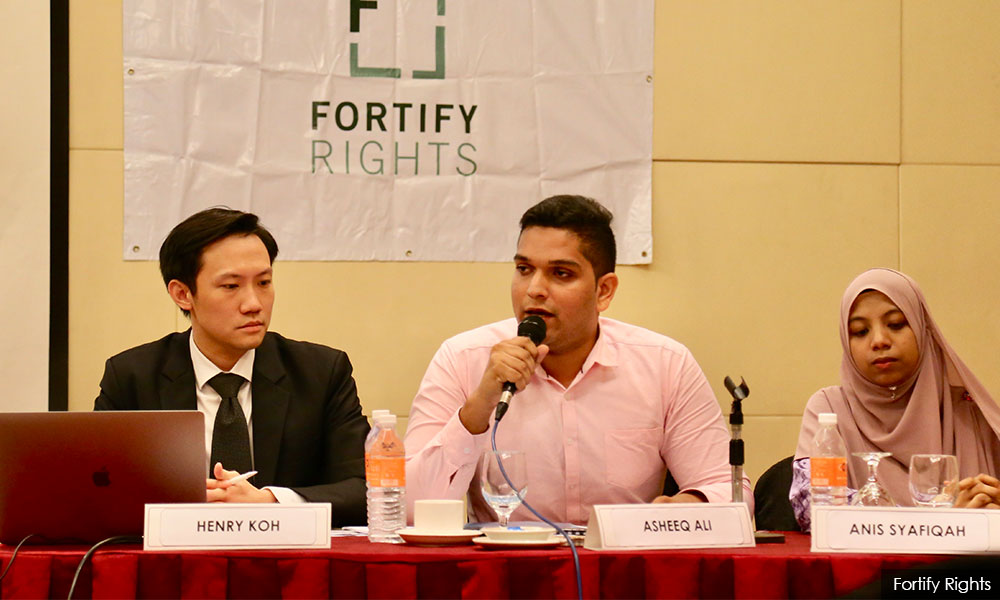
At the launch of the report today, lead author Henry Koh referred to promises 27, 28 and 50 in the Harapan manifesto which all state that Auku will be abolished to encourage freedom of expression among university and college students.
UKM student Asheeq Ali, who was profiled in the report, shared with reporters the importance of being able to participate in political dissent.
“Because the age of voting is 21 and most of the students in the universities are already able to vote, so what is there to curtail their rights to speak about politics in the university?
“The question comes when recently in the election, three million over voters were not registered and all of them are young voters. How do you want them to register when you yourself are stopping them from talking or even thinking about the political situation in the country?
“You scare them away, and you ask them why they are not registering. That doesn’t make sense.
A loophole
Asheeq also pointed out that demonstrations are often seen as damaging, even though they are simply citizens exercising their rights, to which Henry expressed agreement, adding that student demonstrations profiled in the report were not illegal although the organisers and participants were charged.
“When students are demonstrating peacefully […] they are abiding in accordance of Auku. They are doing all these activities outside of campus, but they are still being punished.
“I think that is a loophole that we need to look into right now,” the Fortify Rights report author said, adding that the vague wording of provisions allows for subjective interpretation by university officials.
Auku has been amended five times since its establishment in 1971.
The Fortify Rights report states that initial amendments increased prohibitions on students’ on and off campus activities while later amendments removed prohibitions for off-campus activities.
However, the law would not protect a student body’s freedoms if they were determined by a university’s board of directors to be “unsuitable to the interests and well-being of the students of the university.”


