


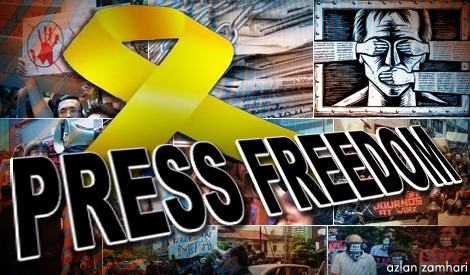

Fresh hope for press freedom
COMMENT | Let’s hope that Pakatan Harapan turns out to be true to its name and that its recent crushing victory over Malaysia’s seemingly endlessly-ruling and increasingly corrupt and repressive Umno/BN regime really does presage the kind of true freedom of the press that Malaysiakini and a few other news portals have so fearlessly pioneered.
Because such progress would not only be a boon to the Malaysian people, officially deprived of truth and transparency as they’ve been for decades, but would also provide a sorely-needed confidence-boost to all those of us concerned about press freedom everywhere.
Not that I’m one of the doomsayers claiming that press freedom is in its death-throes due to the destructive efforts of everyone, from Donald ‘Fake News’ Trump to the despotic regimes heading the countless dictatorships and fraudulent ‘democracies’ around the world.
Unlike the many pessimists currently prophesying the terminal decline or freedoom of the press, I perceive press freedom being still in its hopeful infancy.
Historically speaking, for example, in the context of the countless centuries through which humankind has existed, the printing press itself was born a mere 500 or so years ago, or relatively very recently indeed.
And only around 370 years ago, when poet John Milton published his famous 1644 pamphlet “Areopagitica, A Speech… For the Liberty of Unlicens’d Printing to the Parliament of England”, not only were there yet no newspapers as we know them, let alone all the other media invented since, but the very idea of press freedom seemed virtually unthinkable.
In fact, according to the book The Newspaper (Anthony Smith, 1979, Thames and Hudson, London), even by 1776, the year in which the American colonies that would become the US published their Declaration of Independence, no country in the world accorded its citizens the right of free publication.
It wasn’t until 1849 that John Stuart Mill could confidently write in his classic tract On Liberty that “the time, it is to be hoped, is gone by when any defence would be necessary of the ‘liberty of the press’ as one of the securities against corrupt or tyrannical government.”
And it was only as late as 1948 that the UN, in its Universal Declaration of Human Rights, deemed it a duty incumbent on all nations to respect the right of free publication of news and opinion, in any and every medium and regardless of national borders...
COMMENT | Let’s hope that Pakatan Harapan turns out to be true to its name and that its recent crushing victory over Malaysia’s seemingly endlessly-ruling and increasingly corrupt and repressive Umno/BN regime really does presage the kind of true freedom of the press that Malaysiakini and a few other news portals have so fearlessly pioneered.
Because such progress would not only be a boon to the Malaysian people, officially deprived of truth and transparency as they’ve been for decades, but would also provide a sorely-needed confidence-boost to all those of us concerned about press freedom everywhere.
Not that I’m one of the doomsayers claiming that press freedom is in its death-throes due to the destructive efforts of everyone, from Donald ‘Fake News’ Trump to the despotic regimes heading the countless dictatorships and fraudulent ‘democracies’ around the world.
Unlike the many pessimists currently prophesying the terminal decline or freedoom of the press, I perceive press freedom being still in its hopeful infancy.
Historically speaking, for example, in the context of the countless centuries through which humankind has existed, the printing press itself was born a mere 500 or so years ago, or relatively very recently indeed.
And only around 370 years ago, when poet John Milton published his famous 1644 pamphlet “Areopagitica, A Speech… For the Liberty of Unlicens’d Printing to the Parliament of England”, not only were there yet no newspapers as we know them, let alone all the other media invented since, but the very idea of press freedom seemed virtually unthinkable.
In fact, according to the book The Newspaper (Anthony Smith, 1979, Thames and Hudson, London), even by 1776, the year in which the American colonies that would become the US published their Declaration of Independence, no country in the world accorded its citizens the right of free publication.
It wasn’t until 1849 that John Stuart Mill could confidently write in his classic tract On Liberty that “the time, it is to be hoped, is gone by when any defence would be necessary of the ‘liberty of the press’ as one of the securities against corrupt or tyrannical government.”
And it was only as late as 1948 that the UN, in its Universal Declaration of Human Rights, deemed it a duty incumbent on all nations to respect the right of free publication of news and opinion, in any and every medium and regardless of national borders.
So it’s hardly surprising that, as the 2018 Reporters Sans Frontières (Reporters Without Borders) world map depressingly displays, press freedom has yet to grow from infancy to adolescence, let alone maturity.
In fact, it is yet to be conceived in the so-called ‘People’s’ Republic of China and much of the Middle East; is still very much in the foetal stage in many African, Asian and South-American countries; and is constantly threatened with infanticide in the many formerly apparently thriving democracies like, for instance just a few contemporary regressive examples, Turkey, Poland and Hungary.
And even in many more or less genuine democracies, whose number now hopefully includes Malaysia, freedom of the press is still so far from being fully-developed that it’s experiencing severe growing-pains and looking somewhat stunted.
Not nearly as free
In Australia, for example, where I and my fellow citizens like to presume we enjoy press freedom, there are shrouds of allegedly essential secrecy over ‘intelligence’, defence, immigration and other government departments, and rules of confidentiality that apply to most if not all staff in the public services.
In addition, Australian private citizens and public figures wealthy enough to afford killingly-expensive legal representation enjoy the protection of some of the world’s most press-unfriendly libel and defamation laws.
And, as most of us forget, or don’t notice in the first place, business corporations and many other institutions within our own and other democracies are effectively as dictatorial over their employees as China and N Korea are over their citizens, and just as resistant to press or other public scrutiny.
Thus it took years of revelations to law-enforcement agencies and the press by courageous individuals known as ‘whistle-blowers’ to force Australia’s major banks to submit to the current royal commission into their chronically cavalier if not arguably criminal mistreatment of their customers, and literally decades to bring the Catholic and other religions to book for sexual abuse of children by clerics protected by high-level cover-ups and the so-called ‘seal of confession’.
Then there’s the fact that this kind of freedom or freedumb of the press for big, rich and powerful organisations also extends to those elements of the media that take the liberty of practising what could well be termed fraudom of the press.
The skewing of the news in favour of whichever side of politics seems most favourable to the commercial interests of power-mad media proprietors like Rupert Murdoch.
The fact that the phone-hacking and police-bribery scandal cost Murdoch’s News Corporation untold millions of pounds and the closure of the oldest of its gutter tabloids, the News of the World, doesn’t seem to have taught it any long-lasting lessons in press integrity.
In my country News Corp (or, as some of us refer to it, News Corpse), News Limited (Limited News) or whatever Murdoch’s company here is called, still shamelessly employs The Australian, Daily Telegraph, Herald-Sun and other similar rags to support the Liberal-National or in other words conservative incumbent federal government and to mount rabid attacks on the nation’s foremost independent news organisation, the publicly-owned ABC.
And in the US, Murdoch is the proud owner of a stable of media of which the star is Fox News, favourite viewing of the Christian right, or in other words the Christinsane wrong, and reputedly Donald Trump’s sole source of fake news and flake views.
So, all things considered, the press and other news media, even in the self-styled ‘Land of the Free’, are not nearly as free as they’re cracked up to be.
Therefore the newly-liberated Malaysia now has the opportunity to achieve “mainstream” media that are not only as free to report news and express views without fear or favour as Malaysiakini and its pitifully few peers have done in recent years, but to show the likes of Australia and the US how truly free the press can someday grow to be.
And I and a great many of my writing and cartooning colleagues, not to mention billions of other fans of press freedom around the world, are hoping that Pakatan Harapan can do it.
DEAN JOHNS, after many years in Asia, currently lives with his Malaysian-born wife and daughter in Sydney, where he coaches and mentors writers and authors and practises as a writing therapist. Published compilations of his Malaysiakini columns include Mad about Malaysia, Even Madder about Malaysia, Missing Malaysia, 1Malaysia.con and Malaysia Mania.
The views expressed here are those of the author/contributor and do not necessarily represent the views of Malaysiakini.


