



10 principles towards a better manifesto
Perhaps the two manifestos would set them apart but it is a pretty tough job going through manifestos which are more than a hundred pages long.
And which don’t even include a proper summary in about a 1,000 words about the principles under which they will rule and the specifics of what they can do arising from these principles in the immediate term.
While Harapan’s manifesto comes closer to expressing the long-term aspirations of the rakyat, BN’s is a shameless litany of rewards protruding prominently out of the other more prosaic, pedestrian pronouncements telling the rakyat what they would get if they re-elected them into government yet again.
Here we put forth, not necessarily in order of importance, ten universal principles which should always guide government action and behaviour. These will dispel ...
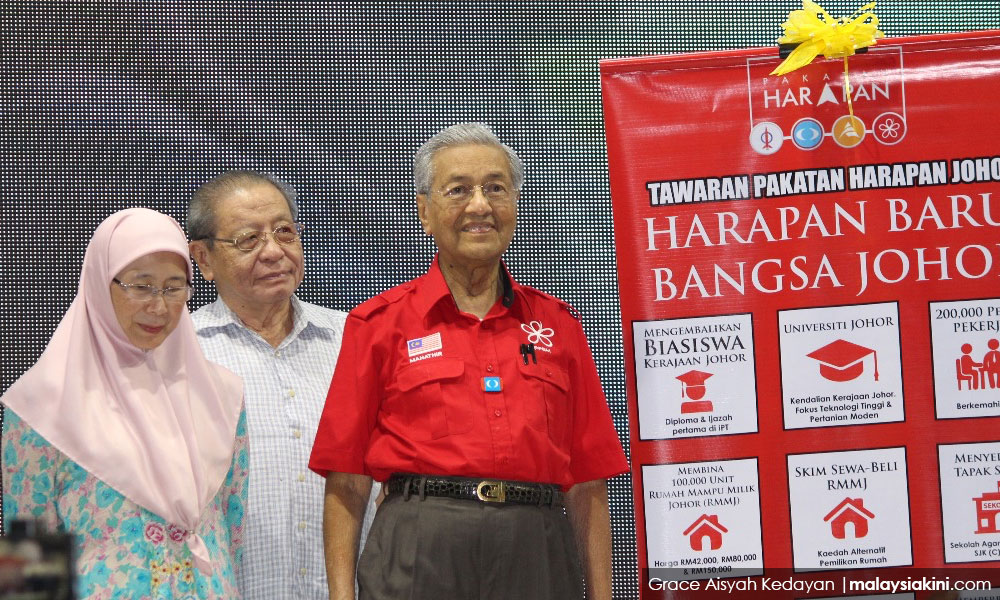
QUESTION TIME | As Dr Mahathir Mohamad, himself of Indian descent, strangely and bizarrely called Tamils “keling”, a term widely regarded as derogatory, and as BN launched its manifesto, a month after Pakatan Harapan did, one wonders just how much separates the two sides.
Perhaps the two manifestos would set them apart but it is a pretty tough job going through manifestos which are more than a hundred pages long.
And which don’t even include a proper summary in about a 1,000 words about the principles under which they will rule and the specifics of what they can do arising from these principles in the immediate term.
While Harapan’s manifesto comes closer to expressing the long-term aspirations of the rakyat, BN’s is a shameless litany of rewards protruding prominently out of the other more prosaic, pedestrian pronouncements telling the rakyat what they would get if they re-elected them into government yet again.
Here we put forth, not necessarily in order of importance, ten universal principles which should always guide government action and behaviour. These will dispel the idea of a so-called guided democracy under the guise of which our freedom has been eroded steadily over the years.
Yours may be different from mine but I think most Malaysians will agree substantially with these ten although they may have some more to add. But ten is plenty for now.
Freedom of speech, expression, assembly and association. This is the basis of a functioning democracy without which there can be no airing and discussing of issues to bring about change.
Thus all laws which in any way retard these must be removed - all powers of detention without trial, the Sedition Act, Poca, the Official Secrets Act, the Printing Presses and Publications Act etcetera should be immediately repealed. The only exceptions should be - and there are laws already to deal with this - instances of defamation and criminal incitement towards violence and similar acts.
Freedom of religion. In an environment in which religious authorities are trampling into areas which they have never before entered, it is necessary to emphasise and practice the concept of freedom of religion.
Individuals should decide whether they want to be in a certain religion or not and practice the religion they want to adopt as their own. Considering that two-fifths of the population are non-Muslims, the right to practice minority religions must be emphasised and protected without any threats.
Religious authorities cannot be the final arbiters of what’s right or wrong - that should be decided by secular courts.
Equality and protection under the law for all. Everyone - and I mean everyone - should be treated the same under the law and no one should be allowed to take extra-judicial action against anyone else. A person should be allowed to choose the life he wants so long as he harms no one else.
This ensures true liberty for all persons and entails removal of archaic provisions in old laws against women, homosexuals and LBGTs amongst others.

It also means adopting measures to ensure the independence of enforcement authorities, including implementing the Independent Police Complaints and Misconduct Commission (IPCMC). For instance, heavy penalties can be introduced for the executive interfering with the work of enforcement authorities.
An independent judiciary and legal service. Appointment of judges should be made by an independent body and subject to Parliament. The Attorney-General’s Chambers should be made independent and the decision to prosecute should be decentralised instead of being solely decided by the AG.
This will stop one person from becoming the judge of whether a prosecution should be made or not and allow those who investigate the cases to decide on whether there is sufficient evidence to proceed.
Eliminating corruption at all levels. All Malaysians know that corruption is endemic at all levels from the policeman on the street to local council officials all the way up to the top. Greater efforts at reducing corruption via independent investigation and prosecution will go a long way towards eliminating corruption.
Successive BN governments have only given lip service to this and very little has been done in practice. Politicians have far more assets than their incomes can justify and no one does anything about it.
A quality education system
All this has to be changed immediately, otherwise, we risk the future of the country with wealth being illegally concentrated in the hands of the few who can bribe their way to continuing riches and out of any attempt to prosecute them.
Proportional representation. One of the ways corrupt and inefficient regimes stay in power is to gerrymander constituencies. Laws to limit huge differences in constituency numbers can be implemented to reduce discrepancies to no more than 10-15 percent between the highest and the lowest.
On top of that laws should be introduced to have a proportion of parliamentary representation, say half, to be based on the popular vote garnered.
Transparency of government. A binding commitment is made towards open tenders, proper evaluation and disclosure of agreements so that there are openness and transparency in government dealings. Also, major contracts should have a period of public discussion ahead of implementation.
Annual reports of government bodies and companies should be detailed so that the public is well-informed about how the government and its various arms are doing.
Accountability of government to the public. Too often, even after misdeeds and corrupt practices are exposed, no one is held accountable for them.
All levels of government should be held accountable for their actions and direct perpetrators should be taken to court for these while heads of departments should be hauled up and asked how come they were ignorant about the misdeeds.
Building up quality education. A quality education ensures the progress of the individual, higher productivity, higher incomes, a more well-informed and well-rounded person and consideration and care for fellow citizens.
A comprehensive action plan which includes revamping the syllabus to make it more relevant, introducing English for some subjects and even including English-medium government schools and others should be systematically considered and implemented.
This is not easy and will take a couple of decades considering how much the quality of education has eroded over the years. But a start has to be made now.
Increasing income and closing income equality gaps. One of the major failures of government over the years has been the slow increase in income relative to living costs for the majority of the population partly through low-wage policies and imports of huge amounts of labour.
This has to be replaced with a high-wage, high-productivity policy which can only be brought about by higher educational standards, training, and more capital investment. A start has to be made now if we are not to be left behind.
Well, that’s our 10 points in less than 1,000 words. A properly functioning democracy, which ensures and protects everyone’s rights, together with competence, transparency and accountability in government is a valid aspirational goal of all cultures, communities and countries.
Third World countries must throw off the notion that they need an authoritarian government to progress - instead authoritarianism has brought about huge levels of corruption and the ultimate of them all - kleptocracy. There can be no less accountability when kleptocracy goes unpunished.
As flawed as Harapan is, their manifesto is closer to rectifying some of these although not everyone will agree with their measures.
While it a matter of great regret that they have chosen someone as unsuitable as Mahathir to make the necessary changes, someone responsible for much of the problems in the first place, it looks like that choice may be less bad than if we chose the incumbents - a very sorry state for the rakyat to be in.
But at least we would have chosen change.
P GUNASEGARAM says there can be no progress without change. E-mail: t.p.guna@gmail.com
The views expressed here are those of the author/contributor and do not necessarily represent the views of Malaysiakini.


