



Your KiniGuide to navigating the perilous world of 'fake news'
KINIGUIDE | Some steps you can take to ensure that fake news doesn't get the better of you.
KINIGUIDE | Last week, the prominent academic journal Science published a grim report that fake news spreads on average six times faster than true news.
This is based on an analysis by a team of Massachusetts Institute of Technology (MIT) researchers on data gleaned from Twitter since its founding in 2006 up till last year.
The report comes as the Malaysian government drafts new laws to combat fake news.
Civil society groups, however, warn that the new laws could lead to additional restrictions on bona fide news organisations and their reporting, pointing out that it is not the role of government to determine what is fake news or not.
With or without new laws, there are some steps you could take to boost your information literacy skills and make you less susceptible to fake news.
What is fake news?
The Collins Dictionary - which chose “fake news” as its “Word of the Year” for 2017 - defines fake news as “false, often sensational, information disseminated under the guise of news”.
The term was used during the 2016 US presidential election to describe websites which were proliferating at the time and spreading misinformation about the candidates.

On the other hand, the term was also used by the then US president-elect Donald Trump to discredit potentially damaging reports about him. This included news reports from genuine and even award-winning mainstream media organisations in the US.
Hence, when the term “fake news” is used, one should be careful in what way it is used. This KiniGuide will refer to the first definition above – the one provided by Collins.
So what do I do when I receive something I’d like to share?
Firstly, stop. That urge to share ought to set off alarm bells. Do first read the story in full and consider its veracity. If it makes you suspicious of the news or you are unsure about its veracity, you should not forward it as it may mislead others.
The first step is to check the original source of the news item. There should be a link to the source. If none is provided, that should be a red flag. Do a search and find out where the article was first published. And if there is a link, click on it and check if it comes from a credible website. Be mindful that someone could set up a dummy website so check the URL as well.
Also, check the date the article was published. Sometimes, an old but otherwise genuine news story is recirculated as though it’s a recent occurrence but the date shows it's a few years old (thus changing the context of the news report).
How can I spot fake news?
Verification and fact-checking can be a tricky business, even for a seasoned journalist. Often - due to limited resources and information - it is only possible to establish the veracity of a claim on some subjective scale rather than to declare the entire statement as being categorically true or false.
The US-based fact-checking site PolitiFact, for example, rates statements on a six-point scale ranging from “True” to “Pants on fire”. South Africa’s AfricaCheck, meanwhile, rates claims in eight different categories that include “unproven” and “exaggerated”
The diverse forms of misinformation - deliberate or otherwise - also makes it difficult to recommend any form of “one-size-fits-all” approach.
That being said, here are some tips and tools that you could use to determine the veracity of media claims that you might come across.
Check your biases
Do you happen to believe that BN is the root of all evil? In that case, that might be a sign you should think twice before sharing that article that is critical of BN. The same applies to articles that paint Pakatan Harapan in bad light if you have a dim view of the opposition coalition.

It is a natural human tendency to readily believe claims that conform to your worldview and be sceptical of claims that don’t.
Being aware of your own biases can help you find these blind spots and you should make a conscious effort to double-check a claim that you would otherwise readily accept as true to make sure you aren’t being hoodwinked.
In fact, if a story makes you feel strongly about an issue, that might be a sign that you should pause. Do consider checking first before you share that story. Especially if you're feeling shocked or angered.
Read past the headline
Headlines are written to draw attention (and clicks) but they may oversell the story. Do read the entire story before drawing any conclusions as there may be important caveats.
It may even contain a disclaimer somewhere identifying it as a work of satire. Or indeed the whole website could be entirely dedicated to satirical works.
Meanwhile, a news report about a scandal may contain an explanation by someone implicated by it, while a report about a medical breakthrough might also mention that it has only been tested on a handful of rats.
Search for more information
Try to run an Internet search on what you have just read. Then try again with similar search terms or allow a search engine’s auto-complete function to suggest related search terms to try.
It helps if you are familiar with your favourite search engine’s advanced search options which can help narrow down search results to those from a specific time, place or website. You can try it here (Google), or here (Bing).
The search feature for social media sites such as Facebook and Twitter also have similar options to allow you to quickly filter through search results and find those that are relevant to what you are looking for.
Alternatively, there is also the Storyful MultiSearch which a browser extension for Google Chrome that sifts through multiple social media platforms at a time. This is particularly useful when tracking down something that has just recently gone viral.
Keep at this and you might find an alternative explanation for what you are looking for or corroborating information. Or perhaps you may learn that some credible authority has either already confirmed or debunked that fantastic claim you were looking into.
Verifying photos and videos
Does the claim you were searching for include photos or videos? Consider running it past a “reverse search” to find where that it may have come from.
Websites that offer this service include Google, TinEye, and Berify.
A common red flag is when a picture or video is published before the event it is supposed to be linked to, or a similar but different image shows up that suggest one of the two images has been doctored.
Or, you may learn that the photo or video you have been examining has been taken out of its original context. If it is a screenshot of a social media posting that is being circulated, try searching for the original posting just in case the screenshot was a fake.
Has it already been reported or fact-checked?
If an unusual but true event has taken place, it is likely to be picked up and reported by a mainstream news outlet at some point – either traditional media or the online media. These reports may be backed by accounts from authorities or eyewitnesses. Conversely, the false news may have already been debunked by the same news outlets.
In addition, it is also common for the police, corporations and other authorities to issue press releases confirming or denying claims that have been circulating on social media platforms. Look for them on their websites and social media accounts.
Various websites also exist for the sole purpose of fact-checking dubious claims that have gone viral such as the US-based Snopes.com and the Malaysian Communications and Multimedia Commission’s (MCMC) Sebenarnya.my.
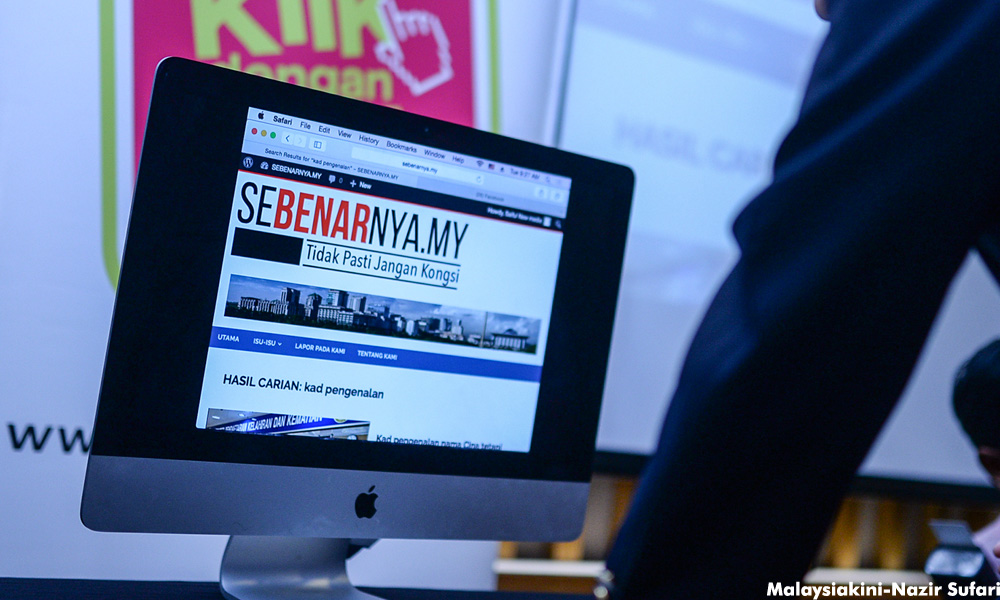
There is also SciCheck and Sense About Science that deals with science-based claims and Medical Myths Malaysia that deals with medical issues.
Evaluating a website
When dealing with a website, it may be useful examine the website for clues that could be used to establish whether it is a reliable source.
Potential red flags to look out for include:
Does the website have an “About Us” page that contains information about itself and the people behind it? What about an address and other contact information?
Does the website produce its own content? Or does it merely rewrite reports produced by other publications? Where possible, you should try to track down the original reports that such articles were based on.
Scan the website’s other articles. Does it look like a serious news organisation or does it seem to have a propensity for outlandish and poorly substantiated claims?
Evaluating a source
Genuine news stories typically contain at least one source who has spoken to the writer; ideally, there should be multiple sources.
Consider the sources cited in the story plus the quotes attributed to the sources. These should guide your judgement in deciding the veracity of a claim.
Do the quotes substantiate the premise of the story? Are the sources in a position to know what they claim to know? Is the source a real person? Does he have proof or corroborating information? If the source is anonymous, does the source have a plausible reason for not allowing his name to be published?
If the answer to any of these questions is “no”, be very sceptical of the story.
What should I do if I find fake news?
The easiest thing to do it to simply ignore it. You can also take pro-active action by reporting it.
On Facebook, you can use its “Report Post” feature to mark posts as “false news”.
Other major social media platforms don’t have tools dedicated to reporting misinformation but depending on the content, you may still report it as spam.
No such tools exist for messaging services such as WhatsApp. You’d just have to settle for telling your contact who sent you the story that it is untrue, and that he should tell others as well.
Likewise, if you have already shared something that you later find to be untrue, you should alert those whom you had shared it with.
One way to do this is to put a “Comment” on the original post about your finding; another is to delete the old post and make a new one clarifying the deleted post.
Where can I learn more about fact-checking?
Facebook has published a 10-point guide in partnership with the Institute of Journalists Malaysia (IOJ) to help towards this.
Another is the book ‘Verification Handbook: A Definitive Guide to Verifying Digital Content for Emergency Coverage’ which contains tips and case studies on verifying information on social media. It is available in electronic format for free from its official website.
The company Storyful, which specialises in gleaning information from social media platforms, has a write-up on how it verifies social media content.
As part of their accreditation requirements, fact-checking services that are a signatory to the International Fact-Checking Network (IFCN) code of principles are required to be transparent about the methods they use, including how they research a claim.
There are 49 IFCN signatories as of the time of writing and each of these may serve as a useful reference.
The investigative news site Bellingcat has published several advanced guides on techniques that can be used for verifying information such as this one on verifying video content.
This instalment of KiniGuide was compiled by KOH JUN LIN.


