


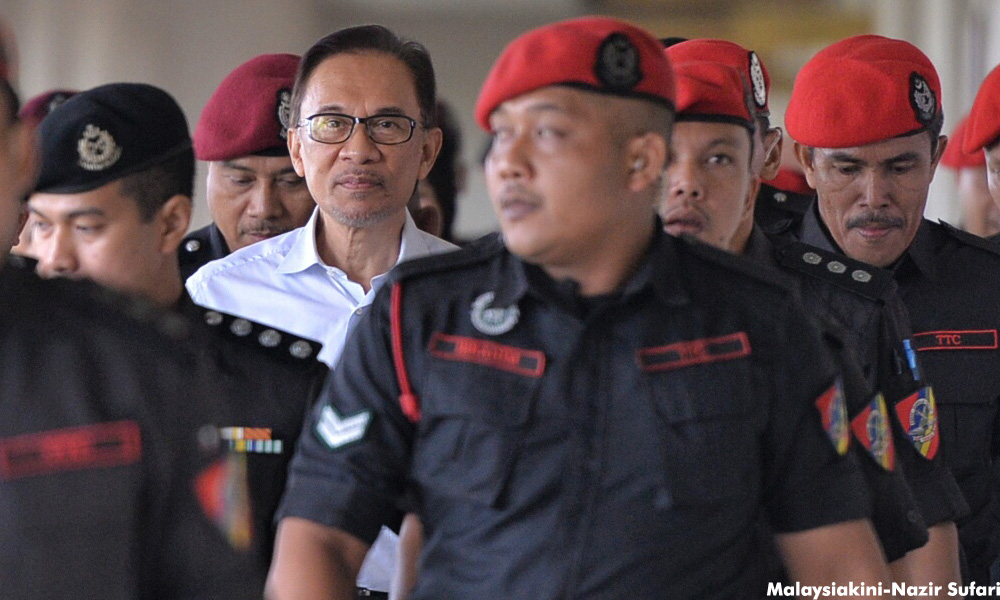

Ops Lalang – Anwar not as culpable as Dr M
COMMENT | In the flurry of recriminations accompanying the 30th anniversary of Operasi Lalang, Anwar Ibrahim is being fingered in the inevitable blame-fixing over that dark chapter of our post-Independence history.
To be sure, he is not as obvious a target of the fault-finders as Dr Mahathir Mohamad. The latter was the home minister and prime minister at the time of Operasi Lalang.
In those roles, Mahathir was at the top of the chain of command as far as effecting the arrests of 106 social and political activists that took place from late Oct 1987 was concerned.
Anwar was the education minister when the ISA dragnet swept scores of linguistic activists and politicians into its maw, amidst rising tensions in the federal capital over issues of mother tongue education.
It was Anwar's ministry that placed some 100 non-Mandarin speaking personnel in Chinese language schools, a move that drew protests from sentinels of Chinese education who inveighed with passion against it at a large gathering in a Taoist temple off Jalan Syed Putra.
In a kneejerk reaction, Umno Youth staged a demonstration at the Jalan Raja Muda Stadium in Kuala Lumpur on Oct 18, an event marked by incendiary speeches, the most blood-curdling of which was delivered by the movement's chief at the time, Najib Razak.
For sheer voltage of its inflammatory content, the speaker deserved to be detained under the ISA - that is, if others less culpable or not guilty of any kind of incitement, were also being detained, as was the case with the 1987 ISA arrests...
COMMENT | Lumping the two as villains of the 1987 drama is not fair and stretches known facts.
COMMENT | In the flurry of recriminations accompanying the 30th anniversary of Operasi Lalang, Anwar Ibrahim is being fingered in the inevitable blame-fixing over that dark chapter of our post-Independence history.
To be sure, he is not as obvious a target of the fault-finders as Dr Mahathir Mohamad. The latter was the home minister and prime minister at the time of Operasi Lalang.
In those roles, Mahathir was at the top of the chain of command as far as effecting the arrests of 106 social and political activists that took place from late Oct 1987 was concerned.
Anwar was the education minister when the ISA dragnet swept scores of linguistic activists and politicians into its maw, amidst rising tensions in the federal capital over issues of mother tongue education.
It was Anwar's ministry that placed some 100 non-Mandarin speaking personnel in Chinese language schools, a move that drew protests from sentinels of Chinese education who inveighed with passion against it at a large gathering in a Taoist temple off Jalan Syed Putra.
In a kneejerk reaction, Umno Youth staged a demonstration at the Jalan Raja Muda Stadium in Kuala Lumpur on Oct 18, an event marked by incendiary speeches, the most blood-curdling of which was delivered by the movement's chief at the time, Najib Razak.
For sheer voltage of its inflammatory content, the speaker deserved to be detained under the ISA - that is, if others less culpable or not guilty of any kind of incitement, were also being detained, as was the case with the 1987 ISA arrests.
Detention without trial, which is what incarceration under the ISA is about, is an unmitigated evil and has no place in civil society.
One of the puzzling aspects of the Operasi Lalang arrests was the detention of individuals who were not involved in activities that had to do with mother tongue education and the politics surrounding the issue, the ostensible cause of the ratcheting up of tensions in Kuala Lumpur in that fateful month of Oct 1987.
An incident in the Chow Kit area of the city, days after the Umno Youth gathering, in which a gunshot was heard, raised the agitational fever then prevailing in the federal capital to an intense pitch.
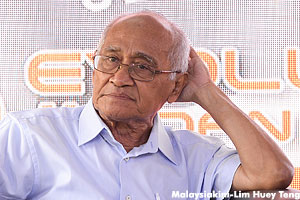
Two public figures, academician and Parti Sosialis Rakyat Malaysia member Dr Syed Husin Ali (photo), and the late national literary laureate Usman Awang, were troubled by the “tahan borong” (wholesale arrests) aspects of the ISA dragnet - the indiscriminate lumping of rabble-rousing politicians and perfervid exponents of mother tongue education, with individuals who in their work and public conduct were unconnected to the ostensible causes of the agitation and had not contributed to the tensions swirling over the federal capital.
Three of the latter were known to Syed Husin who at that time was head of the sociology and social anthropology department in Universiti Malaya. He was then supervising the doctoral theses of Cecilia Ng and Chee Heng Leng, and the Masters programme of Yunos Ali, all three of whom were swept up in the ISA dragnet, a move that reinforced the Orwellian sense of something sinister at work in the public arena.
Troubled by the gratuitous nature of some of the detentions, Syed Husin and Usman sought a meeting with the education minister on Oct 28, a day after the series of arrests began.
Both were longstanding friends of Anwar who agreed to meet the two at his home, which was then in Petaling Jaya.
The duo were only able to see Anwar very briefly, as upon their arrival in the porch of the house, they encountered his father-in-law, Wan Ismail, who was then head of the psychological warfare department in the police force.
The latter had succeeded CC Too, renowned as the brains behind the anti-communist campaign during the Emergency, with Wan Ismail as a redoubtable understudy.
According to Syed Husin, Wan Ismail seemed cross at the sight of the duo whom he may have regarded as disreputable leftists.
The older man receded into the recesses of the house and the visitors, sensing a chill, decided to chat with Anwar on the porch rather than go inside for a palaver.
They swiftly cut to the chase, asking Anwar why the apparently innocuous were being taken in with the febrile.
Syed Husin recalled that Anwar said Mahathir believed a repeat of the May 13, 1969 race riots was likely. Anwar said Mahathir was not going to allow a recurrence of May 13 on his prime ministerial watch.
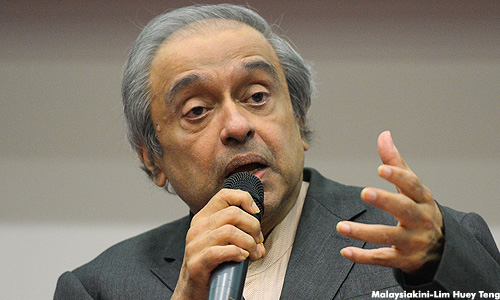
To Syed Husin and Usman, Anwar expressed concern about the arrests, particularly at the detention of Aliran's Chandra Muzaffar (photo) and lawyer Meenakshi Raman of the Consumers' Association of Penang. Anwar had been friendly to both.
Syed Husin cannot remember what Anwar said in response when pressed about as to why - if a May 13-like incident was in the offing – were benign activists being billeted with firebrands.
The chat ended as inauspiciously as it began.
Syed Husin recalled that Anwar had gone on record, after being elevated to Mahathir's cabinet in 1983, as being in favour of the abolishment of the ISA.
Syed Husin said that shortly after Anwar called for its abolishment, a RTM journalist interviewed him at his university office on the ISA, his experiences during detention and whether he supported Anwar's call.
The interview was never aired.
Syed Husin also recalled that Chandra said, shortly after his release from ISA detention, that he had met the inspector general of police (which one Syed cannot remember) for a discussion that included the ISA.
Chandra said the particular IGP told him the ISA cannot be abolished.
Anwar Ibrahim can plausibly be blamed for some current afflictions of the Malaysian polity – Islamic obscurantism, for example, of which he, ironically, has become a notable casualty – but he cannot be faulted for the 1987 ISA arrests.
He would find the idea of detention without trial an abomination, not just from having endured it twice, but because it is one of the starker manifestations of man's inhumanity to man.
TERENCE NETTO has been a journalist for more than four decades. A sobering discovery has been that those who protest the loudest tend to replicate the faults they revile in others.
The views expressed here are those of the author/contributor and do not necessarily represent the views of Malaysiakini.


