


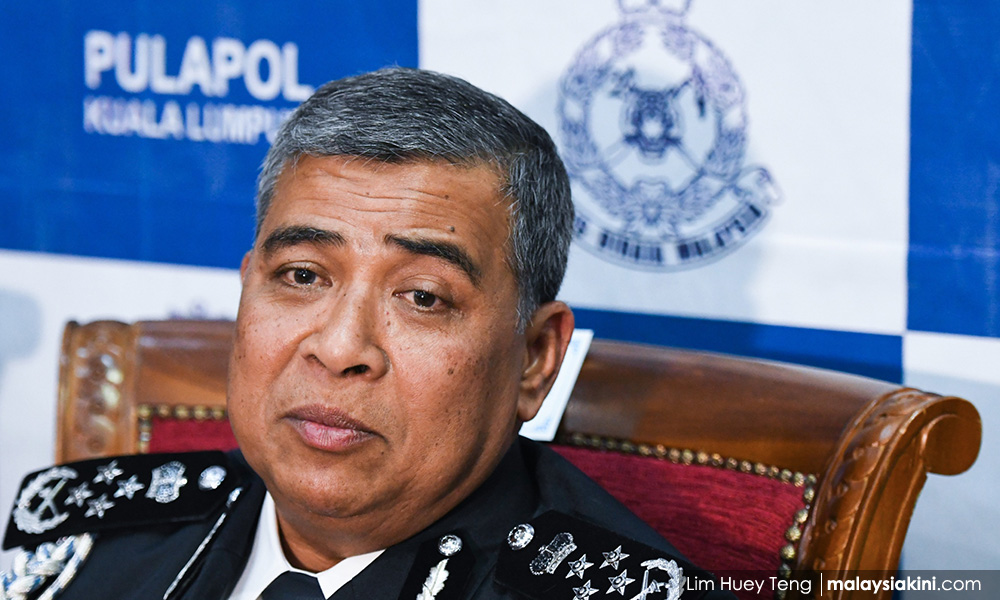

IGP Khalid - Twitter police and terrorist hunter
Of all the top police personnel since Haniff Omar, the country’s fourth and longest-serving inspector-general of police (IGP), there is little doubt that just retired IGP Khalid Abu Bakar has enjoyed the most press coverage.
Khalid became the nation's top cop in 2013 and has made it a point to appear in public regularly, while actively managing his own Twitter account.
Over the past three years, he even maintained a weekly column with Harian Metro.
His ability to craft his public image aside, what else will Malaysians remember him for?
Malaysiakini takes a look back at Khalid's four years as IGP, in a non-exhaustive list, below.
Elite police teams
Khalid set up three new task forces in his tenure - the Special Tactical Squad for Anti-Vice, Gambling and Gangsterism (STAGG), the Special Taskforce on Organised Crime (Stafoc) and the Special Tactical Intelligence Narcotics Group (Sting).
He had the habit of tweeting his congratulations to teams for their successful operations, often including photographs of the items confiscated and accompanied by the encouraging hashtag #GoPDRMGo...
Of all the top police personnel since Haniff Omar, the country’s fourth and longest-serving inspector-general of police (IGP), there is little doubt that just retired IGP Khalid Abu Bakar has enjoyed the most press coverage.
Khalid became the nation's top cop in 2013 and has made it a point to appear in public regularly, while actively managing his own Twitter account.
Over the past three years, he even maintained a weekly column with Harian Metro.
His ability to craft his public image aside, what else will Malaysians remember him for?
Malaysiakini takes a look back at Khalid's four years as IGP, in a non-exhaustive list, below.
Elite police teams
Khalid set up three new task forces during his tenure - the Special Tactical Squad for Anti-Vice, Gambling and Gangsterism (STAGG), the Special Taskforce on Organised Crime (Stafoc) and the Special Tactical Intelligence Narcotics Group (Sting).
He had the habit of tweeting his congratulations to teams for their successful operations, often including photographs of the items confiscated and accompanied by the encouraging hashtag #GoPDRMGo.
Syabas STAGG @PDRMsia gempur judi seluruh negara, sepanjang minggu lalu. Tkap 324 org dan rampas 1629 comp. #GoPDRMGo pic.twitter.com/jfbyJ8ogwA
— Khalid Abu Bakar (@KBAB51) August 15, 2017
Syabas STAFFOC @PDRMsia 13 pelajar,5 bukan pelajar disekitar Klang. Ramai lagi akan ditkap kerana terlibat dlm aktiviti geng 24. #GoPDRMGo pic.twitter.com/EiB1c2Nn5E
— Khalid Abu Bakar (@KBAB51) April 21, 2017
Syabas STING @PDRMsia semlm tkap 9 Warga Afrika di KL dan PJ dan rampas 24 kg ganja. #GoPDRMGo pic.twitter.com/5cm47GqDRu
— Khalid Abu Bakar (@KBAB51) August 22, 2017
Police handling of rallies
The police handling of demonstrations and rallies since Khalid took over as top cop saw a significant drop in the use of excessive force as counter-rally measures.
During the Bersih 3 demonstration in 2012, there were more than 500 arrests while dozens were injured. Tear gas and water cannons were arbitrarily used, the Bar Council reported.
In contrast, subsequent major rallies and counter-rallies saw more pre-emptive and post-rally arrests, although the rallies were allowed to take place without much further interference.
However, there were criticisms against Khalid for applying the Security Offences (Special Measures) Act 2012 (Sosma) against Bersih leader Maria Chin Abdullah to detain her without trial as well as the detention of counter-protest leader Jamal Md Yunos.
1MDB
Khalid was once part of the attorney-general's special task force on revenue recovery, which launched a widely publicised investigation into 1MDB-related matters.
He was among the four signatories of the task force's press statements which provided updates on the investigation.
In July 2015, then attorney-general Abdul Gani Patail was forced into early retirement while two other task force members - then Bank Negara governor Zeti Akhtar Aziz and MACC head Abu Kassim Mohamed - retired soon after.
Like Zeti, Abu Kassim and Gani, Khalid would retire without seeing anyone being charged for offences related to 1MDB, despite recommendations for criminal action by the Public Accounts Committee and legal action taken by other jurisdictions across the globe.
Khalid also faced flak for applying Sosma on activists Khairuddin Abu Hassan and Matthias Chang. Their detention was later ruled illegal.
Interfaith custody battles
Under Khalid’s stewardship, the police refused to take action against Muslim convert Mohd Ridhuan Abdullah, despite orders from the court.
The civil court had granted Ridhuan’s ex-wife S Deepa custody of their children while the syariah court had granted custody to the father.
Khalid argued that since the two courts had differing positions, it was best that the two parties resolve the matter.
Deaths in custody
One nagging problem that has persisted for two decades is deaths of detainees while in police custody and the situation has not improved under Khalid’s helm.
According to human rights watchdog Suaram, there have been at least seven incidents of custodial deaths involving police detainees in this year alone.
The hunt for terrorists
Under Khalid's watch, there have been hundreds of arrests of suspected terrorists, with dozens charged for supporting terrorist groups.
Police also swiftly apprehended the duo behind a terrorist attack on a nightclub and secured their conviction.
Aminulrasyid Amzah
A major black mark on Khalid's career revolved around the death of 15-year-old Aminulrasyid Amzah, who was fatally shot by a policeman in 2010 when Khalid was Selangor police chief.
After the courts had ruled that Khalid was liable of public misfeasance, he was adamant that he need not apologise for claiming in 2010 that there was a machete in the vehicle driven by Aminulrasyid.
Press freedom and freedom of expression
Khalid’s Twitter presence is like a double-edged sword. On one hand, Malaysia had a police chief who was accessible. On the other, he would go after Twitter users for allegedly criminal tweets.
Khalid’s tenure also saw the arrests of The Edge publisher Ho Kay Tat and The Malaysian Insider (TMI) chief executive Jahabar Sadiq, and other TMI journalists. None were charged, but the chilling effect on the press was felt.
However, Khalid will also be remembered for making sure that the Red Shirts didn’t cause too much trouble when they gathered near Malaysiakini’s headquarters.
We thank him for that.
This list is compiled by Annabelle Lee, Zikri Kamarulzaman, Lee Weng Keat and Andrew Ong.


