


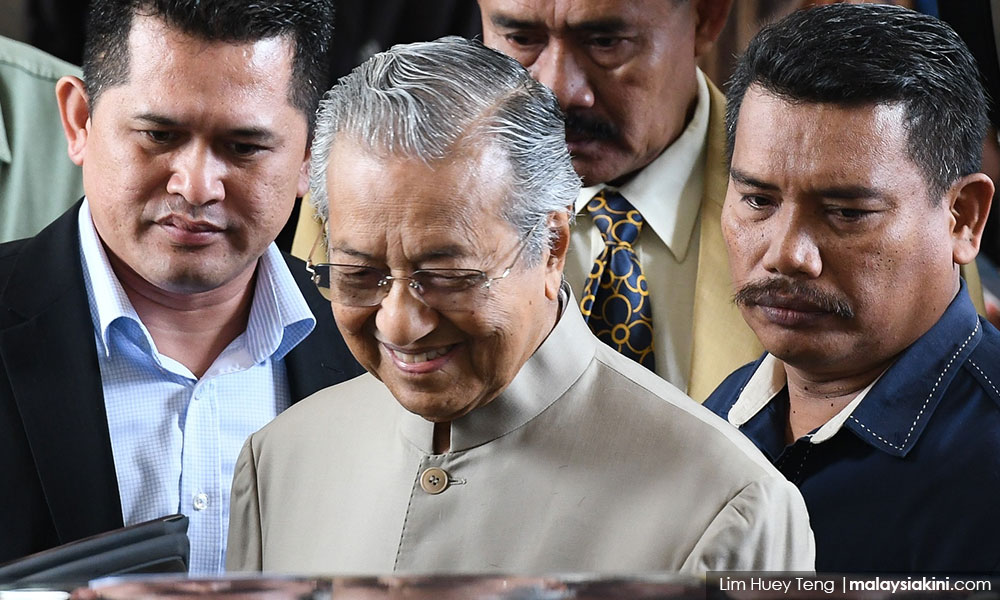

Dr M looked 'normal' when told about RM30b forex losses, RCI told
FOREX RCI | Former premier Dr Mahathir Mohamad had purportedly seemed indifferent when he was informed about the foreign exchange losses incurred by Bank Negara Malaysia.
Testifying before the Royal Commission of Inquiry (RCI) investigating the losses which occurred between the 1980s and the early part of 1990s, Clifford Francis Herbert, who was a former deputy secretary-general with the finance ministry, said he came to know about the losses in late 1993 when he was instructed by then finance minister Anwar Ibrahim to check on the losses suffered by the central bank.
Armed with documents by Bank Negara, Herbert then did his own calculations and reported to Anwar through a note that the central bank had suffered losses amounting to about RM30 billion...
FOREX RCI | Former premier Dr Mahathir Mohamad had purportedly seemed indifferent when he was informed about the foreign exchange losses incurred by Bank Negara Malaysia.
Testifying before the Royal Commission of Inquiry (RCI) investigating the losses which occurred between the 1980s and the early part of 1990s, Clifford Francis Herbert, who was a former deputy secretary-general with the finance ministry, said he came to know about the losses in late 1993 when he was instructed by then finance minister Anwar Ibrahim to check on the losses suffered by the central bank.
Armed with documents by Bank Negara, Herbert then did his own calculations and reported to Anwar through a note that the central bank had suffered losses amounting to about RM30 billion.
Herbert, however, said he could not remember the losses were for which years.
Both Herbert and Anwar then met Mahathir at the latter's office in late 1993 to brief him about the losses.
"Mahathir responded to the brief by saying 'sometimes we make profits, sometimes we make losses'."
Asked by one of the RCI's conducting officers on Mahathir's reaction at the time, Herbert said: "I had expected him to be outraged.
"(But) he looked quite normal," added Herbert.
Asked further whether Mahathir had some inkling about the losses prior to being told about them, Herbert said he was not in the know.
Meanwhile, after given permission to question Herbert by RCI chairperson Mohd Sidek Hassan, Mahathir's lawyer Mohamed Haniff Khatri Abdulla asked him whether he was aware that prior to the meeting held with Mahathir in late 1993 that Bank Negara's annual report for 1992 was already tabled in Parliament.
"I was not aware but it should have been prepared by then," said Herbert.
When pointed out how Bank Negara's forex activities and purported losses incurred had already become issues talked about by then, Herbert stressed that he was not aware of the losses prior to that.
Herbert also said that he had merely reported what Mahathir had purportedly said during the meeting when asked by Haniff whether he agreed that Mahathir's statement on making profits or losses was something which he could not explain.
"So do you agree that it is not in your position to confirm why Mahathir made that statement unlike the suggestion made by (RCI member) Saw Choo Boon that the statement was made perhaps because profits had been made?" Haniff asked Herbert who then replied with an affirmation.
Earlier today, former Treasury secretary-general Mohd Sheriff Mohd Kassim told the hearing that he came to know of the forex losses as it had become public knowledge.
Sheriff also said that he believes that either the governor or finance minister had updated the then prime minister about the forex losses incurred between 1990 to 1994 as it had received wide media coverage as well as queries from politicians.
And although Bank Negara's board of directors had asked then governor Jaffar Hussein about the losses, it was only discussed in one meeting.
Sheriff also acknowledged how the central bank's board of directors had never set any rules in relation to forex trading.
However, Sheriff confirmed that they had indeed voiced their regrets over the absence of rules concerning forex trading.
This was after they saw the internal audit report dated January 21, 1994.
Nevertheless, Sheriff does not believe that the central bank had tried to cover up the losses when it made adjustments to its accounts book involving profit and loss and reserve management as they were made in order to "protect Bank Negara and Malaysia to avoid dangerous implications on the country's economy and currency".
The former Treasury secretary-general also told the RCI that he believes that the total losses incurred were RM15 billion. From that amount, RM9.3 billion was absorbed in the central bank's other reserve account which was set up to absorb losses.
The reserve account managed to cover the losses made in 1991 and 1992 respectively but by 1993 the reserves were insufficient to absorb the losses, he said.
"That's why only RM9.3 billion was absorbed by the reserves and the RM5.7 billion was put under deferred expenditure and placed in Bank Negara's report."


