




Chinese M'sians, an imagined community?
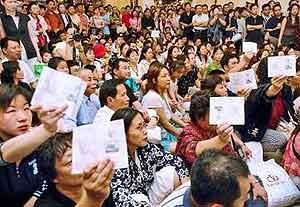
Three weeks ago, some 340 mainland Chinese tourists occupied the lobby of the First World Hotel in Genting Highlands in protest of the caricatures of pigs found on some of their breakfast vouchers.
In a manner reminiscent of the days when China was on the brink of disintegration following the ruthless onslaught by the Japanese and Western imperialists in the first half of the last century, nationalistic sentiments permeated a place famed for its gambling facilities, interrupting the usually boisterously happy atmosphere for at least a few hours.
Just when one thought nationalism and patriotism were priceless and not to be traded for, the patriotic songs prompted the hotel management to issue an apology to their mainland Chinese guests, whose wrath was later soothed with, allegedly, RM80 that given to each of the insulted. The host was relieved, and the guests pleased. What a happy ending.
Three weeks ago, some 340 mainland Chinese tourists occupied the lobby of the First World Hotel in Genting Highlands in protest of the caricatures of pigs found on some of their breakfast vouchers.
In a manner reminiscent of the days when China was on the brink of disintegration following the ruthless onslaught by the Japanese and Western imperialists in the first half of the last century, nationalistic sentiments permeated a place famed for its gambling facilities, interrupting the usually boisterously happy atmosphere for at least a few hours.
Just when one thought nationalism and patriotism were priceless and not to be traded for, the patriotic songs prompted the hotel management to issue an apology to their mainland Chinese guests, whose wrath was later soothed with, allegedly, RM80 that given to each of the insulted. The host was relieved, and the guests pleased. What a happy ending.
But the most bizarre result can be seen in the conspicuous silence on the part of the Chinese press in Malaysia which, for some unknown (or unspeakable?) reason, pushed the news into an insignificant corner of their pages. The details were sketchy, and the tone evasive.
In a week when news in China and Hong Kong was almost dominated by the inhospitality visited upon the Chinese tourists in Genting, the Chinese dailies in Malaysia - which seize every opportunity possible to preach to the reader the paramount importance of the emotional bond of overseas Chinese with their brethren in mainland China - failed miserably to discharge their duty.
 It would therefore be legitimate for one to ask: if the Chinese press in Malaysia should feel so very indignant at the refusal of the obstinate Japanese government to apologise for WWII atrocities, what hindered our journalists here from expressing their outrage at the incivility experienced by the Chinese tourists on our own soil?
Weird, isn't it? If one could go the extra mile and drum up nationalistic sentiments in order to show one's solidarity with the distant kin, why feel inhibited from offering even a small glass of water to the thirsty child knocking on one's door?
Very romantic notions
Perhaps all the talk about ethnic pride is nothing but rhetoric, which can never be as tangible as the commercial interests that take precedence over integrity.
Be so as it may, the lack of public attention on the misfortune of the Chinese tourists is nevertheless indicative of a subtle change in the idea of a universal Chinese community. Most significantly, the recent incident, for all its obscurity, highlights the serious discrepancies in terms of the perceptions of mainland Chinese and Chinese Malaysians towards one another.
I used to hang around with mainland Chinese during my rootless existence in London. One of them, a very good friend of mine from Hangzhou and married to a Malaysian girl, once told me, 'Thanks to the education that I received in China, I long held a very romantic imaginary of the Chinese in Southeast Asia, that all of you were like Tan Kah Kee, having thousands of acres of rubber plantations and the heart tuned to the great motherland of China. Now you and my wife have shattered my sentimental impression as such'.
I smirked and said, 'Well, if my family was indeed rich as Tan, you would not have seen me work so much in Chinese restaurants.'
But I cannot discount the fact that my friend's romanticism does reflect to a large extent the general view of mainland Chinese. In their discourse on the so-called 'Chinese Diaspora', the Chinese in Nanyang, or the South Sea, are invariably self-reliant and industrious, who will come to the aid of mother China in time of crisis and tribulation.
Tan Kah Kee, a successful businessman in British Malaya, left a beautiful footprint to that effect by returning to China and promoting mass education there. He became an icon and a legend, and continues to generate romantic imaginations of mainland Chinese about Chinese living in Southeast Asia.
Xiamen University, which Prime Minister Abdullah Ahmad Badawi visited two years ago, is a living tribute to Tan's educational legacy in China.
Sense of grievance
On the other hand, it is also a fact that the old generation of Chinese in Malaysia still harbour strong cultural and emotional affinities towards China, pretty much in the way the Malays feel about Nusantara.
The 'greater China complex', born out of a strong sense of grievance on the part of Chinese Malaysians, is understandable. Since Merdeka, the state policies in the areas of language and culture have always been characterised by its discriminatory practices towards the non-Malays.
Changes are so slow in the coming and many have perhaps long given up on the hope for a Bangsa Malaysia, especially with the unhelpful hands of the irresponsible politicians who are quick to brandish a keris, or a Malay media that relish in distorting rather than reporting news.
Given such context, one shall not be surprised to read of the views in the Chinese press that a powerful and prosperous China will do much to lift the status of the Chinese overseas. Chauvinistic, yes.
With the staggering economic progress of China comes an increasingly vocal and, at times, aggressive expression of nationalistic pride among the Chinese Malaysians, with which I am ill at ease. But when one puts the greater China complex to an empirical test, its paradoxes and contradictions show.
I once heard, in horror, an old leftist turned capitalist Chinese ' taukeh ' make a series of disparaging and derogatory remarks about the so-called 'little dragon girls', who, according to him, 'have been flooding our local market and ruining many families in the Klang Valley area'.
Strange that the men who are spell-bound by the mainland Chinese prostitutes, euphemistically known as 'customer relations officers', never have to shoulder their chunk of responsibility. And it was certainly odder to see the mainland girls lumped together by our local Chinese press and referred to as 'little dragon girls', as if they are faceless and devoid of individual identities.
And it was only some two years ago that dozens of mainland Chinese workers were cheated into working in Malaysia and found to their dismay that there were no jobs for them, despite having paid a huge sum of money to illegal syndicates both in China and Malaysia.
Stranded and sleeping rough in KL, their unkempt image and shaggy clothing put the locals off who looked askance at them. Chinese Malaysian community leaders, too, avoided them, and chose to heap praises on the economic miracle of China a few thousand miles away instead.
Bowing to official pressure, the Chinese embassy finally stepped in and facilitated the return of these undocumented persons to China. I hope they live happily ever after.
Celebrate commonalities
Mainland Chinese officials, meanwhile, have their fair share of romantic views of overseas Chinese too, not least their habitual reminder of the need for them to 'behave themselves' while living in a 'foreign' land.
Xin Guomin Ribao (New National Daily), which was launched in 1919, marked an important milestone in the history of Chinese literature in Singapore and Malaya. The newspaper carried with it a strong impression of 'a Chinese heart residing in Southeast Asia', and this was made crystal clear in its inaugural editorial as follows:
Now that we find ourselves in the South Sea, all of our words and deeds must be in keeping with the law of the land in which we reside. This is because we live on a foreign soil, and must not go unruly. Such attitude cannot be regarded as servile, but a duty that a civilised person should adhere to.
Taking into account the historical background of the time, such wording was understandable and acceptable. However, when Premier Wen Jiabao received a group of 'overseas Chinese', including some prominent Malaysian businesspeople, in the Great Hall of the People in Beijing early this year, he found it hard to kick the old habit of treating his guests as his own subjects, and urged them to 'abide by the law of the land, and live in harmony with the local people'.
When one compares the position of the Xin Guomin Ribao of 1919, and the 'advice' of Premier Wen of 2005, one may be surprised to know that so little has changed in regard to the mentality of the Chinese government over the last century. I would say their 'romantic imaginary' of 'overseas Chinese' continues to be an obstacle in developing fresh perspectives of the people of Chinese origins living outside of China.
The new rich in mainland China, upwardly mobile and globetrotting, are bound to realise their stereotype of overseas Chinese as being 'patriotic' and 'championing the cause of the great motherland' is archaic and unrealistic, and they will be quick to adjust their expectations accordingly, as my Hangzhou friend has done.
It is certain that the perceptions and observations of mainland Chinese and Chinese Malaysians towards one another will be more diverse and hybrid in the future, while the monolithic view of 'patriotic overseas Chinese' is fast becoming a thing of the past.
After all, the process of globalisation does not just force us to appreciate and celebrate our commonalities, but cause us to look more earnestly for our individualities and differences as well.


