


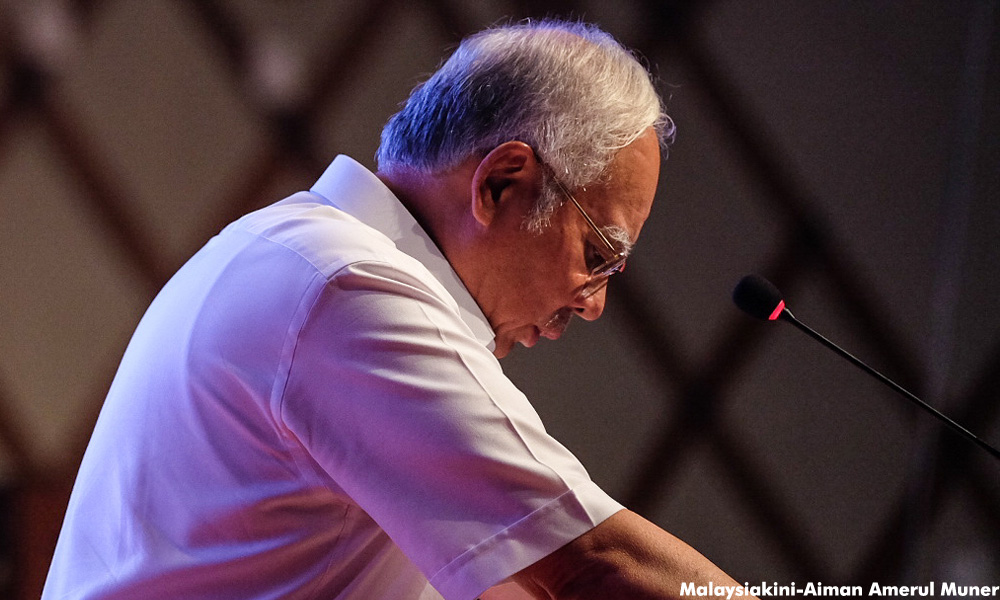

Is PM Najib Abdul Razak trapped?
COMMENT | The ratio of controversies in the upcoming general election versus the previous election in 2013 is probably 50:1 in Malaysia right now.
In the last general election, the key issue was just the ability of the opposition front, then known as Pakatan Rakyat (People's Coalition), to unite as a major electoral pact.
Can three parties, representing the interests of the Malays, Chinese, Indians and others, cohere as a common unit that can weed out the corruption in Malaysia?
Some were convinced, others were not. As it turned out, the (Prime Minister) Najib (Abdul Razak’s) government led by Umno emerged from the electoral fray triumphant. But it barely won with enough votes, it actually lost popular votes.
Umno scraped through, by gaining 47.38 percent of the popular voters, while the opposition had the remainder 50.87 percent. Had it not for the gerrymandered constituencies, Umno would have lost. Instead, despite receiving less popular votes, the Umno-led government had 59.90 percent of the 222 seats in the Parliament, registering 133 seats win.
In the upcoming 14th general election, Najib is facing a tall order again. Some issues are insurmountable, such as 1MDB, as billions have been allegedly swindled or stolen out of the company.
It is arguably one of the largest corruption, malfeasance and abuse of power case in the world, and will, therefore, invite the scrutiny of the US Department of Justice further, not forgetting at least six other jurisdictions that include Singapore, Hong Kong, Luxembourg, Switzerland, the UK and Germany.
As things are, the Umno-led government has to contend with 50 issues which neither Umno nor BN, can resolve over the next few years. Invariably, both are entering the impending 14th general election with excessive baggage.
Among them are the 1MDB scandal; the imposition of a six percent GST on all transactions; the mysterious US$681 million that found its way into Najib's private bank account; the phenomenal rise in the cost of living; the fluctuating prices of oil; the depreciation of ringgit; the prosaic and daily difficulties in making ends meet.
Indeed, one might add the suspension and depletion of the Mara scholarship; the drastic cuts in the subsidy of academic studies; the reduction in the value of bargain with foreigners over the sale of Bandar Malaysia; plus the drop in Malaysia’s reputation abroad...
COMMENT | The ratio of controversies in the upcoming general election versus the previous election in 2013 is probably 50:1 in Malaysia right now.
In the last general election, the key issue was just the ability of the opposition front, then known as Pakatan Rakyat (People's Coalition), to unite as a major electoral pact.
Can three parties, representing the interests of the Malays, Chinese, Indians and others, cohere as a common unit that can weed out the corruption in Malaysia?
Some were convinced, others were not. As it turned out, the (Prime Minister) Najib (Abdul Razak’s) government led by Umno emerged from the electoral fray triumphant. But it barely won with enough votes, it actually lost popular votes.
Umno scraped through, by gaining 47.38 percent of the popular voters, while the opposition had the remainder 50.87 percent. Had it not for the gerrymandered constituencies, Umno would have lost. Instead, despite receiving less popular votes, the Umno-led government had 59.90 percent of the 222 seats in the Parliament, registering 133 seats win.
In the upcoming 14th general election, Najib is facing a tall order again. Some issues are insurmountable, such as 1MDB, as billions have been allegedly swindled or stolen out of the company.
It is arguably one of the largest corruption, malfeasance and abuse of power case in the world, and will, therefore, invite the scrutiny of the US Department of Justice further, not forgetting at least six other jurisdictions that include Singapore, Hong Kong, Luxembourg, Switzerland, the UK and Germany.
As things are, the Umno-led government has to contend with 50 issues which neither Umno nor BN, can resolve over the next few years. Invariably, both are entering the impending 14th general election with excessive baggage.
Among them are the 1MDB scandal; the imposition of a six percent GST on all transactions; the mysterious US$681 million that found its way into Najib's private bank account; the phenomenal rise in the cost of living; the fluctuating prices of oil; the depreciation of ringgit; the prosaic and daily difficulties in making ends meet.
Indeed, one might add the suspension and depletion of the Mara scholarship; the drastic cuts in the subsidy of academic studies; the reduction in the value of bargain with foreigners over the sale of Bandar Malaysia; plus the drop in Malaysia’s reputation abroad.
Some issues even verge on the rise of the cost of the haj to Saudi Arabia; as well the institution of the all-powerful National Security Council Act in 2016, despite the cautionary advice and wisdom from the Council of Rulers, which can suspend the electoral process in Malaysia.
More alarmingly, the public universities' education budget has been slashed by more than 40 percent, with more than 6,000 professors either not renewed of their contracts, retired, or retrenched.
There were also cases, where very profound Professors with years of experience of research and teaching, were offered a fraction of the salary that they use to earn just to retain them and their expertise.
Of course, some accepted it, many rejected it as this is a great insult to their professions and them, personally.
Invariably, Najib has tried to pacify the simmering anger from the ground in 54 parliamentary constituencies, and 92 state constituencies in Felda, first. Last Sunday, Najib announced a raft of measures - worth up to RM1.588 billion - that can provide much economic relief to the disgruntled Felda settlers.
No one knows if the pre-election goodies can reinforce the position of Umno, as Felda has traditionally been its stronghold anyway. But it has been customary of the opposition, especially since 2008, to urge the voters to take all the goodies from the government, only to vote the opposition alliance come the polling day, as the logic is, it is their money anyway.
But for sustainable living and benefits, it is better for them to place their bets on the opposition alliance as it seeks to free the Felda settlers from a very “feudal” existence that accentuates continuous dependencies on the giver.
Still, defeating a powerful incumbent is not an easy task. Since Felda came into being, BN, the ruling coalition government, has almost never lost a single federal seat in Felda areas in the national election.
But the opposition, such as the Democratic Action Party (DAP), was quick to pounce on the corruption of 1MDB.
In fact, the "pink diamond" of the wife of MO1, a public figure widely acknowledged by his minister Abdul Rahman Dahlan as Najib, has denied the accusations. Had the diamond been sold back, the Felda settlers would have been entitled to RM100,000 per person.
With a litany of corruption popping up in the news, Najib has lost his ability to control the narrative. Indeed, this time around, if Najib should just lose few seats out of the 54 parliamentary seat and 92 state seats, some believe Najib will be "Dead Man Walking" in Umno.
By December 2018, Umno's supreme council would have to hold the triennial Umno election. But if the top continues to cause the palm and oil sector to bleed, some heads have to roll, especially Najib’s.
To be sure, it is noteworthy that Najib still feels - rightly or wrongly - that he has the support of the majority of the Malaysians. But if he does, then the 50 or more issues that continue to linger without a solution are hanging on his neck like the albatross.
As things are, Umno remains the biggest bloc in the BN coalition government, with up to 86 seats out of a total of 133 parliamentary seats won by BN in 2013. But losing more and more seats in Felda constituencies implies a gradual but certain erosion of the Malay support.
Already, Sabah and Sarawak alone contributed 47 parliamentary seats to BN. And, Sabah and Sarawak may not be totally averse to switching their allegiance to Pakatan Harapan, which is the opposition front led by Dr Mahathir Mohamad, if they can hold the federal government accountable to the Malaysian Agreement, where Sabah and Sarawak should be entitled to a bigger share of the petroleum, perhaps as high as 20 percent or more, rather than a meager five percent and other rights and obligations under the Malaysian Agreement.
As things are, Felda owns 330,000ha of the land, and it is considered a regional powerful house in palm oil. But the deflated stock prices that refused to yield, have sent the stock prices tumbling to RM1.66; as opposed to RM5.30 when it was first publicly traded on June 28, 2012, a whopping drop of 68.7 percent.
This resulted in huge exposure to many Felda settlers who themselves were “forced” to purchase the shares then at a high price, only to see their holdings plummet, hitting their pockets and incurring huge debts. The Felda settlers are indeed very angry.
Indeed, more storms can be expected to hit Najib’s government. The Mahathir and Anwar Ibrahim reconciliation represents a major turning point in July 2017; as a former prime minister and a former deputy prime minister have paired up.
And with the very experienced cool heads, like another former deputy prime minister Muhyiddin Yassin and a former chief minister Mukhriz Mahathir, their only goal is to bring about the downfall of Najib’s government and Umno, in order to reinvent Malaysia and bring back the lost glory and honor that this country and people certainly deserve.
Muhyiddin was spot on when he spoke about the Malay Tsunami - as this is indeed going to be a Malay Tsunami.
If indeed the opposition coalition wins this election, the team to reinvent Malaysia must be ready to hit the ground running on the minute one, not day one, as this country is in serious flux with huge inherited liabilities and dysfunctional democratic institutions.
The work of reinventing Malaysia is certainly monumental. It requires a team of very experienced, cool and calm heads to manage through such a process. For once, the opposition alliance does have that dream team.
RAIS HUSSIN is a supreme council member of Parti Peribumi Bersatu Malaysia (Bersatu). He also heads the party's policy and strategy bureau.
The views expressed here are those of the author/contributor and do not necessarily represent the views of Malaysiakini.


