


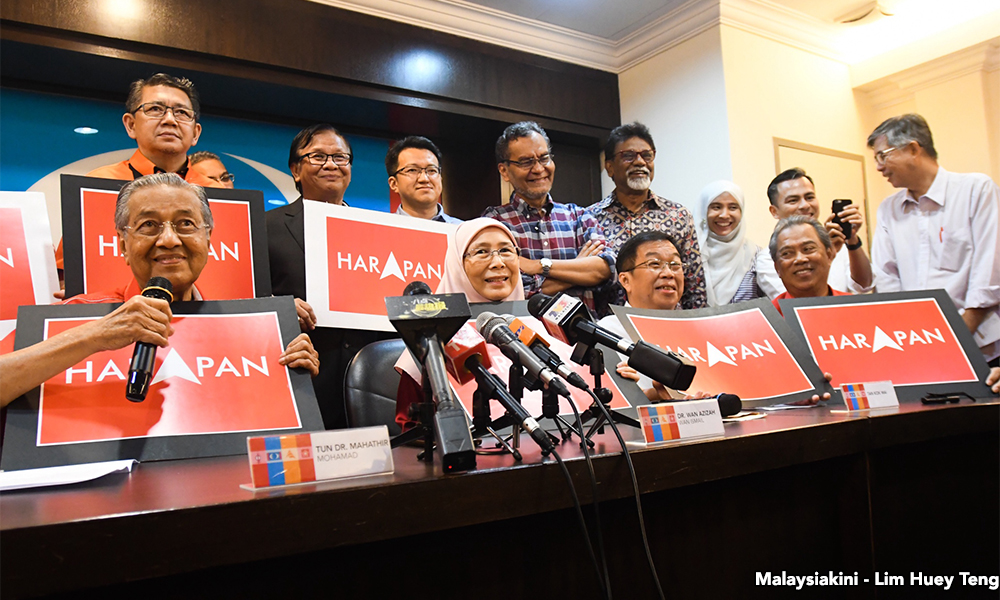

Harapan eyes a tryst with destiny
COMMENT | You have to go back almost a half-century, and then again beyond that, another two decades, for the antecedents of yesterday's coming together of four hitherto dissonant political parties – PKR, DAP, Amanah and Bersatu – to make Pakatan Harapan a now viable concern.
The opposition coalition, relying on nothing more vivifying in the ancient game of politics than that it is, above all, the art of the possible, announced it had overcome what appeared to be formidable obstacles to its parturition.
It unveiled a clear leadership line-up and what is certain to be an electrifying plank of its evolving manifesto: the removal of the Good and Services Tax, a punitive exaction to save the nation from the effects of Umno-BN's wanton profligacy.
The removal of dire obstacles to making Harapan a going concern is almost certain to ease difficult negotiations towards a seat-sharing deal among its component members.
When Gordian knots are sliced
When Gordian knots are sliced, its effects can be paradigm-shifting.
To borrow an Abraham Lincoln formulation: Harapan must now make haste, slowly.
But first the antecedents, recall of which should be sobering to Harapan's endeavour to halt and turn around the country's present gallop to the precipice.
In 1968, there occurred a gathering together of left and centrist politicians, trade unionists and academicians to form Parti Gerakan Rakyat Malaysia (PGRM).
It was a formidable array of professionals and social activists who knew that they would have to sink what differences had previously separated them to rescue the country from the torpor of 11 years of rule by the Alliance.
Essentially, that effort at national rescue was torpedoed by a sleeper issue: Malay poverty. It detonated following the race riots in the aftermath of the general elections of May 1969.
Affirmative action as panacea
As a response, the country resorted to a panacea, affirmative action, that is widely seen as having gone badly off the rails. These days, it is an unspoken consensus that that nostrum has to be rethought and reconfigured.
Its reformulation under a Harapan dispensation ought to be informed by George Orwell's observation that all massive schemes for the betterment of people end disastrously.


