


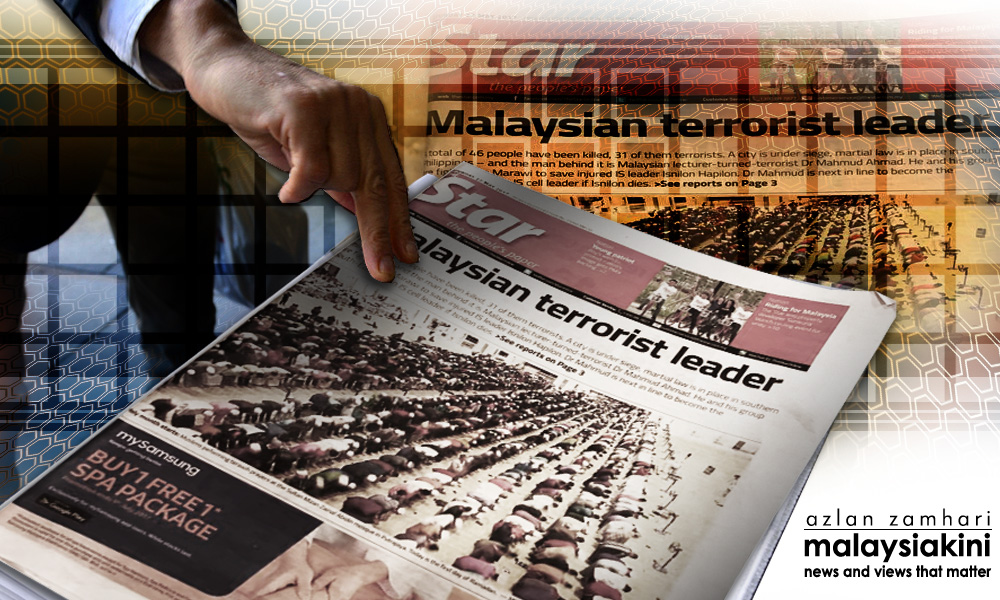

'The Star front page insensitive but not seditious'
The Star was "insensitive" for publishing a picture of Muslims praying and a headline reading "Malaysian terrorist leader" but this does not warrant an investigation under the Sedition Act, said Gerakan Hapuskan Akta Hasutan (GHAH).
"GHAH sees no need for police to commence criminal investigations against The Star because the daily has apologised...
"The publication was insensitive and unreasonable but GHAH believes that the Home Ministry need not investigate the matter under the Printing Presses and Publications Act or as a criminal matter under the Sedition Act," its coordinator Amir Abd Hadi said in a statement.
He added the Sedition Act is archaic and was an inherited legislation that did not originate from the Malaysian Parliament...
The Star was "insensitive" for publishing a picture of Muslims praying and a headline reading "Malaysian terrorist leader" but this does not warrant an investigation under the Sedition Act, said Gerakan Hapuskan Akta Hasutan (GHAH).
"GHAH sees no need for police to commence criminal investigations against The Star because the daily has apologised...
"The publication was insensitive and unreasonable but GHAH believes that the Home Ministry need not investigate the matter under the Printing Presses and Publications Act or as a criminal matter under the Sedition Act," its coordinator Amir Abd Hadi said in a statement.
He added the Sedition Act is archaic and was an inherited legislation that did not originate from the Malaysian Parliament.
As such, he renewed GHAH's call for Prime Minister Najib Abdul Razak to repeal the "draconian" Act as promised.
Inspector-general of police Khalid Abu Bakar this morning said the daily will be probed under the Sedition Act for inciting religious enmity.
The Home Ministry in a show-cause letter to The Star yesterday gave the daily seven days to convince the ministry why it should not be suspended.
The ministry also said it was "saddened" by the daily's front page.
Media advocates, however, condemned the state intervention and called for self-regulation.


