
MP wants Spad to clarify 'single-track' ECRL project
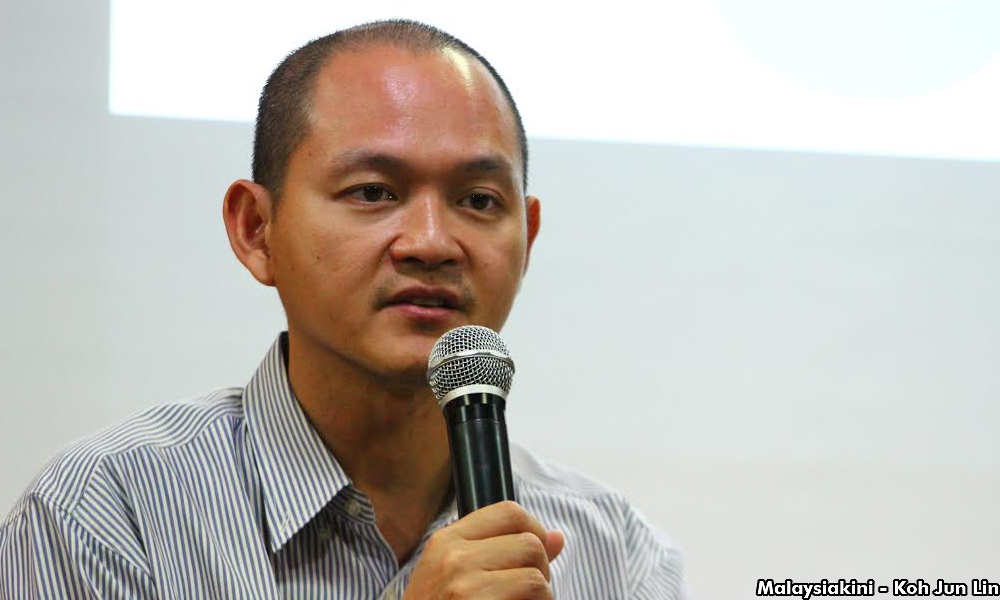
Serdang MP Ong Kian Ming has urged the Land Public Transport Commission (Spad) to clarify several issues regarding the East Coast Rail Link (ECRL) project.
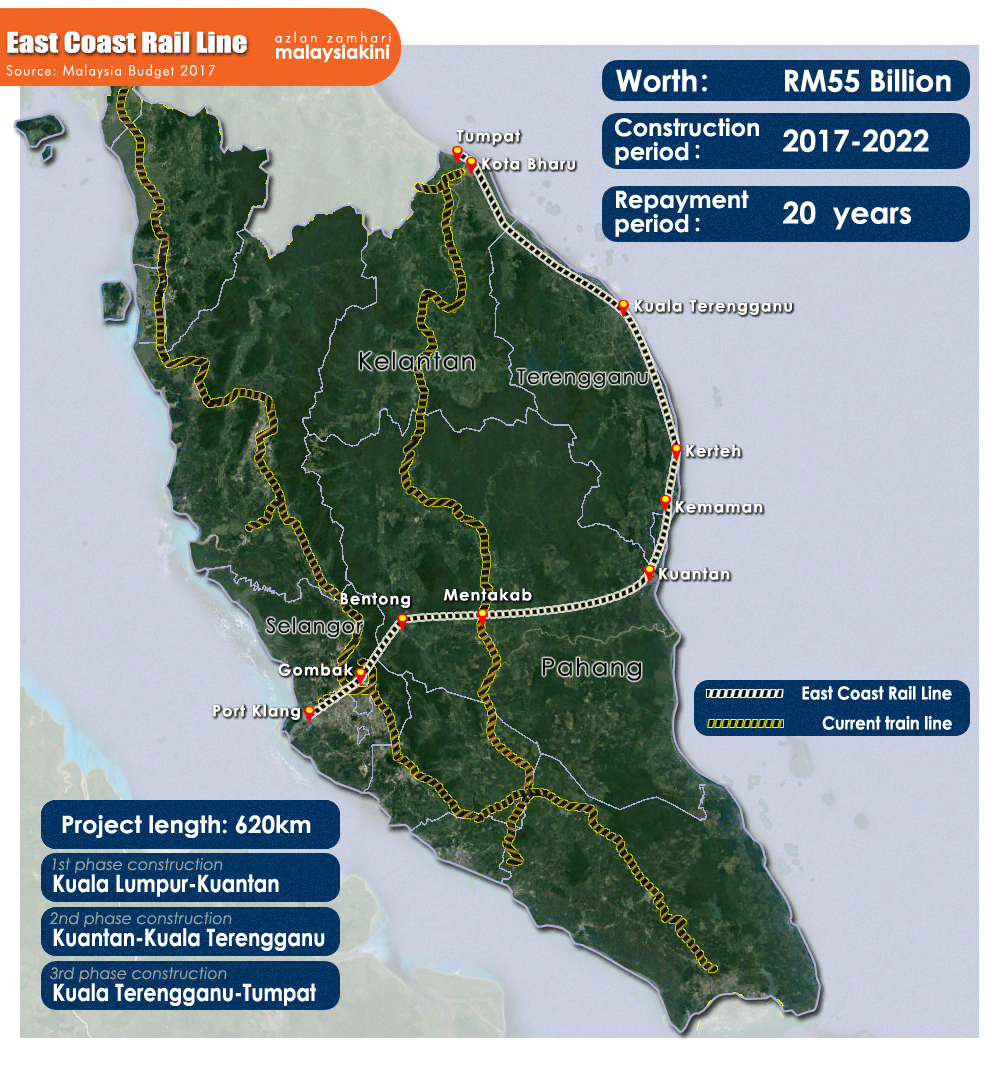
Among others, he asked why promotional materials for the project depict a double-track line, whereas the Environmental Impact Assessment (EIA) report for Phase One of the project appears to suggest that the ECRL project would comprise single-track rail lines.
In Section 5 of the report, it reads “The ECRL will be an electrified single track railway line built on a double track formation…”...
Serdang MP Ong Kian Ming has urged the Land Public Transport Commission (Spad) to clarify several issues regarding the East Coast Rail Link (ECRL) project.
Among others, he asked why promotional materials for the project depict a double-track line, whereas the Environmental Impact Assessment (EIA) report for Phase One of the project appears to suggest that the ECRL project would be single-track rail lines.
In Section 5 of the report, it reads “The ECRL will be an electrified single track railway line built on a double track formation…”
“Does this mean that only a single track will be built for the ECRL even though a railway base that is wide enough for two tracks will be built?
“If this is the case, then the government needs to explain why a project which costs an estimated RM55 billion will only pay for one track,” Ong said in a statement today.
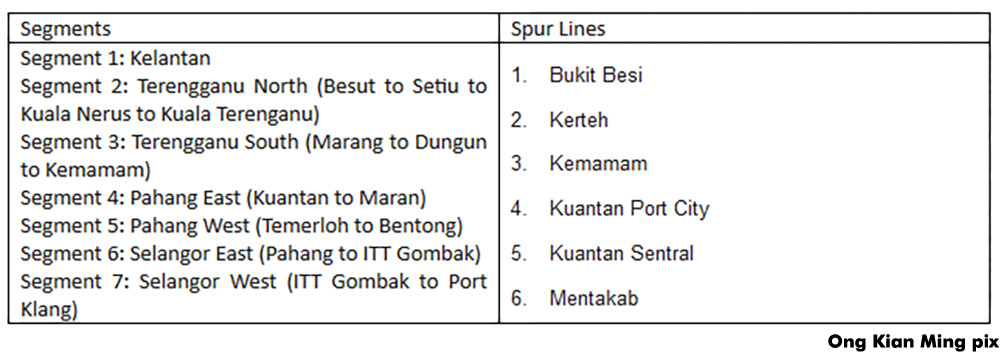
He also urged Spad to provide a detailed cost breakdown of each of ECRL’s seven segments and six spur lines, in addition to the cost of acquiring land for the project.
The EIA states that the project would require 8,699 plots of private land, covering 3,390 hectares. It also requires 2911.99 hectares of land that are owned by state governments, irrigation departments, or designated as roads, utility, or reserve land.
Ong pointed out that in a report by The Edge in November last year, the transport minister was quoted explaining that the ECRL’s increased price to RM55 billion was because the rail alignment is now lengthened to 600 kilometres, not including the Gombak-Port Klang segment that would be in Phase Two of the project.
When the supplementary agreement for Phase Two of the project was signed in Beijing last week however, New Straits Times quoted Malaysia Rail Link chairperson Mohd Irwan Serigar Abdullah saying Phase One costs RM46 billion, while Phase Two costs RM9 billion, hence bringing the total to RM55 billion.
“This contradicts what was said by Liow Tiong Lai. In the interest of transparency, the government should publish a detailed breakdown of the estimated cost of the entire ECRL, including the cost of the seven segments of the ECRL and the six spur lines,” he said.
Ong also claimed that the maps shown at SPAD’s public display on the ECRL project contradicted those mentioned by Minister in the Prime Minister’s Department Abdul Rahman Dahlan in November last year.
He pointed out that the minister had said that the project would require, among others, at least 110 kilometres of multiple bridges.
Studying the drawings at SPAD’s public display section-by-section however, he claimed that the drawings add up to 69 bridges with a total length of 17.7 kilometres, and 33 viaducts with a combined length of 74.6 kilometres.
“Therefore, the total length of bridges and viaducts (assuming that viaducts are also bridges) is 92.3 kilometres. There is a difference of 17.7 kilometres between Rahman Dahlan’s statement and our calculations based on the Spad public display drawings.
“A difference of 17.7 kilometres can translate into billions of ringgit of construction costs. This needs to be clarified by the government,” he said.
Ong also queried why the government was in a rush to sign the supplementary agreement on Phase Two of the project with the China Communications Construction Company (CCCC).
He said when Damansara Utama assemblyperson Yeo Bee Yin asked Spad last month why the Gombak-Port Klang segment was missing from Spad’s public display, Spad replied that the public display only showed segments that are ready for implementation, while Phase Two will be put on public display once due process is completed.
Ong said this raises the question why the agreement was signed, if due process has yet to be completed.