


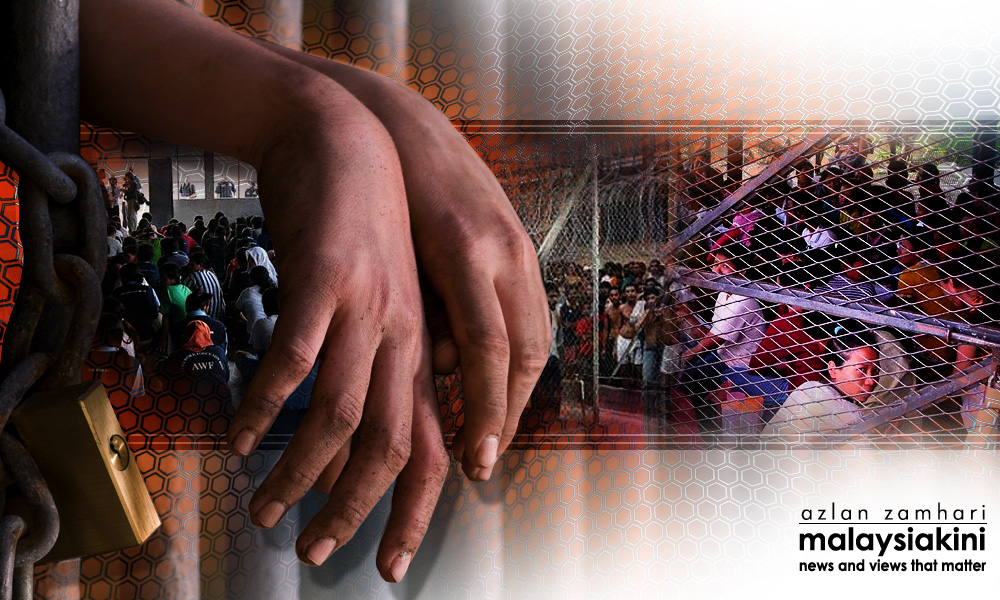

Brutality against migrants should spur us to act for change
COMMENT | The human rights aspect of this brutality alone should spur us to vigorous action and advocacy for change.
That said, we have seen that such language and concepts are not always helpful in effecting change among the powers that be.
International shame always helps though, so hopefully there will be more reports such as the one in The Guardian.
Perhaps the government can also be motivated to start seeing undocumented migrants as a resource, rather than a drain on resources.
These detainees are not militants like the one who invaded Sabah. Any of them found guilty of a crime not related to immigration would be in prison instead.
These are just normal everyday people who were forced to leave their lands of birth, probably at great cost to themselves, for the minute chance of earning enough to create a better life for themselves and their families.
As clearly demonstrated by the prevalence of cheap foreign labour in Malaysia, almost all of them are willing to work hard, and generate value in our economy.
Surely, if we are sincere in our intent, there must be some way to leverage this willingness in a mutually beneficial way economically?
Abusers poisoning their own families
One aspect of this crisis that is often overlooked is a hidden cost of allowing these abuses to continue.
The cost to the victims are obvious. Perhaps we too easily overlook the cost to the abusers and those around them as well.
Imagine working at one of these detention centres. From the accounts gathered, it sounds like there is scant chance of being a professional, engaged in dignified work and an honest living.
More likely, you are either engaged in abuse and exploitation, or complicit in it. After all, there is clearly no series of exposes or protests by detention guards about the actions of their colleagues, or the conditions in these camps.
We should consider what living like this is doing to these individuals, and to their families and loved ones around them.
One does not go to work in the morning, surround oneself with abuse, exploitation, rape and forcing other human beings to live in degrading squalor, and then come home unaffected, to lead a normal, healthy family life.
What you get instead is at best a damaged, dehumanised individual, and at worst, one who takes the practice of abuse home as well.
How many Malaysian men and women - immigration officers, police, prison guards, Rela members - are leaking poison into their families and the rest of Malaysia’s social fabric this way?
We owe it to them, as well, to put a stop to what is happening at immigration detention centres and elsewhere. Dehumanisation is never a process that only works in one direction...
COMMENT | The human rights aspect of this brutality alone should spur us to vigorous action and advocacy for change.
That said, we have seen that such language and concepts are not always helpful in effecting change among the powers that be.
International shame always helps though, so hopefully there will be more reports such as the one in The Guardian.
Perhaps the government can also be motivated to start seeing undocumented migrants as a resource, rather than a drain on resources.
These detainees are not militants like the one who invaded Sabah. Any of them found guilty of a crime not related to immigration would be in prison instead.
These are just normal everyday people who were forced to leave their lands of birth, probably at great cost to themselves, for the minute chance of earning enough to create a better life for themselves and their families.
As clearly demonstrated by the prevalence of cheap foreign labour in Malaysia, almost all of them are willing to work hard, and generate value in our economy.
Surely, if we are sincere in our intent, there must be some way to leverage this willingness in a mutually beneficial way economically?
Abusers poisoning their own families
One aspect of this crisis that is often overlooked is a hidden cost of allowing these abuses to continue.
The cost to the victims are obvious. Perhaps we too easily overlook the cost to the abusers and those around them as well.
Imagine working at one of these detention centres. From the accounts gathered, it sounds like there is scant chance of being a professional, engaged in dignified work and an honest living.
More likely, you are either engaged in abuse and exploitation, or complicit in it. After all, there is clearly no series of exposes or protests by detention guards about the actions of their colleagues, or the conditions in these camps.
We should consider what living like this is doing to these individuals, and to their families and loved ones around them.
One does not go to work in the morning, surround oneself with abuse, exploitation, rape and forcing other human beings to live in degrading squalor, and then come home unaffected, to lead a normal, healthy family life.
What you get instead is at best a damaged, dehumanised individual, and at worst, one who takes the practice of abuse home as well.
How many Malaysian men and women - immigration officers, police, prison guards, Rela members - are leaking poison into their families and the rest of Malaysia’s social fabric this way?
We owe it to them, as well, to put a stop to what is happening at immigration detention centres and elsewhere. Dehumanisation is never a process that only works in one direction.
Apathy, the worst abuse?
As the oft quoted saying goes, the only thing necessary for the triumph of evil is that good men (and women) should do nothing.
In this, the less we do, and the more we continue our apathy (something I know I have struggled with myself), the more equally complicit we are to the man or woman whose fists land on a helpless detainee.
The one way in which immigration detainees are worse off than, say most victims of abuse in police custody, is that they are so very far away from anyone who might even be able to show up and inquire about their well-being.
They are isolated and alone, with almost no one (save those few, overstretched brave men and women who have been fighting this fight for years) to speak up for them.
This, more than anything else, is what empowers their exploiters.
Will we change this reality? Or leave them helpless in the hands of their abusers?
Yesterday: Part I - Forgotten hellholes - horror abuses in immigration detention centres
NATHANIEL TAN is grateful for the efforts of organisations like Tenaganita, Suaram and the UNHCR in advocating for the rights and welfare of undocumented migrants. He is sure they could use your help.
The views expressed here are those of the author/contributor and do not necessarily represent the views of Malaysiakini.


