



One computer prodigy’s path to activism
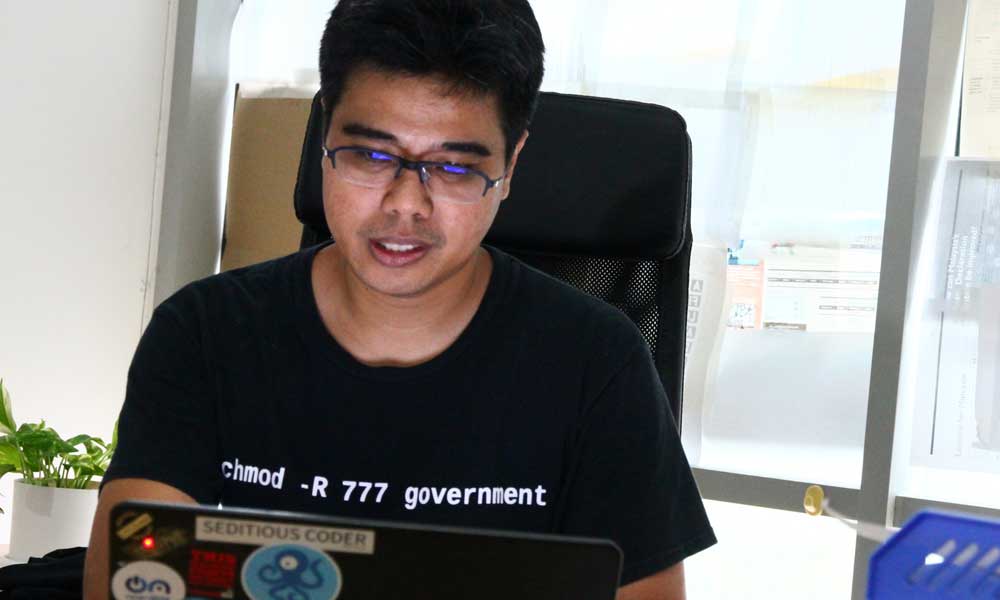
MALAYSIANS KINI | If one could judge a person by what he wears, few are more apt than the T-shirt that Sinar Project co-founder Khairil Yusof, 40, was wearing for his interview with Malaysiakini about a month ago.
It features one line of computer code. When translated into English, it roughly means: Give everyone the permission to read, write, and execute everything in the folder named ‘government’.
Despite how pervasive the Internet has become in our daily lives, Sinar Project is the only group working to promote civic technologies in Malaysia, and is also one of very few in Asia.
Its work includes monitoring online censorship in Malaysia, hosting cybersecurity workshops for journalists and activists, making parliamentary written replies available to the public, and making digital tools to promote government transparency and openness.
Despite its unique role, Sinar Project has run into funding issues that many other NGOs share, and Khairil is mulling to return to his former role as an IT consultant while keeping the project alive on a part-time basis.
Here, edited for concision and clarity, is Khairil’s story in his own words, as told from Sinar Project’s office in Subang.
MY FATHER WAS A DIPLOMAT, SO I GREW UP IN A WHOLE LOT OF DIFFERENT PLACES - India, Russia, and Australia. I was born in Johor, but when we were around in Malaysia, we were usually in Kuala Lumpur.
For example, I was only in a Malaysian primary school for Year Four, and then after Form One, I was in Australia already. I didn’t actually grow up in Malaysia. At least not for a long stretch.
Ever since I was a high school student, or even primary school student, I’ve always enjoyed doing different things. So I’ve enjoyed doing advanced maths, just as I enjoyed doing art, or graphics design, or sports.
Since I was a child, I didn’t feel that I was supposed to be constrained. Just enjoy any form of knowledge or interest, without being shoehorned into some specific area...
MALAYSIANS KINI | If one could judge a person by what he wears, few are more apt than the T-shirt that Sinar Project co-founder Khairil Yusof, 40, was wearing for his interview with Malaysiakini about a month ago.
It features one line of computer code. When translated into English, it roughly means: Give everyone the permission to read, write, and execute everything in the folder named ‘government’.
Despite how pervasive the Internet has become in our daily lives, Sinar Project is the only group working to promote civic technologies in Malaysia, and is also one of very few in Asia.
Its work includes monitoring online censorship in Malaysia, hosting cybersecurity workshops for journalists and activists, making parliamentary written replies available to the public, and making digital tools to promote government transparency and openness.
Despite its unique role, Sinar Project has run into funding issues that many other NGOs share, and Khairil is mulling to return to his former role as an IT consultant while keeping the project alive on a part-time basis.
Here, edited for concision and clarity, is Khairil’s story in his own words, as told from Sinar Project’s office in Subang.
MY FATHER WAS A DIPLOMAT, SO I GREW UP IN A WHOLE LOT OF DIFFERENT PLACES - India, Russia, and Australia. I was born in Johor, but when we were around in Malaysia, we were usually in Kuala Lumpur.
For example, I was only in a Malaysian primary school for Year Four, and then after Form One, I was in Australia already. I didn’t actually grow up in Malaysia. At least not for a long stretch.
Ever since I was a high school student, or even primary school student, I’ve always enjoyed doing different things. So I’ve enjoyed doing advanced maths, just as I enjoyed doing art, or graphics design, or sports.
Since I was a child, I didn’t feel that I was supposed to be constrained. Just enjoy any form of knowledge or interest, without being shoehorned into some specific area.
I think it is just my personality. I just have the curiosity for different subjects. If it is of interest to me, I would be interested in it.
I HAVE BEEN DOING PROGRAMMING SINCE PRIMARY SCHOOL. I’ve always grown up around computers and liking computers. I was about nine or ten-years’ old. At that time, I was in Moscow in an American school, but that was also about the time when hobbyist computers came out - Commodore 64, Atari, Apple IIe.
It was a time when if you wanted to use a computer, you’d have to learn how to program it. As a kid I just wanted to play games, so I’d just program games.
If you wanted to play a game, you’d have to read a magazine or something, and the magazine would usually have an example of how to create a game.
As a kid, I would type it out; not really know what I’m doing, but the motivation was that I wanted to play games. I ended up learning how to do some basic programming from those magazines.
My parents encouraged it. They bought the computer. I don’t think they had any knowledge of what I would do with, but it was more of an enabling environment, and I had an interest in it and kept playing with it.
SO AS I KEPT GROWING UP, MY SKILLS KEPT IMPROVING, because it is something I kept going. Then you’d see these movies where people are connected to the internet, and I also wanted to know how do I connect to the internet. How do I dial-up using the phones and so on.
Even back in high school, for example when I was in Australia, I was already trying to set up a bulletin board service, where people would dial-up and you would do a server that provides services like downloading images, documentation, or music.
I would tie up the house phone for hours on end while I was running the services at night. If you try to call my house at that time, the phone would probably be engaged because people were calling my house number to connect to this bulletin board service that I was running as a hobby.
I GRADUATED FROM THE AUSTRALIAN NATIONAL UNIVERSITY with a major in economics, history, and Asian Studies in 2000.
Immediately after graduating, I wasn’t really sure what I wanted to do. When I went to university, it was the Asian Financial Crisis and Australia had just come out of a recession. So in my mind, I was of this opinion that whatever my qualifications were, I might not be good enough to get a job.
But I still felt that I wanted to do something IT-related. I like computers, so I did find another start-up developing search engines. This was the Dotcom Boom of 2000, so basically most of the jobs at that time were IT start-ups. I was there for about eight months.
I CAN’T REMEMBER THE NAME OF THE START-UP. All I can remember was that the start-up founder got rich by writing - ironically enough - an employee surveillance program called Little Brother.
He thought Big Brother was too ominous, so he said that to make it a little less ominous, he made the software called Little Brother, which would basically be a tool for employers to monitor what their employees were doing.
So I find it ironic in the sense that I’m now doing a lot of things to counter surveillance and to increase privacy.
Around 2000, (then prime minister Dr Mahathir Mohamed) came up with the open source policy for Malaysia. He realised or was at least advised that for software, the Malaysian government should adopt open source software.
THIS WOULD LEAD TO THE NEXT PHASE OF MY CAREER.
You would have the agencies like the Malaysian Administrative Modernisation and Management Planning Unit (Mampu) pushing policy for adoption of open source in Malaysia, and this also led up to my next job in the UN Development Program (UNDP) because UNDP had an ICT for Development program. It was called the Asia Pacific Information Development Program (APIDP).
That was kind of my lucky break going from start-ups and small companies straight to the UNDP regional office. From just a person in Malaysia programming, I’m now advising countries on open source.
It was also where I picked up a lot of my skills - A lot of best practices, how to run a project, how to communicate, how to write position papers, how to get funding, how to build partnerships.
THE APIDP PROGRAM EVENTUALLY ENDED AROUND 2008. I was looking for a job, but I was also interested in bringing my skills back to Malaysia.
When I came back, I joined Mampu as a consultant. After my eight months at Mampu, I went back to my UN roots. A lot of the skills that I still had as well as the experience that I still had, I then did individual consulting for the International Labour Organisation for over six years. A lot of individual consulting on a lot different projects.
One of the things I’ve had problems with as a consultant was that you’re doing somebody else’s projects, but not in Malaysia itself and it is always doing the best for somebody else’s project.
After 2011 or so, I started wanting to see if there is a way to do this in Malaysia, and to do my own project or initiatives.
That feeling was there, but I’m not sure what it was yet.
UP UNTIL THIS STAGE, I WAS NOT AN POLITICALLY ACTIVE PERSON. I did stuff at the international level - policy, fighting corporate lobbyist, and what not. But it was not on a political or activism level. At least not at the local level.
I didn’t know who my MP was, just like your typical Malaysian who is not aware of what’s happening. But in 2011, the Computing Professionals Bill (CPB) draft was leaked.
The CPB would create a law that would dictate how an IT person can or cannot do work – you’d have to be registered as a professional, you’d have to have specific qualifications before you can or can’t do something, and that resonated quite strongly with me because I was one of those people who doesn’t have qualifications in IT.
That’s when I started getting more involved in understanding what the government is doing and what are my rights as a Malaysian citizen to deal with this sort of things.
Should I go and protest, for example? A lot of IT people did.
What we learnt from that is that if there is enough of a protest, and organised support from industry groups and what not, you can actually overturn an unpopular bill before it is passed.
SOON AFTER THE CPB THING HAPPENED, BERSIH 2 HAPPENED. I think that’s the watershed moment when I became committed to doing more.
One of the interesting about tear gas was that I realised it is actually an act of violence. It is somebody hurting you. So after that, one of the things that is still in my mind was how do I hit back at the people who hit me, without using violence.
Me, (Sinar Project co-founder) Ng Swee Meng, and I think there were a couple of other people basically sat together and started thinking: What can we do as IT people?
A lot of things we are doing now in Sinar was kind of discussed over at a mamak table. It was a very Malaysian thing, at a mamak shop in Bangsar, talking on the things that we’d probably need to do in order to get all these people, to get justice, or at least accountability.
AFTER THAT, THERE WAS AN EVENT CALLED GEEKCAMP.MY. It was an unconference. (An unconference is a conference where the topics are decided by the participants rather than the organisers). I got to learn that a lot of other IT people were also there at Bersih, so that’s kind of the core community of Sinar Project, I guess.
We were discussing the name... That was when some of us who were already from the open source world so we already have a community of tech people. We were discussing what should we call this initiative.
It had to be Malaysian. The thought of shining light, transparency, and whatnot, and Sinar became the name of the project. So it was called Sinar Project because it was not an NGO or anything. It was a little project codename that we were all going to work on together.
THAT WAS THE START OF OUR VOLUNTEER PROJECTS, I think for a period from 2011 to 2012. We spent our weekends on it, sometimes our public holidays, building different tools.
That’s when we found out at the encouragement of some of my ex-colleagues that there is actually funding to do these things. It was called the Information Society Innovation Fund Asia. They were very tech-focused, so they understood what we were doing, and they had funding for successful projects to do things like rights - using technology for rights.
We were successful in getting this, and that’s when we have our initial seed funding. It was an additional USD28,000 to spend more effort trying out all these different tools or ideas that we have, to prototype them. It ended up being really successful.
If you do projects voluntarily and you keep sacrificing your weekends, it really weighs you down after a while. Being able to do this part time while being paid really kept the project going, and we ended up winning an award on the next year for our project.
AT THE AWARDS CEREMONY IN TURKEY, that’s when I met with one of our potential donors. This was called Hivos, a Netherlands-based humanitarian NGO, and they have a program in Southeast Asia called Tech for Asia supporting exactly the thing we’re doing as well, but their funding was a little more substantial.
I think we got US$75,000 or so for that grant. That was actually enough for us to have a go at it. They gave us enough funding for six months to have a go at starting an NGO and do this full-time.
We also realised from that grant that, hey, there is possibly enough grants to keep doing this full time as an NGO. That’s when I started to assemble the team that you see at Sinar.
IT WAS A BIT OF A LEAP AT THAT TIME. A lot of people including our donors were like, ‘Wow, you guys are taking a leap of faith by quitting your jobs to start an NGO with only six months of funding.’
But for me, I can’t have all that experience that I’ve had at UN and so on be wasted. I think I should have a go at this, and see if we can do an NGO in Malaysia, taking all the experience that I have from before, doing it now as my project, for Malaysia, instead of doing somebody else’s project.
That’s where Sinar started coming in. That’s the Sinar that you know now.
For some time after that, we got enough project funding to keep doing what we were doing continuously getting more impact, more exposure.
Then our work results would get recognised around the region, as well as internationally, because it is kind of unique to have an NGO that does rights, but is also heavily tech-focused as you can see from this office - servers everywhere.
THE COMMON PROBLEM WITH NGO FUNDING is that you’d go project-by-project, or grants, but what you need for sustainability is what you’d call core funding.
Core funding is basically the funding for the amount of funds you’d need to keep everybody employed, let’s say for the whole year, full time, to pay the rent, to pay the bills, without worrying on a project-by-project basis.
So if you have the core funding, then you can apply for the projects and do projects well without the stress of chasing each project one-by-one. So the problem has always been to be able to get enough core funding.
SO THE SITUATION THAT WE’RE NOW IN, we are running short on funds and we’re not sure about where our next funding is coming. It is actually not a new situation, it’s just that we’ve overcome it before, but doing it continuously just puts too much of a strain.
The uncertainty... Is this project coming in or not? Can we last a month or two without income while waiting for the next project? It’s just too much of a strain on the team.
We’ve realised that, no, we need to go back and tell everybody that, no, we can’t do this as three people. Sinar needs to be a proper NGO with proper funding, and donors can’t keep expecting us to keep doing things on a project-by-project basis.
LUCKILY FOR US, we did get some core funding from AccessNow, which is an international digital rights group based in the US. They were able to give us some core funding.
It’s not much, it’s about US$40,000 this year. That only covers the salary of two people for six months in the office.
Right now, we don’t have the bulk of the activated population like the US to get enough core funding from the public. Most likely for us to continue, we’re going to need to depend on core funding from foreign donors.
It does buy us time, in which we’re able to focus on how to we raise core funding for the next six months, or even the next few years.
Those things are not that fast. It takes time to apply for much larger grants.
SO WE’RE HOPING THAT THAT WILL HAPPEN. We are always eternally hopeful that we will be able to get core funding before our time runs out.
But at same time, we’ve done this before as part-time back in 2011, so we do know that there are ways that we can keep certain things going at the most minimum level - going back to doing it part-time, keeping some essential services on the most minimum, such as running the servers out of our houses.
We’ve thought about the worst-case scenario - how to keep things going until such a time when things might be better, as well the best-case scenario where we do get institutional funding for the next three years or so.
That would allow us to grow and plan over three years instead of going project-by-project.
Malaysians Kini is a series on Malaysians you should know.
Previously featured
Doctor bids to destigmatise mental illness
The ‘Puan Sri’ who fights for the environment
I’m no freak, says ‘outsider artist’ Rahmat Haron
The real 'Tauke' of Malaysian football
Zunar - the makings of Malaysia’s most dangerous cartoonist
Gerai OA empowering Orang Asli women through craft
How four teens cook up a solution for food wastage
Organic farmer now lighting up Borneo's interiors


