


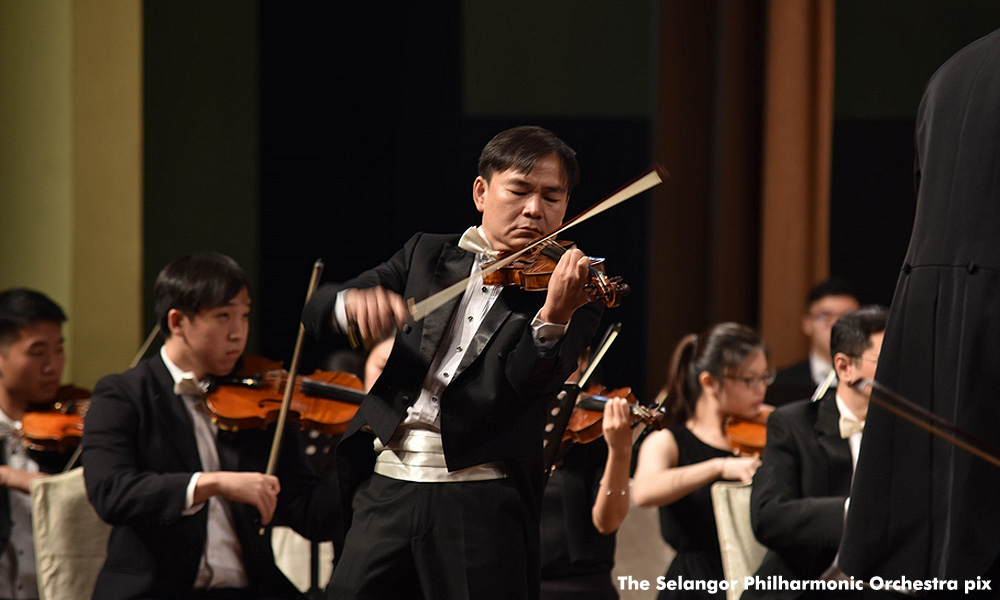

A musical interlude - the Selangor Philharmonic Orchestra
INTERVIEW This is a departure for me and hopefully there will be many more. What I am attempting to do with these series of articles is highlight the contributions of Malaysians when it comes to culture and art in this country. I am especially interested in projects and organisations that nurture young talent.
Please feel free to contact me through Malaysiakini, if you want to talk about what your organisation is doing in creating an environment where people express themselves. It can be anything from traditional dance, photography, anything - even specific religious or cultural - endeavours that contribute to Malaysian culture.
We kick off this series with an interview with Chan Ling Chee, the founder and music director of the Selangor Philharmonic Orchestra (SPO). Having seen the young performers at work, I am impressed by the passion and yes, the talent that Chan and his team have managed to harness.
Young people join the SPO for a variety of reasons and not all of them see the organisation as a stepping-stone to a professional career.
As one young musician said, “Fact is, the majority of musicians want to have a career in music. But for me the answer is no. I very much enjoy being a musician by weekend/night and a having a professional career by day. I find that my day job is what supports my musical activities. And I would like to keep my musical interest as a hobby which keep me happy and passionate.”
Another young participant describes the ethos of the SPO - “SPO is a non-profit organisation, we don’t play music for money but to enjoy the music. We share the music with others and to let people know that classical music isn’t just an old music but music to stick all of us together.”
INTERVIEW This is a departure for me and hopefully there will be many more. What I am attempting to do with these series of articles is highlight the contributions of Malaysians when it comes to culture and art in this country. I am especially interested in projects and organisations that nurture young talent.
Please feel free to contact me through Malaysiakini, if you want to talk about what your organisation is doing in creating an environment where people express themselves. It can be anything from traditional dance, photography, anything - even specific religious or cultural - endeavours that contribute to Malaysian culture.
We kick off this series with an interview with Chan Ling Chee, the founder and music director of the Selangor Philharmonic Orchestra (SPO). Having seen the young performers at work, I am impressed by the passion and yes, the talent that Chan and his team have managed to harness.
Young people join the SPO for a variety of reasons and not all of them see the organisation as a stepping-stone to a professional career.
As one young musician said, “Fact is, the majority of musicians want to have a career in music. But for me the answer is no. I very much enjoy being a musician by weekend/night and having a professional career by day. I find that my day job is what supports my musical activities. And I would like to keep my musical interest as a hobby which keep me happy and passionate.”
Another young participant describes the ethos of the SPO - “SPO is a non-profit organisation, we don’t play music for money but to enjoy the music. We share the music with others and to let people know that classical music isn’t just an old music but music to stick all of us together.”
Hard work behind the scenes
However, there is hard work that goes on behind the scenes, made difficult by the reality that classical music is not as widely appreciated as it is in other countries.
As Chan says, “As a non-profit organisation, the SPO has limited resources to pursue its objectives. To date, it has been the community and local government's support which has enabled the SPO to continue training our young musicians, supporting them through the provision and maintenance of musical instruments, venue rental fees, and concert event expenses.
“Concert admission tickets have been kept low in keeping with SPO’s core objective of promoting and spreading the beauty of classical music. We hope to be able to build additional partnerships with like-minded people and organisations - this has been rather challenging in the difficult economic climate in which local companies are operating. Support for the arts tends to be set aside quickly during budget cuts.”
I began by asking Chan how music came into his life.
“I started around eight years old on the piano, later the cello at the age of 16. Mr Lam Siu Chong saw my potential and started training and later introduced to me the cello as the orchestra back then needed a cellist. Before playing the cello in the orchestra, I was in the percussion section.
“Due to family conditions back then, I started teaching music and studying music at the same time, taking external exams. I began to immerse myself more in orchestra music. I also participated in other orchestras under many different conductors. Later on, I took up the baton (conductor). At the time, I was simultaneously teaching piano, cello and double bass and training both performing students and teachers too.”
In its official website, the SPO says, under your guidance the SPO has grown substantially. Could you describe your efforts in expanding the SPO to what it is today?
“Substantially here, means in numbers. SPO’s Chapter 1 concert staged around 50 musicians and Chapter 9 around 90 musicians. Of course, over the years, players come and go mainly due to their studies and work. I try extending invitations to various musicians by telling them about the SPO and the works we have played and are playing, some come in through friends’ recommendations and some inquire after SPO performances.”
In your opinion, how does the SPO contribute to nation-building?
“Most players are from high schools, colleges, and young working adults. Through weekly rehearsals, SPO becomes a training ground for these musicians. Through playing in an orchestra, discipline, commitment and responsibility are instilled. Leadership position and opportunities are also given to them to encourage responsibility and commitment towards the orchestra.
“They learn the most when they are asked to take part in organizing concerts. Not only do they learn playing music together but they also learn to reach out the outside world. I believe after organising concerts, these students will not easily succumb to peer pressure and are equipped to work in the real world.”
What values do these young performers learn from the SPO?
“SPO’s emphasis on classical music builds requires patience, persistence and discipline. We also emphasise on teamwork among students.”
How do students and parents contribute to the development of the SPO?
SPO activities include non-musical tasks like treasury work, library maintenance, setting up the place before and after rehearsals, that is shared amongst the players. Parents also come in to help mostly in organizing concerts. For the younger players that need transportation to rehearsal, parents play an important role to ferry them back and forth.”
Supposing a young person has an interest in music but has no experience or training, how does the SPO handle such students?
“SPO does have criteria for musicians who seek to join, example;
SPYouthO - Minimum a grade 3 level
SPO - Minimum a grade 6 level
“‘New’ players will be under observation for a month. Sometimes, opportunities arise that give new musicians the experience of concert pressures which can accelerate learning. SPO does not accept any ‘total new beginner’ for any instruments.”
Why do you believe that classical music is relevant in this day and age?
“There are many elements to look into when playing classical music compared to modern music such as intonations, phrasings, rubato, balancing, projection to mention a few. The players also need to look at the conductor and respond to conductor movements. One of the fundamental aspect of orchestral play is teamwork, which is perennially relevant in most form of organised music.”
There is this perception that classical music and performances are elitist. How do you change this perception?
“Slowly. Patiently. Sharing generously our love of beautiful music to anyone who cares to listen but most importantly teaching new generations. The first two of SPO’s explicit visions and goals are relevant;
(1) Promoting and spreading the beauty of classical music in Selangor;
(2) Educating and training young musicians to appreciate large-scale performance and organisation.
“As SPO is a community orchestra, players tend to come in and out due to studies and work. Therefore, it will take relatively longer to attain the standard of a professional orchestra whose members are paid. In fact, I train the SPO most of the time, more than I conduct.
“What organisations like the SPO need beyond state and federal funding is the support of the community they cater to. What I like about the SPO is that they are a group of people who are sincerely interested in spreading their love of classical music but also putting in the required hard work for an organisation that is essentially self-funded with the help from the most unlikely of private donors.”
Please refer to their official website for more information about their performances or how you could contribute.
S THAYAPARAN is Commander (Rtd) of the Royal Malaysian Navy.


