




How to study Johor’s ‘Forest City’
I have been following the exchange of ideas between Dr Mahathir Mohamad and the Sultan of Johor on Johor’s ‘Forest City’; on whether the project is about progress and growth of a region and promoting multiculturalism as claimed by the sultan, or about selling off Johor to a foreign country, a profit-driven venture going against the spirit of nationalism, and benefitting those who own the capital to dictate the process of national development.
It is a cultural and political-economic issue and will be the main focus of Malaysia’s general election #14, analysts believe, as reported.
But how are we to know if Johor’s ‘Forest City’ is good for the country or a major developmentalist-virus that will threaten sovereignty, and one carried out willingly by the kingdom’s decree, to destroy the country? Central questions these are, I believe we should ask.
Herein, I believe we need the tools of studying the nature of this form of ‘mega structural change’ to decide whether to believe the claims made by the present multi- mega-billionaire Sultan of Johor or the former longest-serving and still well-revered former prime minister of Malaysia, Dr Mahathir.
I hope at the end of this essay, the ideas can be used by policy-makers and opinion leaders to study the sustainability of an idea as it gets transplanted onto a nation-state/country subscribing to the neo-liberal ideas of how to ‘develop’ its people, places, and resources.
About a decade ago, I studied the genesis of Cyberjaya and Putrajaya; with cities created by the then-prime minister, Dr Mahathir. It culminated in a doctoral dissertation/thesis entitled ‘Thesis on Cyberjaya: Hegemony and Utopianism in a Southeast Asian state’, submitted to Columbia University in the city of New York.
I wanted to find out how the implantation of the city of Cyberjaya, especially, is a form of neo-colonialism architecture by Dr Mahathir, a staunch anti-Western-Buy-British-Last-Look-East type of leader. Mahathir wanted to fully-cybernate the country and invited a panel international advisors essentially from Silicon Valley, California, USA to advise him how to catapult Malaysia into the Information Age.
How successful Cyberjaya and the Multimedia Super Corridor (The MSC) today is still being studied and debated of the impact of such a transplantation of a Western-based foreign idea.
The findings of the study allowed me to present a table of explanation on how hegemonic formulations and possible form of total colonisation and the setting up of a centre-periphery nation can be analysed.
The idea of cybernetics as it progresses from its philological roots in the idea of the explanation into the behaviour of living systems onward to its evolution as a systems theory to its appropriated and hybridised version in the case of Malaysia’ Cyberjaya and the MSC, is an example of an idea that can be analysed as a transcultural process. I analysed Cyberjaya and the MSC as a genealogy.
I have been following the exchange of ideas between Dr Mahathir Mohamad and the Sultan of Johor on Johor’s ‘Forest City’; on whether the project is about progress and growth of a region and promoting multiculturalism as claimed by the sultan, or about selling off Johor to a foreign country, a profit-driven venture going against the spirit of nationalism, and benefitting those who own the capital to dictate the process of national development.
It is a cultural and political-economic issue and will be the main focus of Malaysia’s general election #14, analysts believe, as reported.
But how are we to know if Johor’s ‘Forest City’ is good for the country or a major developmentalist-virus that will threaten sovereignty, and one carried out willingly by the kingdom’s decree, to destroy the country? Central questions these are, I believe we should ask.
Herein, I believe we need the tools of studying the nature of this form of ‘mega structural change’ to decide whether to believe the claims made by the present multi- mega-billionaire Sultan of Johor or the former longest-serving and still well-revered former prime minister of Malaysia, Dr Mahathir.
I hope at the end of this essay, the ideas can be used by policy-makers and opinion leaders to study the sustainability of an idea as it gets transplanted onto a nation-state/country subscribing to the neo-liberal ideas of how to ‘develop’ its people, places, and resources.
About a decade ago, I studied the genesis of Cyberjaya and Putrajaya; with cities created by the then-prime minister, Dr Mahathir. It culminated in a doctoral dissertation/thesis entitled ‘Thesis on Cyberjaya: Hegemony and Utopianism in a Southeast Asian state’, submitted to Columbia University in the city of New York.
I wanted to find out how the implantation of the city of Cyberjaya, especially, is a form of neo-colonialism architecture by Dr Mahathir, a staunch anti-Western-Buy-British-Last-Look-East type of leader. Mahathir wanted to fully-cybernate the country and invited a panel international advisors essentially from Silicon Valley, California, USA to advise him how to catapult Malaysia into the Information Age.
How successful Cyberjaya and the Multimedia Super Corridor (The MSC) today is still being studied and debated of the impact of such a transplantation of a Western-based foreign idea.
The findings of the study allowed me to present a table of explanation on how hegemonic formulations and possible form of total colonisation and the setting up of a centre-periphery nation can be analysed.
The idea of cybernetics as it progresses from its philological roots in the idea of the explanation into the behaviour of living systems onward to its evolution as a systems theory to its appropriated and hybridised version in the case of Malaysia’ Cyberjaya and the MSC, is an example of an idea that can be analysed as a transcultural process. I analysed Cyberjaya and the MSC as a genealogy.
Ideological migration
In the table below I presented the parts of the tool for analysing hegemonic ideas that have history and consequences. I call the strategy “tool of analysis for trans-cultural flow of ideas” to highlight the idea of ideological migration from one cultural system to another and to analyse it as a phenomena of social change that has its roots and consequences in the social relations of production.
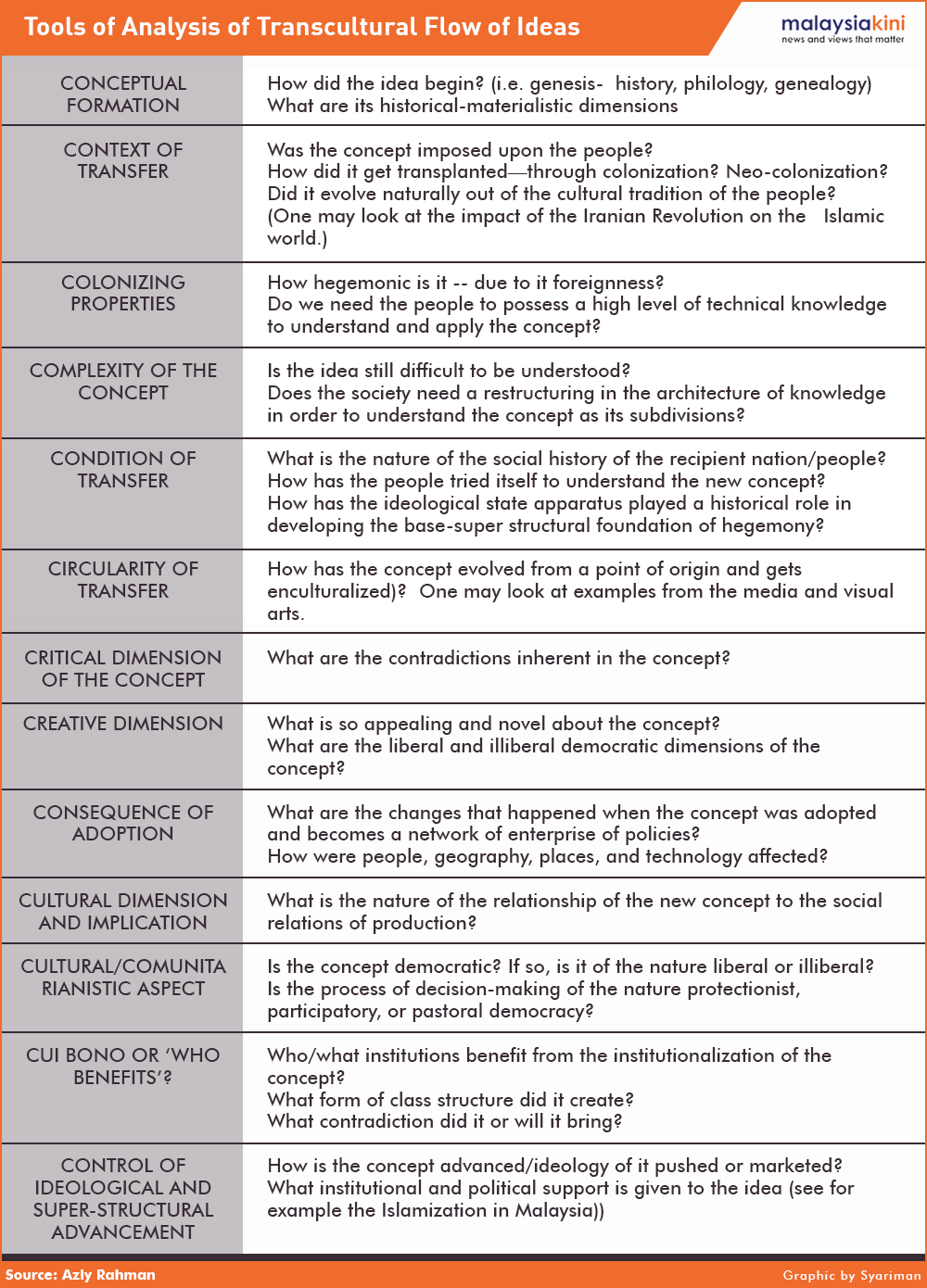
Those are the questions we need to study Johor’s ‘Forest City’. They form the set of critical questions in defining the nature of colonialism that may be emerging from the much-talked-about ‘Forest City’.
The most important consideration in a country’s adoption of new technology, concept, culture, and social engineering is always to question the meaningfulness to those affected. How will it affect the people and the environment and what kind of decision making is involved. Does development mean “development of the people, by the people, for the people” or for huge profits alone without thinking of the human and ecological consequences.
I hope these notes help for the Sultan of Johor and Dr Mahathir as key figures in the emerging national dialogue on the ‘Forest City’. I believe we can help the nation engage in the discussion on the future of the country and to help us distinguish the forest from the trees, in this critical mega dialogue on Johor’s ‘Forest City’.
Aren’t we not a nation rooted in analytical thinking and rational thoughts - rather than emotional outbursts founded upon feudalism and modern dictatorship and autocracy?
DR AZLY RAHMAN grew up in Johor Baru, Malaysia and holds a Columbia University (New York City) doctorate in International Education Development and Masters degrees in the fields of Education, International Affairs, Peace Studies and Communication. He will be pursuing his fifth Masters in Fine Arts, specialising in Fiction and Poetry Writing. He has taught more than 50 courses in six different departments and has written more than 350 analyses/essays on Malaysia. His 25 years of teaching experience in Malaysia and the United States spans over a wide range of subjects, from elementary to graduate education. He has edited and authored six books; Multiethnic Malaysia: Past, Present, Future (2009), Thesis on Cyberjaya: Hegemony and Utopianism in a Southeast Asian State (2012), The Allah Controversy and Other Essays on Malaysian Hypermodernity (2013), Dark Spring: Essays on the Ideological Roots of Malaysia's General Elections-13 (2013), a first Malay publication Kalimah Allah Milik Siapa?: Renungan dan Nukilan Tentang Malaysia di Era Pancaroba (2014), and Controlled Chaos: Essays on Mahathirism, Multimedia Super Corridor and Malaysia’s ‘New Politics’ (2014). He currently resides in the United States where he teaches courses in Education, Philosophy, Cultural Studies, Political Science, and American Studies. His forthcoming book, One Malaysia, under God, Bipolar, a joint project between Gerakbudaya and World Wise Books of New Jersey, USA, is his seventh compilation of essays on Malaysian Cultural, Creative, and Critical Studies. He is currently working on his eighth book, on Gifted and Talented Education in Malaysia, honouring a prominent educator. Twitter, blog
The views expressed here are those of the author/contributor and do not necessarily represent the views of Malaysiakini.


