


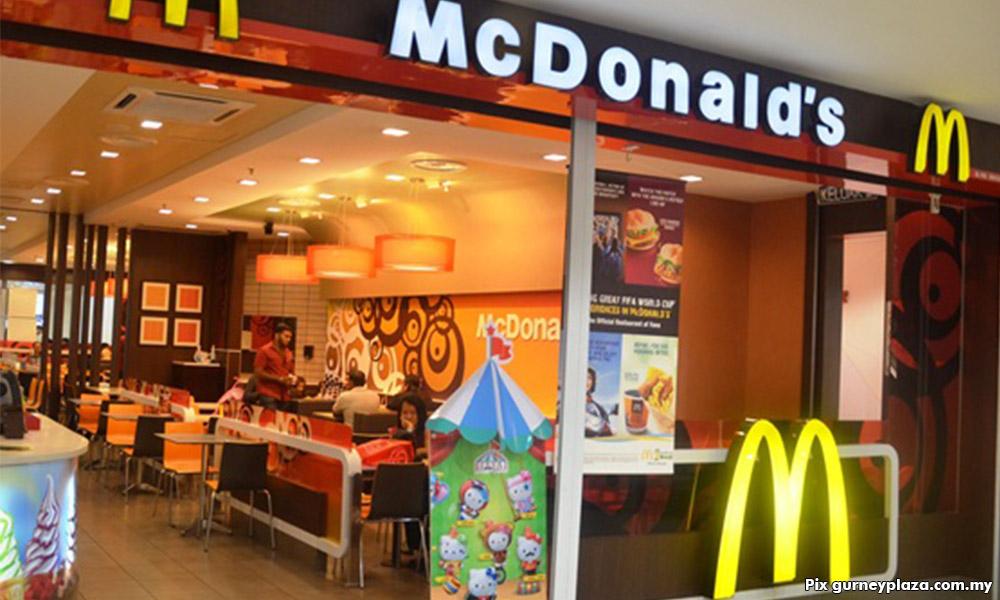

Why a McDonald’s boycott is misplaced
COMMENT I have several enduring childhood memories, and among them was sitting in the freezer in the McDonald’s outlet at Ampang Park during my brother’s birthday party.
He had turned either three or four, and us kids lined up eagerly to enter the great unknown - a fast food joint’s cold room.
For what felt like an eternity, we sat in there mostly in silence, pondering our fates in the almost pitch dark amid rock hard burger patties, wondering what we got ourselves into.
That is until the restaurant manager cracked open the heavy door, probably mere minutes after, and ushered the stream of bewildered children in party hats through the kitchen back to the party where the cake awaited.
I don’t remember what cake it was, which is a shame because I know my mother would always let us pick some special cake for our birthdays.
What I do remember was my brother howling his heart out. The restaurant manager tried to be funny and covered the candles with his hand each time the kid tried to blow them out. By the third time, out came the water works. Needless to say, my brother wasn’t lovin’ it (cue: groans).
I am guessing not many children will have the same memories I did, now that many are urging a boycott against McDonald’s Malaysia.
This was prompted by the fast food chain’s decision not to allow cakes at birthday parties, unless the cakes are halal-certified.
The popular burger chain said this was to adhere to its own halal certification requirements. All its outlets are certified halal by the Islamic Development Department of Malaysia (Jakim) and allowing outside food could jeopardise that, it said.
It said it was making an exception for outside food in the form of cakes for birthday parties - but to keep its own halal label, it needed to make sure those cakes are also halal.
In a bind
It’s a strange ruling for the simple reason that not many cakes are actually halal-certified.
Don’t get me wrong - not all cakes are halal. Some cakes are baked using alcohol (tiramisu, black forest, fruit cake, etc), others with lard (yes, lard cakes do exist, Google it) - neither of which are permissible for Muslims to consume.
Most cakes, however, are simply combinations of sugar, butter and flour, and most bakers will make clear if a cake contains alcohol. Cakes for children’s birthday parties, too, are unlikely to contain alcohol.
But even if cakes are baked with halal ingredients, it is not every day that you find a bakery that has halal certification. And the last I checked, neither does my mother’s kitchen.
Halal certification is cumbersome and expensive, according to the Muslim Consumers’ Association and cabinet minister Ismail Sabri Yaakob, who urged for a way to allow Muslim-owned small-to-medium enterprises with little capital to spare, to circumvent the strict requirements.
It is the same strict requirements that are now putting McDonald’s in a bind.
“But my kid’s birthday cake is not for everyone else to eat!” decried one angry parent who no doubt had visions of a grand McDonald’s birthday party for the little boy sometime this year.
True, but by allowing outside food into its premises, McDonald’s is risking the certificate it went through hurdles to get.
Jakim’s guidelines for halal certification is clear on this. Item 5.5 (v) of Jakim’s Manual Procedure for Malaysia Halal Certification states: “Non-halal food/ beverages are not allowed to be brought into the premise compound.”
“What about the ringgit notes which my non-halal hands touched after I ate pork? What about my non-halal breath?” other incredulous (now ex) McDonald’s patrons decried...
COMMENT | Strict Jakim rules puts McDonald’s in a bind but it can’t have its cake and eat it, too.
COMMENT I have several enduring childhood memories, and among them was sitting in the freezer in the McDonald’s outlet at Ampang Park during my brother’s birthday party.
He had turned either three or four, and us kids lined up eagerly to enter the great unknown - a fast food joint’s cold room.
For what felt like an eternity, we sat in there mostly in silence, pondering our fates in the almost pitch dark amid rock hard burger patties, wondering what we got ourselves into.
That is until the restaurant manager cracked open heavy door, probably mere minutes after, and ushered the stream of bewildered children in party hats through the kitchen back to the party where the cake awaited.
I don’t remember what cake it was, which is a shame because I know my mother would always let us pick some special cake for our birthdays.
What I do remember was my brother howling his heart out. The restaurant manager tried to be funny and covered the candles with his hand each time the kid tried to blow them out. By the third time, out came the water works. Needless to say, my brother wasn’t lovin’ it (cue: groans).
I am guessing not many children will have the same memories I did, now that many are urging a boycott against McDonald’s Malaysia.
This was prompted by the fast food chain’s decision not allow cakes at birthday parties, unless the cakes are halal-certified.
The popular burger chain said this was to adhere to its own halal certification requirements. All its outlets are certified halal by the Islamic Development Department of Malaysia (Jakim) and allowing outside food could jeopardise that, it said.
It said it was making an exception for outside food in the form of cakes for birthday parties - but to keep its own halal label, it needed to make sure those cakes are also halal.
In a bind
It’s a strange ruling for the simple reason that not many cakes are actually halal-certified.
Don’t get me wrong - not all cakes are halal. Some cakes are baked using alcohol (tiramisu, black forest, fruit cake, etc), others with lard (yes, lard cakes do exist, Google it) - neither of which are permissible for Muslims to consume.
Most cakes, however, are simply combinations of sugar, butter and flour, and most bakers will make clear if a cake contains alcohol. Cakes for children’s birthday parties, too, are unlikely to contain alcohol.
But even if cakes are baked with halal ingredients, it is not every day that you find a bakery that has halal certification. And the last I checked, neither does my mother’s kitchen.
Halal certification is cumbersome and expensive, according to the Muslim Consumers’ Association and cabinet minister Ismail Sabri Yaakob, who urged for a way to allow Muslim-owned small-to-medium enterprises with little capital to spare, to circumvent the strict requirements.
It is the same strict requirements that are now putting McDonald’s in a bind.
“But my kid’s birthday cake is not for everyone else to eat!” decried one angry parent who no doubt had visions of a grand McDonald’s birthday party for little boy boy sometime this year.
True, but by allowing outside food into its premises, McDonald’s is risking the certificate it went through hurdles to get.
Jakim’s guidelines for halal certification is clear on this. Item 5.5 (v) of Jakim’s Manual Procedure for Malaysia Halal Certification states: “Non-halal food/ beverages are not allowed to be brought into the premise compound.”
“What about the ringgit notes which my non-halal hands touched after I ate pork? What about my non-halal breath?” other incredulous (now ex) McDonald’s patrons decried.
Well, happily for halal-cert holders and the rest of us, ringgit notes and “breath” may very well be a new trendy food fad in the future but for now, they are not “food or beverages”.
The birthday cake risk
Is a little kid’s birthday cake such a major risk for a big player like McDonald’s? Logic would dictate McDonald’s should take a chill pill, but recent experiences faced by the firm may indicate why the fast food chain is being so careful.
In 2013, a viral message claiming its burgers contain traces of pork forced both McDonald’s and Jakim to issue a statement rebutting the matter. The viral message continues to circulate, causing the outlet to continue to firefight each time the matter gains traction over the years.
Similarly, in 2014, franchises reported lower sales while delivery personnel, even children of staff suffered verbal and physical abuse following urgings for boycott by Muslims claiming McDonald’s donates part of its profits to support violence against Palestinians. More than two years later, McDonald’s Malaysia continues to refute the allegations.
A Universiti Teknologi Malaysia study published 2011 found that halal status and food safety is the top two influencing factors for Malays when choosing fast food.
A UiTM study published in 2014 found fast food consumption to be higher among urban Malays compared to other ethnicities. Other studies suggest the trend is growing.
McDonald’s holds 40 percent of the fast food market, behind KFC, the top choice for Malay fast food consumers (given that the UiTM study found fried chicken is top choice of fast food for Malays).
Needless to say, this is not a demographic McDonald’s can ignore. Allowing any room for doubt on its halal certification is risking losing more customers to KFC.
Whose fault is it then?
McDonald’s Malaysia on Sunday said the policy is not discriminatory, in what seemed like a direct plea to its non-Muslim customers.
What it sounds like to me is a company caught between a rock and a hard place. Risk its halal status and lose Malay customers, try to keep to Jakim’s strict standards and agitate non-Muslim customers.
Well, McDonald’s can’t have its cake and eat it.
What it could have done was to strictly impose a no outside food allowed policy, birthday parties notwithstanding. And yes, while this may tend to annoy, it could have informed party organisers that cakes can only come from its own McCafe outlets.
Instead, it tried to please everyone (would-be birthday party organisers who want to bring in their own cake, Jakim and its Muslim customers) by requiring cakes to be halal-certified.
And what thanks did it get? Yet another boycott urging, and a misplaced one at that.
So who then should the boycott be against?
Perhaps the outrage should be against Jakim for standards so strict that even a cake lovingly-baked by the mother of a birthday boy, using halal ingredients in a Muslim household, could be deemed a risk.
But the halal division of Jakim is a standards agency after all and any standards agency which allows leeways is slacking on the job, no?
Perhaps then we should just blame ourselves for this sorry state of affairs.
Because in the decades that has passed, Muslim Malaysians have stopped using their own intellect and good judgment to decide if what they consume is good for them or not.
So if there is one thing to be outraged about in the whole halal cakes episode, it is this - that in the decades that passed, Muslim Malaysians have willingly surrendered their free will to decide even the simplest of things - to eat or not to eat cake - to big brother.
AIDILA RAZAK is a Malaysiakini journalist. She notes that her McD’s freezer experience was before the fast food chain obtained halal certification in 1995. Jakim would probably frown at kids sidling up to uncooked patties; the agency’s hygiene requirements are pretty strict, too.


