



Do they really care about the Rohingya?
“For the powerful, crimes are those that others commit.”
- Noam Chomsky, ‘Imperial Ambitions: Conversations on the Post-9/11 World’
What I really want to know from Sekretariat Umat chairperson Aminuddin Yahaya, who had urged Buddhist monks in Malaysia to state their stand on a demonstration held by their counterparts in Myanmar against Prime Minister Najib Abdul Razak’s alleged interference in the Rohingya issue, is whether “killings of innocent people” also go against the teachings of Islam. After all, to some Muslims, only violence against Muslims is worthy of condemnation.
Furthermore, and this is an important point, those monks in Myanmar were protesting against the interference by the Najib regime in the internal politics of their country, so the more appropriate question for Aminuddin would have been, do Buddhist monks in Malaysia support Buddhists protesting against foreign interference in their domestic policies?
This, of course, brings up another important question. If Malaysia is so gung-ho about interfering in the domestic polices of a foreign country, what happens when a foreign country interferes in our domestic policies?
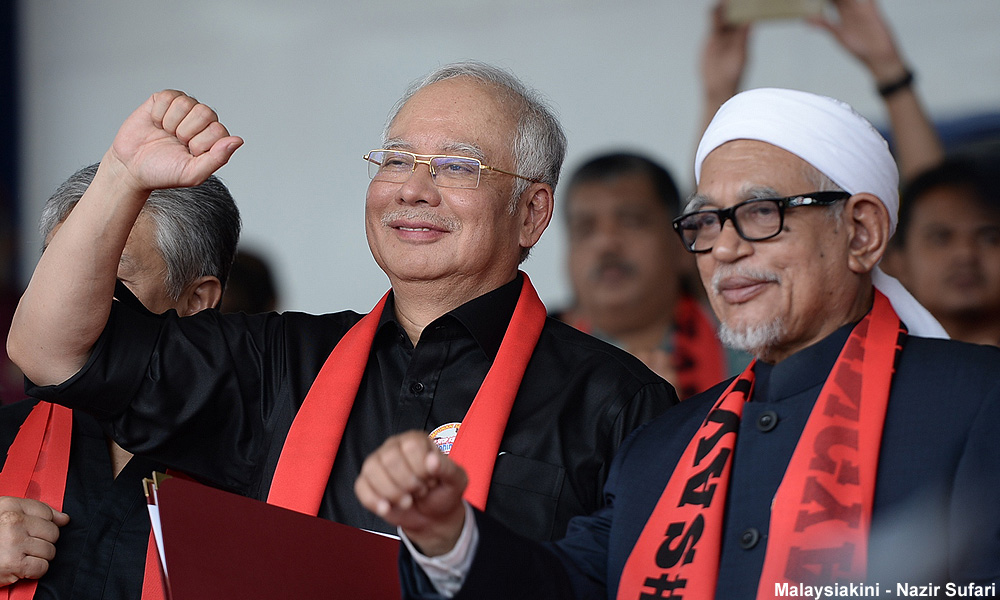
Well, another important question is how PAS president Abdul Hadi Awang would respond to this - that Islam compels “Muslims to protect the rights of anyone who is oppressed”.
Two points need to be considered:
1) Does this include the Orang Asli rights and the right to their ancestral lands currently encroached by loggers that the state government in Kelantan does not recognise? Does this also include the rights of minorities when it comes to Islam in this country?
2) If this was a Muslim solidarity gathering, why is it that no Muslim members of the opposition were invited to the big show? Does this demonstration mean that only Muslims are outraged by the plight of the Rohingya?
Now some may argue that these are not important questions and the real victims are the Rohingya, but I would argue that if you are going to carry out a demonstration about the plight of minorities in another country, it is incumbent upon you to demonstrate that the rights of minorities are also protected in your country.
Please be very clear, I am not equating domestic minorities' inequalities to the plight of the Rohingya. However, I do think that if you are going to hold a demonstration on the plight of a minority group, you should have at least a history of supporting minority rights but more importantly, have a history of supporting the very people you claim are in need of help.
And if this is indeed about minorities rights, then why hasn’t there been a large-scale demonstration by establishment Muslim powerbrokers on the plight of the Orang Asli? Are they not worthy of large-scale Muslim support?
For example, where was the large-scale demonstration when the bodies of five Orang Asli children were discovered in the jungle when they ran away from school fearing abuse? Where was the large-scale Muslim outrage to this tragedy?
As reported in the BBC, “But Colin Nicholas argues that the government has little interest in protecting their identity and says indigenous people are being increasingly sucked into a Malay-centric nation state.
"You pluck young children - seven-year-olds, eight-year-olds - from the village," he says. "Then put them in a school hostel for three months at a time without seeing their parents, give them a new education, give them a new culture, give them a new language and sometimes a new religion, and in one generation you have people who are no longer Orang Asli...
“For the powerful, crimes are those that others commit.”
- Noam Chomsky, ‘Imperial Ambitions: Conversations on the Post-9/11 World’
What I really want to know from Sekretariat Umat chairperson Aminuddin Yahaya, who had urged Buddhist monks in Malaysia to state their stand on a demonstration held by their counterparts in Myanmar against Prime Minister Najib Abdul Razak’s alleged interference in the Rohingya issue, is whether “killings of innocent people” also go against the teachings of Islam. After all, to some Muslims, only violence against Muslims is worthy of condemnation.
Furthermore, and this is an important point, those monks in Myanmar were protesting against the interference by the Najib regime in the internal politics of their country, so the more appropriate question for Aminuddin would have been, do Buddhist monks in Malaysia support Buddhists protesting against foreign interference in their domestic policies?
This, of course, brings up another important question. If Malaysia is so gung-ho about interfering in the domestic polices of a foreign country, what happens when a foreign country interferes in our domestic policies?
Well, another important question is how PAS president Abdul Hadi Awang would respond to this - that Islam compels “Muslims to protect the rights of anyone who is oppressed”.
Two points need to be considered:
1) Does this include the Orang Asli rights and the right to their ancestral lands currently encroached by loggers that the state government in Kelantan does not recognise? Does this also include the rights of minorities when it comes to Islam in this country?
2) If this was a Muslim solidarity gathering, why is it that no Muslim members of the opposition were invited to the big show? Does this demonstration mean that only Muslims are outraged by the plight of the Rohingya?
Now some may argue that these are not important questions and the real victims are the Rohingya, but I would argue that if you are going to carry out a demonstration about the plight of minorities in another country, it is incumbent upon you to demonstrate that the rights of minorities are also protected in your country.
Please be very clear, I am not equating domestic minorities inequalities to the plight of the Rohingya. However, I do think that if you are going to hold a demonstration on the plight of a minority group, you should have at least a history of supporting minority rights but more importantly, have a history of supporting the very people you claim are in need of help.
And if this is indeed about minorities rights, then why hasn’t there been a large-scale demonstration by establishment Muslim powerbrokers on the plight of the Orang Asli? Are they not worthy of large-scale Muslim support?
For example, where was the large-scale demonstration when the bodies of five Orang Asli children were discovered in the jungle when they ran away from school fearing abuse? Where was the large-scale Muslim outrage to this tragedy?
As reported in the BBC, “But Colin Nicholas argues that the government has little interest in protecting their identity and says indigenous people are being increasingly sucked into a Malay-centric nation state.
"You pluck young children - seven-year-olds, eight-year-olds - from the village," he says. "Then put them in a school hostel for three months at a time without seeing their parents, give them a new education, give them a new culture, give them a new language and sometimes a new religion, and in one generation you have people who are no longer Orang Asli."
Dirty little secret
Which is not to say that PAS (in this case) is uninterested in working at the grassroots level concerning Orang Asli issues. Indeed, in one of my interviews with PSM’s Dr M Jeyakumar Devaraj, this very issue was discussed. The Sungai Siput parliamentarian said:
1) “PAS played a big role in the bridge that we built for Kg Perje, the Orang Asli kampong.”
2) “A PAS leader, who is an engineer, helped us design the bridge and visited the site several times, and supervised the technically difficult step of raising the cables.”
3) “Several PAS members came in with us on several occasions for the gotong-royong. A PAS member loaned us his cement mixer for a nine-month period. Perak PAS also contributed RM5,000 for the project.”
However, was the plight of the Rohingya really an issue for Malaysia? Let us be honest, the Rohingya were treated extremely badly by the Umno state before this big show of support. Last year as reported in The New York Times, Rohingya refugees from Malaysia were going to the United States:
“It’s a bit of a dirty little secret, but that population going to the US is largely people in Malaysia who have been awaiting resettlement for 10 to 15 years,” said Amy Smith, an executive director of Fortify Rights, a human rights group focusing on South-East Asia.
“While the refugees wait, they cannot send their children to government-accredited schools and are suspended in a social and legal limbo that local charities and off-the-books jobs can only partly relieve.”
And let us not forget that the healthcare crisis facing the Rohingya in Southeast Asia, again reported in the NYT - “The study analysed health care indicators in Myanmar, Bangladesh, Malaysia and other countries where about 1.5 million Rohingya live. The researchers compiled data from governments, human rights groups and other sources. It found that the indicators were consistently worse for the Rohingya, a Muslim ethnic group, than for other populations living in the same areas.”
So really all this talk about championing the cause of the Rohingya is just a load of horse manure. We cannot even look after our own marginalised communities - correction - we seem to have no problem oppressing our own minority communities, so this idea that Malaysia is now some sort of champion for the Rohingya, is honestly, obscene.
Of course, what was really interesting for me was Wisma Putra’s contention that this was also a security issue. Jasminder Singh and Muhammad Haziq Jani from the S Rajaratnam School of International Studies (RSIS), Nanyang Technological University, Singapore, did an extremely interesting piece about this issue - ‘The Rohingya Crisis: Regional Security Implications’ – and two points should be of concern to Malaysians:
1) “On Oct 9, 2016, some 200 men crossed from Bangladesh into Myanmar’s Rakhine (Arakan) State by boat to attack three border guard posts in Maungdaw Township. According to the Myanmar government, the attackers killed nine policemen and took away more than 50 guns and thousands of bullets. Days later, YouTube videos revealed the emergence of the Bangladesh-based Harakah al-Yaqin militant group which is also known as the Faith Movement.
2) “Online extremists in Indonesia have expressed their desire to mount ‘jihad’ on behalf of the Rohingya, with some supporters hoping that the ‘mujahidin’ will be able to smuggle into Myanmar. The Rohingya crisis has become a rallying cry for jihad and surpasses in gravity when contrasted with issues such as the alleged blasphemy by the governor of Jakarta, Basuki Tjahaja Purnama (‘Ahok’). Some social media users in Indonesia have gone to the extent of declaring their readiness to be suicide bombers for the sake of the Rohingya. The Rohingya issue is fast developing into a security threat that would have an adverse impact on peace in the region.”
How many Indonesian and Bangladeshi migrant workers do we have in Malaysia? What is the statistics on Rohingya violence in Myanmar (and the other way around) in Malaysia? What are the current measures and the efficacy of those measures when it comes to human trafficking in Malaysia?
In an article about our security apparatus, I wrote this: “Add to this the complicated reality of security apparatus personnel navigating the petty fiefdoms and the allegiances of said fiefdoms to Umno warlords and potentates and the fact that Malaysia is a nexus for human trafficking, with the complicity - well-documented - of the security apparatus. This last part is extremely important because the unsanctioned flow of illicit human cargo is the conduit for Islamic extremists to leave and enter the country.”
The plight of the Rohingya is more than just misery porn from Umno and PAS political elites. To treat it as just another propaganda tactic to bolster Malay/Muslim solidarity and detract from financial scandals hides the very real security issues this country faces.
S THAYAPARAN is Commander (Rtd) in the Royal Malaysian Navy.


