


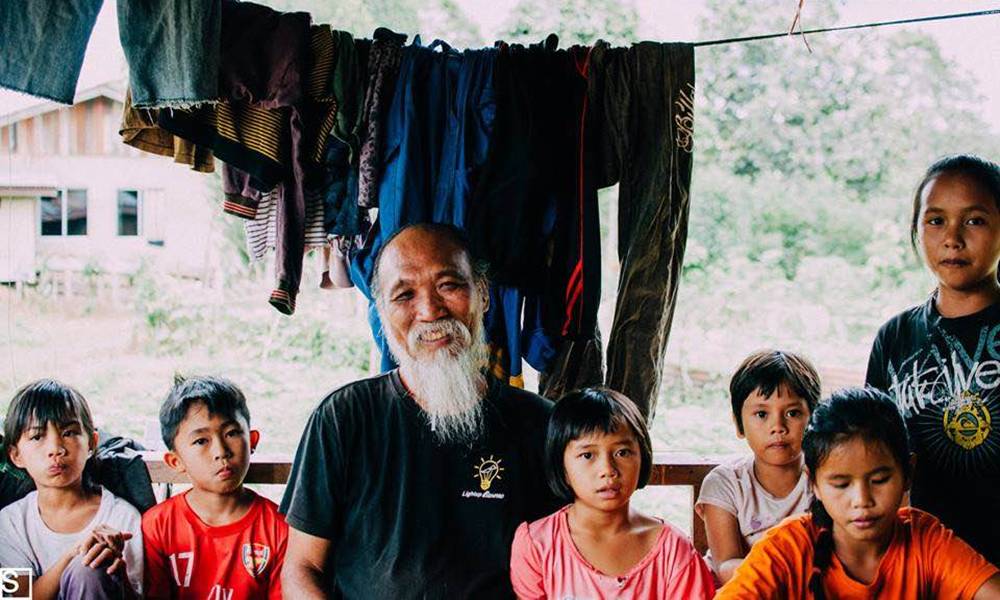

Organic farmer now lighting up Borneo's interiors
MALAYSIANS KINI When Ong BK went to Borneo as an election observer back in 2011 during the Sarawak state elections, he had been running an organic farm in Penang for the last decade.
But during his time in Borneo, he said he got the chance to meet with a lot of people in the interiors.
“That experience led us to meet a lot of people in the interior, where they expressed their wish to get basic amenities... which are normally either absent or very far away.
“The contact in Borneo actually caused me to think about getting into this project to bring basic amenities to rural areas,” Ong said in a phone interview with Malaysiakini.

The project in question is the Lightup Borneo, a civil society initiative started by Ong in 2011, right after the Sarawak state elections.
The main objective of Lightup Borneo, which is based in Kota Kinabalu, is to provide access to lighting and basic electricity supply to the interiors, he said.
They do this, he added, by building micro- and pico-hydro generators as well as a pioneering floating hydro generator for villages in rural areas.
So far, Lightup Borneo has completed over 20 projects, he said, with most of them being in Sarawak, then Sabah and even a few in rural areas in West Malaysia.
The project is mostly run by volunteers, with each project costing around RM4,000 to RM5,000 per kilowatt.
Not only that, Ong said, they are also supported mainly by donations.
While speaking to him, it becomes clear that Ong has become an ardent champion of the rural cause as he explained in great detail the huge divide between rural and urban.
At one point, he also cited the victory of the United States’ president-elect Donald Trump as a sign of rural disillusionment against what is perceived as an unfair advantage to the urban areas.
This is his story, in his own words:
THE CONVENTIONAL WAY TO THINK about getting these (basic necessities) would be through our democratic system.
(But) we cannot ignore the fact that after 50 years since the formation of Malaysia, they (the rural areas) are not getting enough of those basic services.
If we were to walk away and say, “You wait for the process to turn its wheels slowly and deliver you the services,” that would be a grave injustice to the people there, who are citizens just like the rest of us.
YOU ARE RIGHT TO SAY IT IS THE RESPONSIBILITY OF THE STATE, but equally staring us in our eyes is that for half a century, these indigenous people have been around and they are not getting those (basic necessities).
If we continue to tell them, “Look, the proper way to get it is to get the government’s attention, then we would be condemning them to not getting these services for a long time.
MALAYSIANS KINI When Ong BK went to Borneo as an election observer back in 2011 during the Sarawak state elections, he had been running an organic farm in Penang for the last decade.
But during his time in Borneo, he said he got the chance to meet with a lot of people in the interiors.
“That experience led us to meet a lot of people in the interior, where they expressed their wish to get basic amenities... which are normally either absent or very far away.
“The contact in Borneo actually caused me to think about getting into this project to bring basic amenities to rural areas,” Ong said in a phone interview with Malaysiakini.
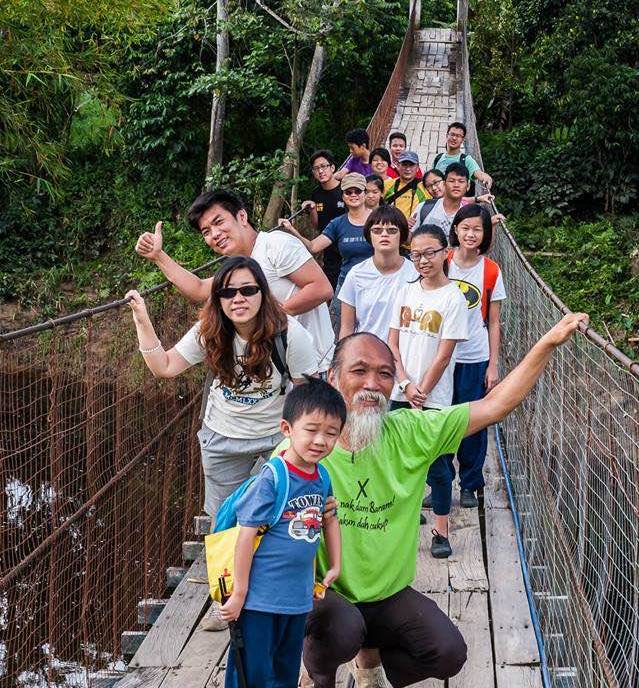
The project in question is the Lightup Borneo, a civil society initiative started by Ong in 2011, right after the Sarawak state elections.
The main objective of Lightup Borneo, which is based in Kota Kinabalu, is to provide access to lighting and basic electricity supply to the interiors, he said.
They do this, he added, by building micro- and pico-hydro generators as well as a pioneering floating hydro generator for villages in rural areas.
So far, Lightup Borneo has completed over 20 projects, he said, with most of them being in Sarawak, then Sabah and even a few in rural areas in West Malaysia.
The project is mostly run by volunteers, with each project costing around RM4,000 to RM5,000 per kilowatt.
Not only that, Ong said, they are also supported mainly by donations.
While speaking to him, it becomes clear that Ong has become an ardent champion of the rural cause as he explained in great detail the huge divide between rural and urban.
At one point, he also cited the victory of the United States’ president-elect Donald Trump as a sign of rural disillusionment against what is perceived as an unfair advantage to the urban areas.
This is his story, in his own words:
THE CONVENTIONAL WAY TO THINK about getting these (basic necessities) would be through our democratic system.
(But) we cannot ignore the fact that after 50 years since the formation of Malaysia, they (the rural areas) are not getting enough of those basic services.
If we were to walk away and say, “You wait for the process to turn its wheels slowly and deliver you the services,” that would be a grave injustice to the people there, who are citizens just like the rest of us.
YOU ARE RIGHT TO SAY IT IS THE RESPONSIBILITY OF THE STATE, but equally staring us in our eyes is that for half a century, these indigenous people have been around and they are not getting those (basic necessities).
If we continue to tell them, “Look, the proper way to get it is to get the government’s attention, then we would be condemning them to not getting these services for a long time.
IMPLEMENTATION OF THIS PROJECT would have an effect on the society and (get) the government to actually pick up their responsibility finally.
We don’t think we can actually install all the hydro generators needed in Borneo, (but) we need to do something to showcase to society, the villagers and the government that this is doable, desirable and actually quite an urgent issue to be addressed.
A LOT OF THEM WHO DONATED ARE THOSE WHO HAVE MADE TRIPS TO PROJECT SITES so they can verify themselves that there is a real need and there is a real community receiving the goods.
So they visit these places and also help bring light to other leaders about the issue of the lack of electricity, because to a lot of urban folk in West Malaysia, a lot of them are not fully aware of these situations.
FLOATING GENERATORS are a new design that we have done, as we found that actually about half the locations do not fit the typical image of a place where you can use a hydro generator because they are not near a hill or the hill does not have running water or a strong enough running water source.
Some of the villages are nearer to a river instead of a hill, so we thought we can either give up or come up with a new design to tap into the potential of running water.
Flowing rivers can theoretically be used to generate electricity. We took about half a year to design a new kind of turbine that can generate electricity from flowing rivers, so we thought if this design worked, it will be applicable to expand the feasibility of hydro electricity to a lot of areas.
IT IS IMPORTANT FOR PEOPLE IN URBAN AREAS TO BE EXPOSED TO RURAL AREAS, so they know the reality of rural areas, which is actually quite ignored by people in town.
It may well be okay if the town and rural areas are separate countries, then you have no obligation to them, but in real life, it is not true. Our country’s economy is actually dependent on (rural land).
WITH SUCH A BIG AMOUNT OF OUR ECONOMY DEPENDING ON RURAL LAND, it is seen as rather unfair from the rural point of view that not much basic infrastructure is even given back to them.
THIS IS NOT AN ISSUE that we can leave to the government to do at their own pace.
If the rural areas are not getting basic services, it is a denial of their rights.
It is up to civil societies and the urban educated middle-class to choose where they want to stand on this, whether they want to ignore it or take a different stand and make a contribution to the situation.
MAINSTREAM POLITICAL PARTIES, whether from ruling or opposition, very few actually have a rural focus, even though there are a number of reasons for us to take the rural forum more seriously.
The political system has a number of biases and one of them is the rural-urban bias. It is disproportionate to the population, the rural population has a lot more seats compared to the urban area.
So even if there are parties who can win all urban seats, they cannot change the government, because there are more seats in rural areas.
If they are political parties who say they want change but do not go to rural areas, it sort of sounds like they are irrational.
IT IS LIKE A SOCCER GAME, and one side only chooses to run less than half a field and then they want to convince their opposition that they are serious about change.
If they seriously want to bring change to the country, then they have to address obvious injustices and unfairness in the country, chief of it is the rural-urban imbalance.
TRUMP’S VICTORY IN THE US ELECTION WAS ACHIEVED ON THE BACK OF UNHAPPY RURAL VOTERS, though rural folk there are not as badly deprived as in Malaysia.
It is up to Malaysian parties to think seriously if they can afford to leave out rural voters in their next move.
WE ARE SEEING SOME (IMPROVEMENTS) but there is still a long way to go to be fair to the rural population.
Malaysians Kini is a series on Malaysians you should know.
Previously featured:
Meet Bersih's unofficial sidekick, the Bersih Kid
A crusader in crutches has ‘hunger’ for Bersih 5
Activist helps fellow Orang Ulu on rocky road to get MyKads
A doctor’s hearing loss spurs a health plan for the poor
Aida Redza dances to connect with communities
The brains and brawn behind M’sia’s pro wrestling scene
Meet Adam, a star in M’sia rising breed of professional gamers
Passion to preserve Malaysia's visual history
'Osama sent me his regards, but I wasn't interested'
Struck with hot steel, jailed under EO, PSM's Saras defines resilience
Meet Anis Syafiqah, the ordinary student who wants to catch MO1
How one Malaysian bagged seven journalism awards in the US
Beat me on the track, Supermoto champ Husna tells haters
How arguing on drying laundry led to Science Cafe KL
Bringing student activism to Malaysians abroad
Ramli Ibrahim has a reason to dance for joy
Denounced by relatives, ex-engineer battles for indigenous Sarawakians


