



Attitude of non-cooperation may affect voting pattern in next GE
COMMENT No matter how intense the politics may be, cooperation on matters that affect the people should be the top priority.
However, as Penang Chief Minister Lim Guan Eng pointed out, the flash flood problem in the state could only be solved through cooperation between the state government and federal government.
This is why a certain level of professionalism and cooperation (summed up in the words, ‘political maturity’) must always exist in a healthy democracy, even though both sides of the political divide can by all means thrash it out in Parliament or the state assembly on burning issues.
The moral of the story is not to be another Emperor Nero who played the fiddle while Rome burnt.
Watching from afar
While holidaying in Vietnam, I could see clearly what was happening, and I decided that I would put together an article for all Malaysians to read - and understand what is happening in the country.
As a voter, I find it hard to support any party that appears to be arrogant, as exemplified by one state exco member from Negri Sembilan over the pollution issue involving Sungai Semenyih, which caused the treatment plant in Selangor to be shut down.
Besides the cold shoulder purportedly given by the Negri Sembilan water regulatory body, Badan Kawalsetia Air Negeri Sembilan (BKSANS) to Lembaga Urus Air Selangor (Luas), Negri Sembilan Education and Health Committee chairperson Shamsulkahar Mohd Deli further added insult to the injury by telling his counterpart, Elizabeth Wong, to “consult with water experts before adding activated carbon to dilute pollution in Sungai Buah, Nilai”.
As a trained chemist, I can understand why activated carbon was used albeit it being expensive, especially since the pollutant was identified in the laboratory as 1-Bromo-4-phenoxybenzene, an additive used in flame retardant products.
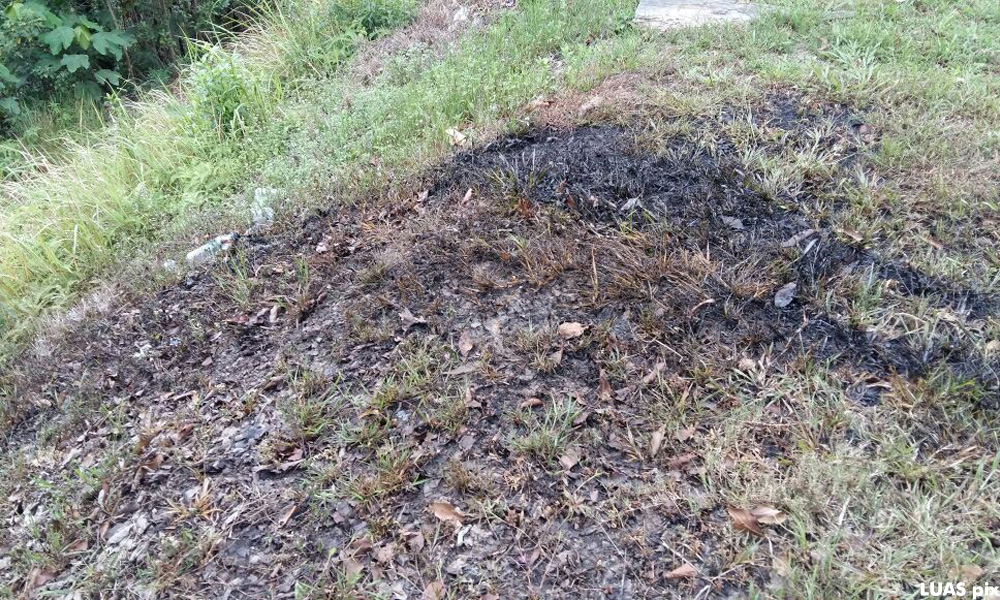
Despite being only an additive to be added in small quantities to the finished product (compared to the effluents from a factory environment), the amount of the chemical released was not small, based on the picture of grass scorched by the chemical released by Wong during a press conference recently.
Based on police investigation, there was no evidence that there was a sabotage involved; but in my opinion, the impact of the dumping act was great enough to warrant further investigation. I am told that the location was not in an industrial area. It was near the Elite Highway, according to Wong, and as such, all the more we have to investigate the case thoroughly.
Perhaps it was because I was out of the country that I could see clearly what was happening.
COMMENT No matter how intense the politics may be, cooperation on matters that affect the people should be the top priority.
However, as Penang Chief Minister Lim Guan Eng pointed out, the flash flood problem in the state could only be solved through cooperation between the state government and federal government.
This is why a certain level of professionalism and cooperation (summed up in the words, ‘political maturity’) must always exist in a healthy democracy, even though both sides of the political divide can by all means thrash it out in Parliament or the state assembly on burning issues.
The moral of the story is not to be another Emperor Nero who played the fiddle while Rome burnt.
Watching from afar
While holidaying in Vietnam, I could see clearly what was happening, and I decided that I would put together an article for all Malaysians to read - and understand what is happening in the country.
As a voter, I find it hard to support any party that appears to be arrogant, as exemplified by one state exco member from Negri Sembilan over the pollution issue involving Sungai Semenyih, which caused the treatment plant in Selangor to be shut down.
Besides the cold shoulder purportedly given by the Negri Sembilan water regulatory body, Badan Kawalsetia Air Negeri Sembilan (BKSANS) to Lembaga Urus Air Selangor (Luas), Negri Sembilan Education and Health Committee chairperson Shamsulkahar Mohd Deli further added insult to the injury by telling his counterpart, Elizabeth Wong, to “consult with water experts before adding activated carbon to dilute pollution in Sungai Buah, Nilai”.
As a trained chemist, I can understand why activated carbon was used albeit it being expensive, especially since the pollutant was identified in the laboratory as 1-Bromo-4-phenoxybenzene, an additive used in flame retardant products.
Despite being only an additive to be added in small quantities to the finished product (compared to the effluents from a factory environment), the amount of the chemical released was not small, based on the picture of grass scorched by the chemical released by Wong during a press conference recently.
Based on police investigation, there was no evidence that there was a sabotage involved; but in my opinion, the impact of the dumping act was great enough to warrant further investigation. I am told that the location was not in an industrial area. It was near the Elite Highway, according to Wong, and as such, all the more we have to investigate the case thoroughly.
Perhaps it was because I was out of the country that I could see clearly what was happening.
Emergency response
It was an emergency response situation, as the water contamination would affect thousands of people in Selangor who are served by the Sungai Semenyih treatment plant. To the employees from several government agencies who had worked around the clock to solve the problem, I say, “Bravo”.
To date, it is learnt that 30 tonnes of activated carbon had been expended. Long term, activated carbon is not a solution, but for the safety and health of the people, this was the price that Selangor had to pay.
Yet, what shocked me was when Shamsulkahar was quoted as saying on Oct 31 in an English daily that to date the state has not been able to detect any other source of contamination in the area.
Evidence proved otherwise, that the pollution had in fact started from Negri Sembilan. In less than 72 hours, the Department of Environment discovered other sources of pollution from the industrial area. This clearly shows how Negri Sembilan handles its monitoring of the water resources.
Pollution of our waterways, especially from industries, does not happen overnight, and Shamsulkahar should retract his statement immediately.
This is why Selangor Menteri Besar Azmin Ali found it difficult to cooperate with his counterpart, Mohamad Hasan, who did nothing to exemplify a good chief executive state, especially after the matter had gained traction in the media.
This is why Wong, in a press statement dated Oct 24, decried: “Yesterday evening, Air Selangor and the Selangor Water Management Board (Luas) had identified the site in Nilai, Negri Sembilan, where evidence of dumping of pollutants was found.”
Umno ministers and the Negri Sembilan menteri besar, she stated in the press statement, should assist in the clean-up instead of denying that the source of pollution was from Negri Sembilan.
The lack of neighbourliness was simply too jarring not to be commented on here. In the context of a condominium, it is the responsibility of the unit above where water leaking from its bathroom has to be fixed before it starts seeping into the ceiling of the unit just below. What Wong would least expect to see was an attitude of “That’s your problem, you handle it yourself!”
Luas had reportedly received a shrug from BKSANS with words allegedly to that effect. At the point of writing, BKSANS has yet to extend a helping hand to Luas. It is such non-cooperation shown by BKSANS which irks me, what more when I expect Mohamad to show a better example, being the menteri besar.
At least, at the federal level, Natural Resources and Environment Minister Wan Junaidi Tuanku Jaafar has acknowledged that odour is a basic parameter that has to be included into monitoring procedures for raw water supply. “So far,” he acknowledged, “only Pengurusan Air Selangor monitors the odour parameter.”
Although the odour parameter is not included in the list under Schedule A or B in the Environmental Quality Act 1974, it is a basic parameter that can alert us that something might not be right.
What about Najib?
The big question is whether Prime Minister Najib Abdul Razak would advise his fellow Umno colleagues to act professionally, or he remains silent about it.
During the launch of his book, former prime minister Abdullah Ahmad Badawi was said to have warned some from his Umno ranks who wanted to create trouble to wrest back states like Selangor and Perak.
Former New Straits Times Press group editor-in-chief Kalimullah Hassan said that Abdullah warned them: “You do that, we will throw you behind bars and you will be there for a long time.” Would Najib have such courage to tell some of his supporters not to play with fire, and instead extend their helping hand when water supply to Selangor is at stake?
I wonder where is the red-shirt leader and Sungai Besar Umno chief Jamal Mohd Yunos, who said that the red-shirts decided to focus on social responsibility initiative to help Sekinchan from being submerged in flood recently. Would Najib advise Jamal to go help with the building of bunds to divert the water for treatment?
According to Kalimullah in his speech, “Without his (Abdullah’s) blessing and protection, the bravado of these so-called leaders just withered and thankfully, there were no incidents (after five states fell into the hands of Pakatan in 2008).”
Anyway, it is not my intention to accuse Umno of sabotaging, but when fingers are already pointing that direction, yet if Najib did nothing about it, I would not be surprised that people are still wondering if someone was up to mischief.
It is because many of us are from Negri Sembilan anyway, and although we live in Selangor, we have many relatives still living in Negri Sembilan, whom we can influence to cast their votes “wisely”.
STEPHEN NG is an ordinary citizen with an avid interest in following political developments in the country since 2008.


