Malaysias governance standards drop
The overall standard of governance in Malaysia has dropped in six core areas over the last eight years despite intermittent upward trends, according to a World Bank perception study.
The overall standard of governance in Malaysia has dropped in six core areas over the last eight years despite intermittent upward trends, according to a World Bank perception study.
The Governance and Anti-Corruption snapshot of Malaysia released on Monday outlined the rise and fall of standards in six areas of governance based on two-year study cycles between 1996 and 2004.
The six areas are voice and accountability, political stability and absence of violence, government effectiveness, regulatory quality, rule of law and control of corruption.
 Governance areas were ranked based by percentile rank, a score transformed from raw data for easier understanding and interpretation.
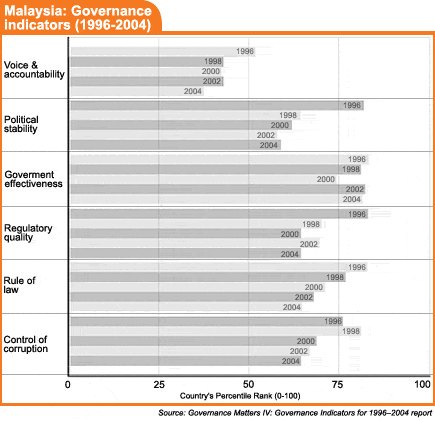
As shown ( see chart below ), the first five displayed a downward slide in the first two years (1996-1998) of the study period, with the political stability component taking a sharp dive.
Only control of corruption in those two early years, which measures minor and major abuse of public power for private gain, moved the opposite way. But it progressively got worse since.
For Malaysia, a list of 13 sources were used to determine the basic question: 'Has real change taken place over time in a country?'
Voice and accountability - which measures the perception of political, civil and human rights - started on the lowest percentile rank and settled on a plateau between 1998 and 2002, before dipping.
 Despite a promising start, control of corruption fell sharply between 1998 and 2000, and continued sliding until the end of the study period last year.
Rule of law, which is a perception of the quality of enforcement of contracts, the police, judicial independence and crime rate, stayed on a downward trend throughout the study period.
But several areas showed slight improvement between 2000 and 2002. Government effectiveness, gauging bureaucratic competence and quality of public service delivery, saw a spike over these years.
The same period saw improvements in the perception of market-unfriendly policies, as outlined by the regulatory quality component.
Post-2002, all components continued their gradual slide, with the exception of political stability - which measures the likelihood of violent threats to or changes in government - including terrorism. It went up in 2004.
At the end of the study period, rule of law, regulatory quality and control of corruption all settled at the same point that was lower from where these began.
Snapshot of performance
The report covering 209 countries and entitled 'Governance Matters IV: Governance Indicators for 1996-2004', is authored by D Kaufmann, A Kraay and M Mastruzzi.
It provides a snapshot of governance performance for individual countries or groups of countries, either a comparison within one country for all six areas or of one indicator across several countries.
The fourth in a series that began in the 1990s, it derived its data from cross-country surveys of firms and citizens, commercial risk-rating agencies, think-tanks, government agencies, international organisations and academic institutions.
The indicators were based on hundreds of individual variables drawn from about 40 data sources provided by 31 organisations, said the authors.
"While we find that the quality of governance in a number of countries has changed significantly (in both directions), we also provide evidence suggesting that there are no trends, for better or worse, in global averages of governance," they said, allowing for margins of error.
"Finally, we interpret the strong observed correlation between income and governance, and argue against recent efforts to apply a discount to governance performance in low-income countries."
The authors also said the study has revealed the "enormous impact of corruption on investment climate variables".
They found that some countries had improved over a relatively short period of time due to a relatively rapid institutional change which was only feasible in the short term, with deteriorating situations in other countries. Many remained stagnant.
So the worldwide average, they argued, had not improved over the last eight years.
The authors urged both rich and emerging countries to re-prioritise and focus more on transparency, voice, prevention and incentives.
Inaction blamed
The World Bank, in a press release, blamed inaction and a lack of firm targets by governments for failing to practise good governance in order to significantly improve the living standards of people in developing countries.
"A key finding is that a realistic improvement in (any one core area) can be expected to result in (an average of a) 300 percent increase in per capita incomes in the longer term."
Kaufmann said that in spite of the shining examples, neither rich nor poor countries had improved much on their governance standards.
"This sobering reality ought to motivate collective action in the next stage," he said in the statement.
He suggested that governments "frankly distill" workable methods and failures, such as "single-minded anti-corruption campaigns".
The focus, he added, should be more on voice and transparency reforms instead.