


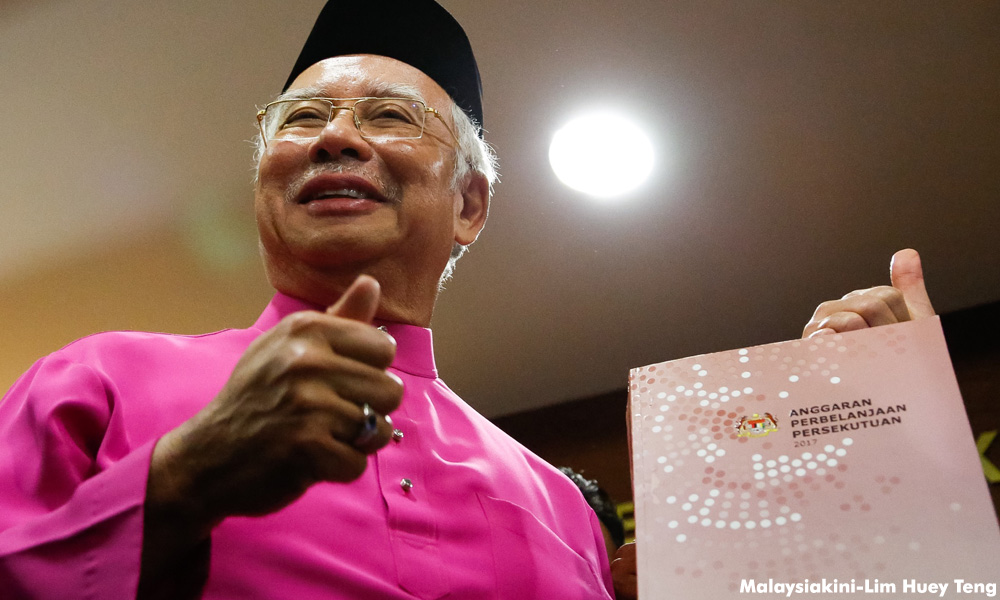

Analysis: Najib's budget speeches increasingly political
When Pakatan Harapan MPs staged an unprecedented walkout in the middle of Prime Minister Najib Abdul Razak’s Budget 2017 speech, the premier accused them of turning their backs on the people’s welfare.
The MPs had embarrassed themselves, he said, while his ministers accused the MPs of being immature, childish, or rude.
While that may be the case, Malaysiakini’s analysis of Najib’s budget speeches since the tabling of the 2010 budget shows that there is also credence to opposition MP Liew Chin Tong’s complaint: that the prime minister was taking pot-shots at the opposition, and they have had enough.
Increasingly, Najib’s budget speech has become more than just a statement on government policy, and an opportunity for him to score political brownie points against his opponents.
When Pakatan Harapan MPs staged an unprecedented walkout in the middle of Prime Minister Najib Abdul Razak’s Budget 2017 speech, the premier accused them of turning their backs on the people’s welfare.
The MPs had embarrassed themselves, he said, while at least his ministers accused the MPs of being immature, childish, or rude.
While that may be the case, Malaysiakini’s analysis of Najib’s budget speeches since the tabling of the 2010 budget shows that there is also credence to opposition MP Liew Chin Tong’s complaint: that the prime minister was taking pot-shots at the opposition, and they have had enough.
Increasingly, Najib’s budget speech has become more than just a statement on government policy, and an opportunity for him to score political brownie points against his opponents.
When Najib tabled his very first budget speech in Oct 2009 for the 2010 budget, he made no mention of BN nor the opposition at all.
This lasted until this Budget 2012 speech, but even then, it was because he mentioned the opposition once when he offered to raise MPs’ salaries. This was on the condition that both government and opposition MPs agree to it.
When the Budget 2013 came around however, it was already a forgone conclusion that this was going to be an election budget and Najib began highlighting his BN coalition.
Mentions of ‘Barisan Nasional’, particularly in context of ‘Barisan Nasional government’ instead of merely ‘government’, skyrocketed, as did veiled attacks on the opposition.
The trend continued after the election when Najib was gloating over his victory and thanking his supporters in his speech, but took a pause during the tabling of the Budget 2015.
This did not last long however, as mentions of BN and the opposition increased in subsequent budget speeches amid the looming Sarawak state election, and increasing political pressure on him as calls for his resignation over the 1MDB scandal intensify.
The analysis entailed studying official English translations of Najib’s budget speeches since his very first budget speech in Oct 2009.
These speeches are around 8,000 to 12,000 words in length, excluding headings, subheadings, and formalities. From these, the number of times where certain keywords such as ‘Barisan Nasional’ and ‘opposition’ is mentioned in the speech is tallied.
Mentions of certain unnamed ‘parties’ are also added to the opposition’s tally when it can be construed as reference to Najib’s political opponents.
Off-the-cuff remarks are also excluded from the analysis, as it was based on the prepared text of the speech.
Meanwhile, the analysis also revealed that Sabah and Sarawak are often mentioned together in Najib’s speeches, and had been steadily increasing since the 2013 general election.
These are often references to various development projects and preferential treatment for the two East Malaysia states, such as a price uniformity program to keep the price discrepancies between East and West Malaysia low, and the upgrading of regional airports.
Since Budget 2014, the RM16.1 billion Pan-Borneo Highway was also added into East Malaysia’s bag of goodies.
After the Sarawak state election in May this year however, mentions of both Sabah and Sarawak dropped to pre-2013 general election levels.
Or as Sarawak United People’s Party president Dr Sim Kui Hian puts it, "This is a rakyat-centric budget that the government focuses on infrastructures and amenities, as well as lay out plans to increase people's disposable income.
"Nevertheless, the budget is of no surprise to the people of Sarawak.
"We see that this budget fails to provide sufficient Sarawak-centric (policies) to boost socio-economic development in Sarawak.”
Najib coined the term ‘1Malaysia’ in a Sept 16, 2009 speech, just five months after being sworn into office.
In the speech, he spoke of racial and religious harmony in Sabah and Sarawak, and how he aspires this for all of Malaysia.
“To build towards a unified and harmonious Malaysia with a bright future, we must develop our nation as 1Malaysia. The renewed and expanded investment in the future of Sabah and Sarawak that I have proposed is a step in this direction.
“Doing so will ensure that we are providing the same opportunities to all and improving the lives of all. Doing so will ensure that we are providing the same opportunities to all and improving the lives of all Malaysians, regardless of race, religion or the corner of Malaysia that they choose to call home.
“In the end, whether we live in a remote longhouse or a high-rise in Kuala Lumpur, we are all Malaysians and we are all part of the 1Malaysia that we love,” he said at the time.
The term 1Malaysia was mentioned in Najib’s Budget 2010 speech as well, both as a brand name for a slew of government programs, and as a grander concept for a better Malaysia.
However, the term’s use as a grand concept in Najib’s budget speeches has disappeared since Budget 2013, save for a mention in the Budget 2015 speech on the fact that he had introduced it in 2009.
Instead, the term’s use has been limited to the names of government programs, such as the Bantuan Rakyat 1Malaysia (BR1M) cash transfers, the Perumahan Rakyat 1Malaysia (PR1MA) housing scheme, and 1Malaysia clinic.
As for the term 1MDB, the state investment fund was last mentioned in 2011, while the fund’s charity arm 1MDB Trust was mentioned once during the 2013 budget speech where it was to provide RM300 million for educational purposes in the interiors of Sarawak.
Race - particularly race-based policies - are hardly mentioned at all in Najib’s first budget speech.
However, things changed rapidly in subsequent budget speeches. This is possibly due to backlash from his own party and right-wing groups such as Perkasa over Najib’s New Economic Model (NEM) policy.
The NEM was meant to replace the race-based affirmative action under the New Economic Policy (NEP) with needs-based policies.
The trend has started reversing during the Budget 2016 speech – just in time for the Sarawak state election – and is now close to Budget 2011 levels.


