


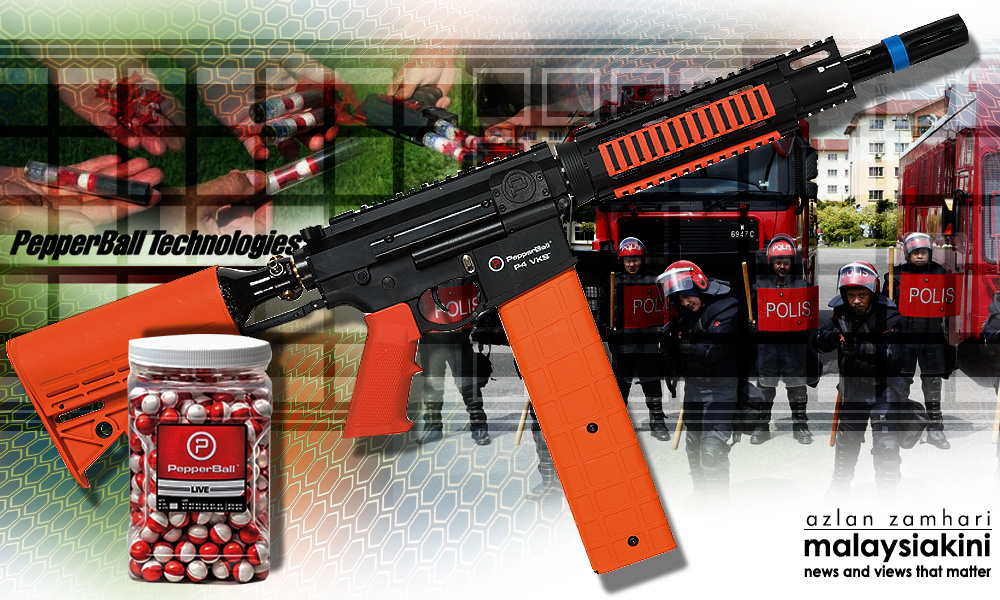

Ouch! Guide to the FRU's newest weapon, pepperballs
KINIGUIDE | The authorities will be armed with pepperballs come Bersih 5. But what are they?
KINIGUIDE Have you ever played paintball? Did you get hit by one of its many colourful pellets?
It stings. It bruises. It ruins your clothes. Add chilli extract to the mix however, and you have a crowd control device in your hands.
That is exactly the proposition that PepperBall Technologies Inc (PepperBall Inc) offers, and its eponymous products are filling the Federal Reserve Unit’s (FRU) arsenals.
In this instalment of KiniGuide, we take a look at pepperballs and their effects.
What are pepperballs?
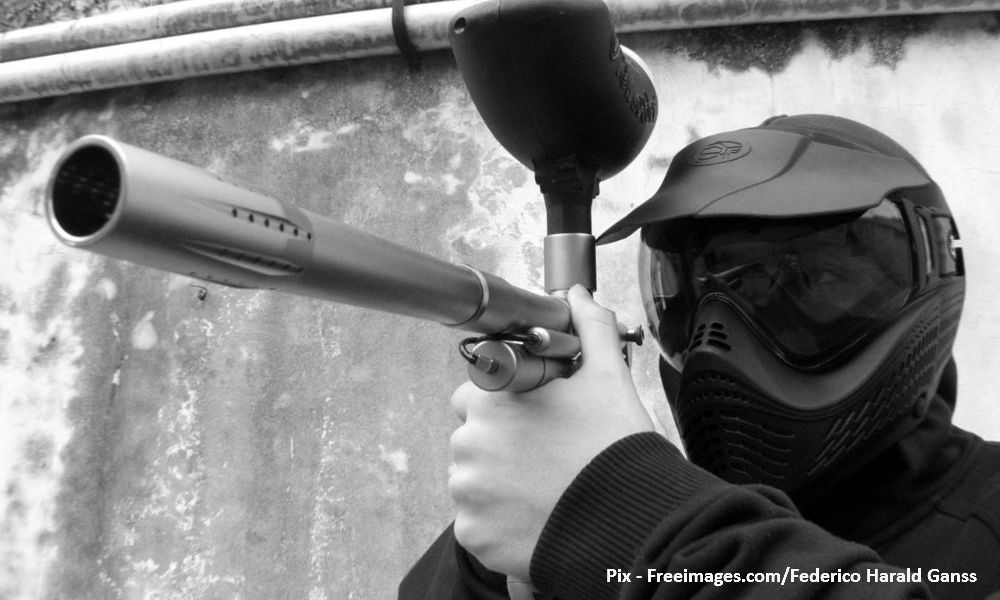
They are spherical pellets similar to those used in the sport known as paintball, and come with compressed-gas powered launchers for the pellets.
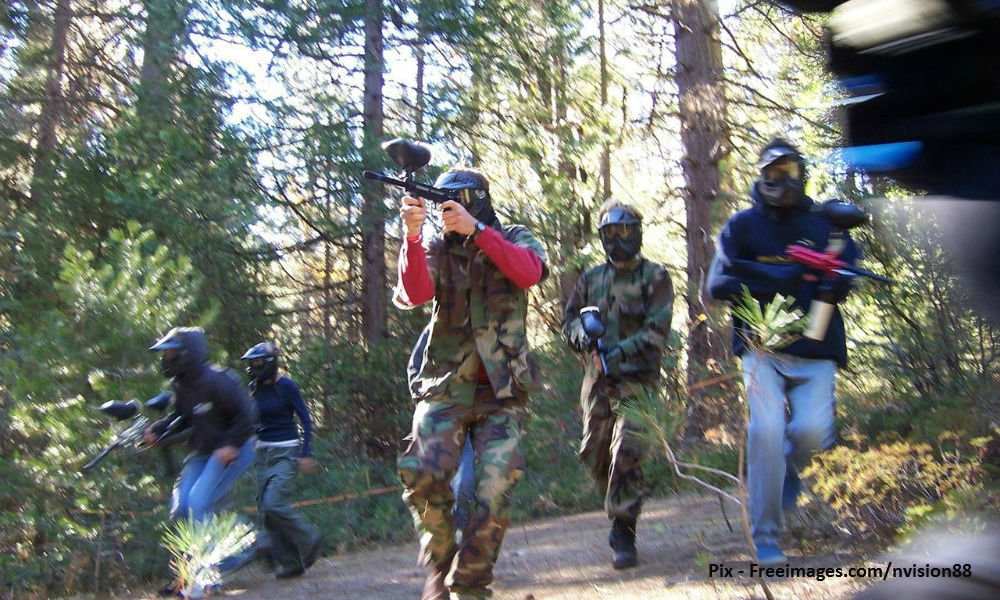 In essence, they are no different from paintball markers except for the fillings used in the pellets, and some adaptations to make the launchers more suitable for law enforcement use - an attachment point for a flashlight and other accessories, for example.
(Paintball markers are often colloquially called ‘guns’, but ‘marker’ is the more widely accepted term among sports enthusiasts. This is in part to distance the sport from the violence associated with firearms and warfare, and in part because of the marker’s original use for marking trees – at least until some foresters thought it would be fun to shoot each other with it.)
Pepperballs are marketed by the US-based company PepperBall Inc as a less-than-lethal alternative to firearms in forcing compliance from suspects, including for crowd control.
The company is owned by United Tactical Systems LLC, which is also based in the US. The Singapore-based IPS Securex Pte Ltd is PepperBall Inc’s sole distributor for the Asia Pacific region.
What did the police buy?
 According to Sinchew Daily, Utusan Malaysia, Berita Harian, and other media reports, the police bought three types of pepperball launchers.
FRU commander Wan Abdullah Ishak was quoted saying that the police bought five Variable Kinetic Systems (VKS), hundreds of Tactical Marking Pistols (TMP), and five Flash Launchers. Reports vary on whether 140 or 150 TMPs were acquired.
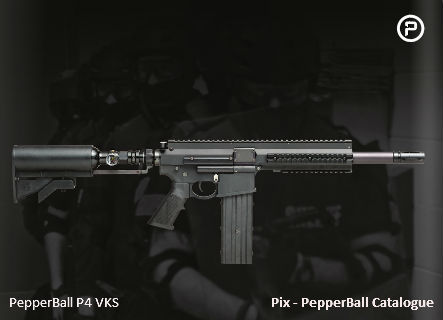
The VKS resembles an assault rifle in appearance. It reportedly weighs in at four kilogrammes, and can be loaded with 150 pellets in a hopper fitted on top of the launcher, or 15 pellets in an internal magazine.
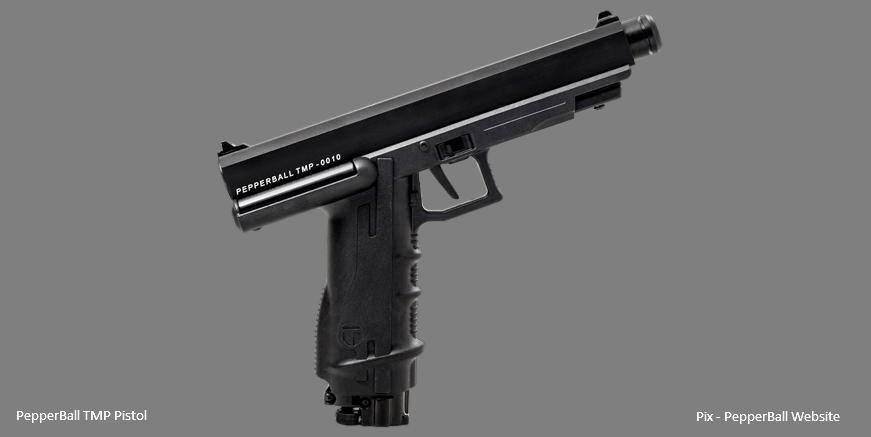
The TMP meanwhile resembles a pistol (photo). Securex’s website states that it can hold up to eight pellets and a disposable canister containing compressed carbon dioxide gas.
 Oriental Daily quoted Wan Abdullah saying that the VKS has a range of about 100 metres, while the TMP has a range of 30 metres.
As for the flash launcher, the product is essentially a combination of a flashlight, laser sight, and pepperball launcher rolled into a small handheld package.
What comes out of these launchers?
PepperBall Inc markets a range of projectiles for its pepperball launchers, including one known as ‘Live’, and the ‘Live X’ that is supposedly 10 times more potent.
Based on the company’s website and several demonstration videos, these pellets would break upon impact and disperse a puff of pelargonic acid vanillylamide (pava) powder.
Pava is also used as the active ingredient in some types of pepper spray. It can be found naturally in chilli peppers, but can also be synthesised artificially.
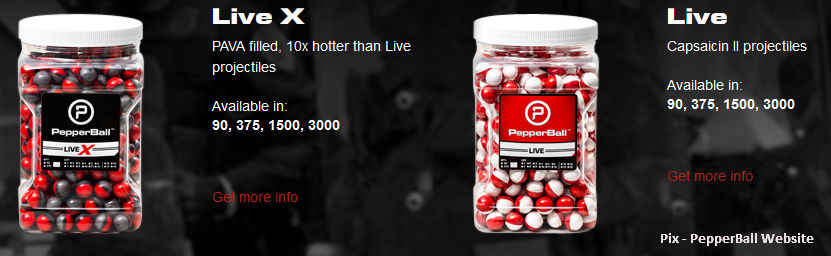 The powder is meant to irritate a person’s eyes and respiratory system, in hopes of incapacitating him or encouraging him to leave the area. It also causes a burning sensation on the skin.
In addition to these, the company also markets solid nylon pellets for breaking through glass windows and windshields, and paint-filled ones for marking suspects.
There are also inert pellets for training purposes – one version is filled with water, while another is filled with scented powder.
How much did it cost the police?
We don’t know. ‘Pepperball’ and several similar search terms did not yield any results in the government’s MyProcurement website for tender results, nor was it listed on the website’s list of direct negotiations.
 Its cost was not mentioned in any media reports either.
However, there are several online stores offering to sell PepperBall pellets, as well as some equipment that is not of the same type as the ones being used by the Malaysian police.
The online store Southern Police Equipment lists 'Live' pellets as costing US$5,100 (RM21,480) for 3,000 pellets, while the 'Live X' costs US$10,195 (RM42,930) for 3,000 pellets.
What do the police like about the pepperballs?
Wan Abdullah was quoted touting the pepperballs as safer than the teargas and water cannons currently in the police's arsenal, although he added that they would continue using the older equipment.
He also claimed that pepperballs are safer than tasers, which are also in the police’s arsenal.
In addition, unlike tear gas, he said pepperballs can be targeted at specific individuals such as an aggressive rioter, while sparing the rest of the crowd.
Wan Abdullah also reportedly said pepperballs would help the FRU seize the initiative and save on manpower, as only a truckload of pepperball-equipped FRU personnel would be needed.
Who else is interested?
The Prisons Department’s website lists a call for quotations for supplying the department with flash launchers and accessories. It is dated Sept 21, 2015.
It is unclear whether they had proceeded with the purchase.
Is it really that safe?
Instances of death or serious injury involving the use of pepperballs and similar products are rare, but not unheard of.
In Oct 2004, a weapon described as ‘pepper-spray-filled pellets out of compressed-air guns’ killed a bystander in Massachusetts, US, according to the Associated Press. She was reportedly struck in the eye socket.
Subsequent reports state the weapon was a FN303 pepper-pellet gun, and its projectile had pierced her eye, shattered the bone behind it into nine pieces, and damaged her right brain. The 21-year-old college student was pronounced dead 12 hours later.
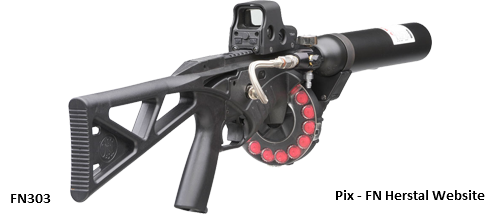 The FN303 (photo) – manufactured by the Belgian firearms maker FN Herstal – launches pellets that are weighed down with bismuth however, and would have struck much harder than PepperBall Inc’s offerings that more closely resemble recreational paintball markers.
That being said, there are good reasons why even paintball players wear masks or goggles for protection, and paintball marshals often strictly forbid players from removing them in the field even when the game is not in play.
Wan Abdullah seemed to be aware of these risks, and said the pepperball pellets would cause pain and bruises for two or three days upon impact.
Nanyang Siangpau quoted him saying FRU personnel are trained to aim at suspects' legs, and shooting above that level is forbidden.
Is it going to be used during the Bersih 5 rally on Nov 19?
Yes. Wan Abdullah was reportedly asked this question, and he responded in the affirmative.
However, according to Oriental Daily, he also stressed that the FRU needs to be prepared, whether it is to deal with the Bersih 5 rally, or to keep the peace during an election.
What should I do if I get struck by one of these things?
Assuming that you don’t want to escalate matters, leave immediately and seek shelter. Get fresh air if possible.
Wash the affected areas with copious amounts of cold water, and use soap if it is available. According to the UK’s National Health Service, the irritating effects of Pava may last up to two hours.
Contaminated clothing should be removed and sealed in a plastic bag. It should be washed separately from other clothing, and should be wearable again after several washings.
Seek immediate medical attention if you have difficulty breathing, if you had been hit in the head, neck, or genitals, or if your injuries seem particularly severe (such as if your finger is sprained after being struck).
This instalment of KiniGuide is compiled by Koh Jun Lin.


