


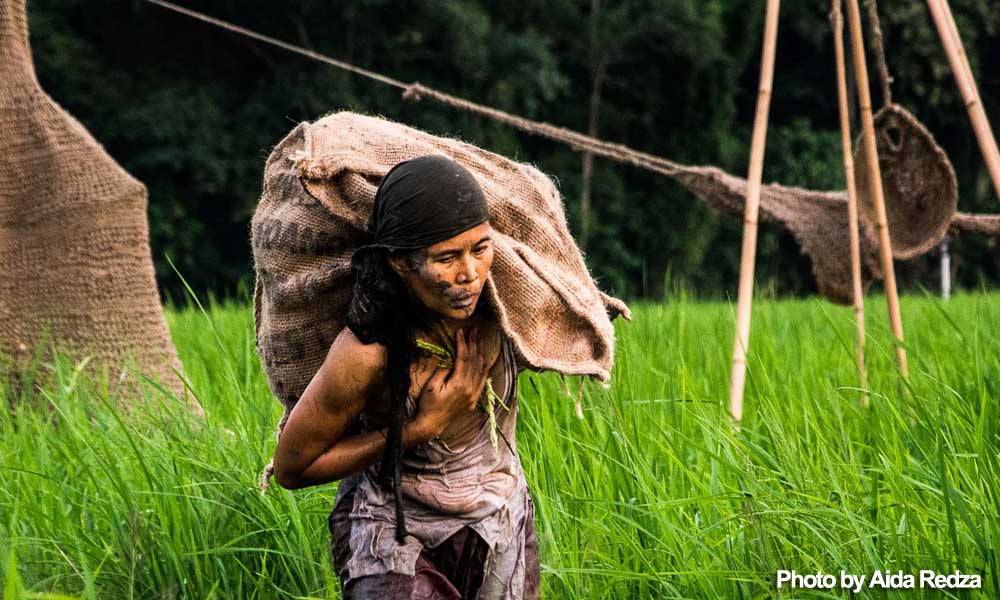

Aida Redza dances to connect with communities
MALAYSIANS KINI Intense and controversial, Aida Redza does not merely perform. In all her dances, her soul seeks connection with the past, and with the community around her.
She imbues life into the streets, back lanes and abandoned homes and padi fields, where she loves to perform best - out in the open, under the sun or stars, with the wind in her hair.
She does not paint her face or wear glittery clothes when performing, and would rather roll in the mud in padi fields to showcase her cause.
MALAYSIANS KINI Intense and controversial, Aida Redza does not merely perform. In all her dances, her soul seeks connection with the past, and with the community around her.
She imbues life into the streets, back lanes and abandoned homes and padi fields, where she loves to perform best - out in the open, under the sun or stars, with the wind in her hair.
She does not paint her face or wear glittery clothes when performing, and would rather roll in the mud in padi fields to showcase her cause.
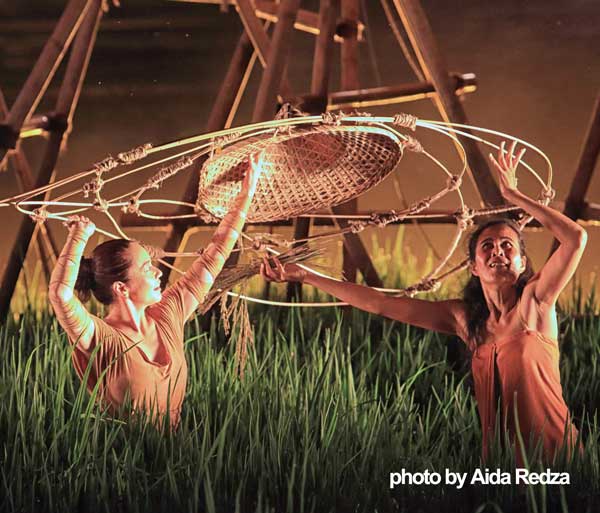 For Aida, every outdoor area is her stage, everyone has a story to tell, every spirit must be coaxed into life.
Her latest performance ‘Moved by Padi’ has reached its peak, where the padi planted about three months ago in a 20m x 20m plot, sandwiched between two high rise buildings in Macallum Street Ghaut, will be harvested.
Only a 15 minutes walk from Komtar, where the state’s administrative offices are located, Macallum Street Ghaut is densely populated by those living in low and medium-cost flats, built by the Penang Development Corporation (PDC).
Today, Aida and her cast Lisa Foo (installation artist/scenographer), Ng Chor Guan (composer/performer), Siti Sarah Ameera (visual artist), Mao Arata, Japan (choreographer/performer) will learn how to harvest padi from farmer Pak Cik Awang, who has been instrumental in keeping the plants alive since June.
Armed with traditional pisau tuai, the padi will be cut and threshed, the harvested seeds spread wide on a clean mat, while the dancers walk and dance over the bundles to separate the grains from the straw (dried leaves and stem).
The project is a mixed media performance in George Town Festival 2016, the state’s annual arts, culture and heritage festival to honour the Unesco World Heritage Status, awarded since 2008.
Presented by Ombak-Ombak ARTStudio with ZXC Theatre Troupe, the project is funded and supported by MyPAA Royal Arts Gala Fund, Japan Foundation Kuala Lumpur (JFKL), PDC (Penang Development Corporation).
“Rice is our staple food in Asia, and it brings communities together, to make you feel belonged,” Aida told Malaysiakini in an interview.
“The production help bring the farmer and Chinese contractor (who had to dig the field) and sound vendors together, to learn how to respect the spirit of the padi,” said Aida, who has lived in Penang since 10.
“The project sort of allows young people to connect with their past, though some may not have seen a padi field before,” added the artist, who was born in Selangor.
“We also learnt about each other’s pantang-larang (taboos), and this is something all races can share, where we try not to speak negative things because the spirits can hear,” she explained.
“For me, it brought me back to my roots, for I am of Minangkabau and Mendaling parentage. In the past, we had padi fields, though the Minangs were always more well-known as warriors”.
Aida, 47, a mother of two, studied creative arts and theatre in University Sains Malaysia. After this, she was a student of dance performance and choreography at the University of North Carolina, and then studied for a dance unlimited PhD programme at Codarts, Rotterdam.
She is currently project consultant for the World Alliance of Breastfeeding, administrator for Penang Artslink Pearl and artistic director for Euphoria Penang Modern Dance Ensemble.
In her own words, Aida says:
I UNDERSTAND HOW ARTISTS NEED TO LIVE TO SURVIVE, how most people are only impressed in spectacular and grand entertainment, that authentic, intuitive, deep and original dance experiences that touch and move people, including everyday people, toward change and transformation, are little valued or appreciated.
MY ADVICE TODAY, THOUGH MAYBE IT DOES NOT MAKE SENSE, is to please be wise about how we 'hijack' dance for our own uses and purposes, or for art for art’s sake, as opposed to using it to give back to the society, and the world around us.
WE NEED TO CONSIDER RECLAIMING DANCE AS IT WAS DANCED since our existence, which is to serve as an irreplaceable way of expressing human lives, thoughts, and emotions before it was modified to what it is today, to serve popular and commercial demands.
BUT I GUESS I HAVE TO ACCEPT THAT THIS IS ALSO RELEVANT since dance follows closely to the development of the human race, and I admit though I try to speak like a wise woman, but I, too, get pulled into this modern race to live and earn from, using dance for popular art and entertainment work.
I, TOO, AM A HIJACKER, so that is why when we get to work to share dance with the community outside the circle of the commercial, or art, I truly treasure the moment, because we have served.
Malaysians Kini is a series on Malaysians you should know.
Previously featured:
The brains and brawn behind M’sia’s pro wrestling scene
Meet Adam, a star in M’sia rising breed of professional gamers
Passion to preserve Malaysia's visual history
'Osama sent me his regards, but I wasn't interested'
Struck with hot steel, jailed under EO, PSM's Saras defines resilience
Meet Anis Syafiqah, the ordinary student who wants to catch MO1
How one Malaysian bagged seven journalism awards in the US
Beat me on the track, Supermoto champ Husna tells haters
How arguing on drying laundry led to Science Cafe KL
Bringing student activism to Malaysians abroad
Ramli Ibrahim has a reason to dance for joy
Denounced by relatives, ex-engineer battles for indigenous Sarawakians


