



'Release draft agreements on Penang's Transport Master Plan'
Draft agreements related to projects which would affect the daily lives of citizens must be released and publicly shared regardless whether it has been inked or not, said a representative of the World Wide Web Foundation.
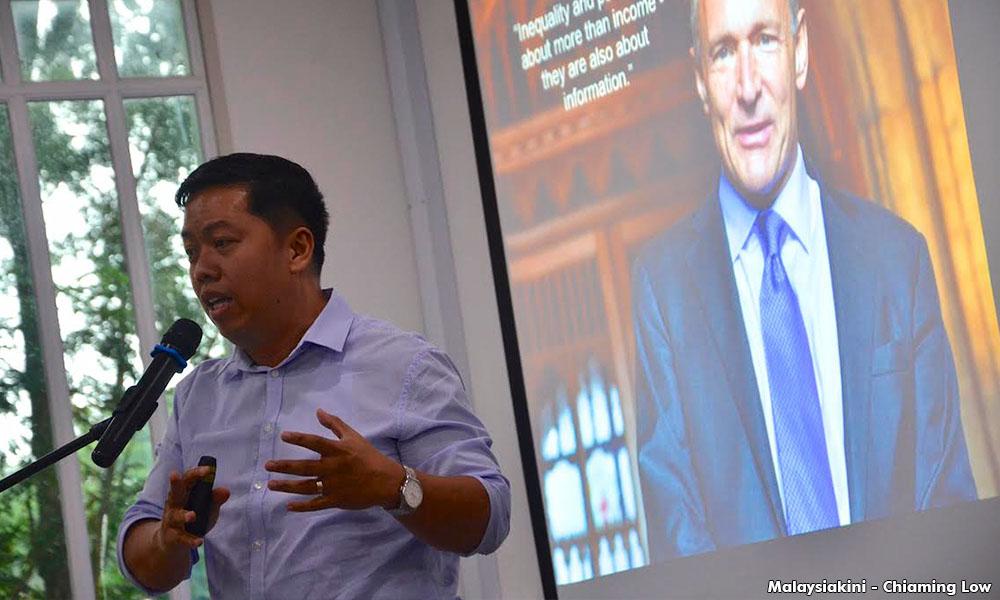
“If it affects my daily life, more so it has to be shared. The concept of good governance is that when a certain project affects my life, details of it should be shared,” said the Foundation’s regional research manager for Asia, Michael Canares.
Draft agreements related to projects which would affect the daily lives of citizens must be released and publicly shared regardless whether it has been inked or not, said a representative of the World Wide Web Foundation.
“If it affects my daily life, more so it has to be shared. The concept of good governance is that when a certain project affects my life, details of it should be shared,” said the Foundation’s regional research manager for Asia, Michael Canares.
“Many times, governments will say it is only a draft, and that it cannot be shared, but if it is a draft, then there is much more need for me to be involved in the process because that particular project affects my daily life."
Canares said this at "Fighting Corruption through a Transparent and Open Government" seminar in Penang today, which was held at the Penang Institute in conjunction with the International Right to Know Day today.
The event was jointly organised by the Institute for Democracy and Economic Affairs (Ideas), and the Governance, Integrity, Accountability and Transparency (GIAT) Coalition.
Canares was responding to a question from the floor about the Penang government’s delay in releasing the draft agreement prepared by SRS Consortium, the state’s project delivery partner to implement the RM27 billion Transport Master Plan.
State executive councillor Chow Kon Yeow had said the document will be made public, however, it is learnt that the state failed to release the document because it has yet to be signed with the private company.
The panelists, including Ideas CEO Tricia Yeoh and Sinar Project co-ordinator Khairil Yusof, and moderator cum Penang Institute CEO Zairil Khir Johari, were asked to advise the state government on the matter.
Governments responsible for disclosing data
Canares said opening up of the data and releasing it to the public opens up the opportunity for the data's quality to be improved, especially after discussions start around the issue.
“The responsibility to disclose information and documents of public interest rests with the powers that be. It is the governments which are responsible for disclosing the data, and civil society do not have to do what they do if the governments were doing their job,” he added.
Yeoh said some of the arguments to justify withholding agreements and documents for public viewing is that it may affect, not just the personal privacy, but the competitive advantage of the company.
Canares replied that the government do not have to reveal the names of the companies involved in bidding for the projects.
“However, certain items can be publicised, like specifications, plans and drafts, these should not be hidden."
Yeoh said the Selangor water supply agreement was earlier not disclosed but its secrecy was challenged by DAP's Klang MP Charles Santiago.
Santiago said the agreement should be revealed due to public interest.
“He eventually won the case and the agreement was made available. Citizens should know some details earlier, such as whether the agreement would affect their lines significantly,” Yeoh said.
Khairil said the select committee headed by Selangor speaker Hannah Yeoh made recommendations to the Selangor government.
“This means that all agreements inked by the state with any parties must be listed under the Freedom of Information Act,” he added.


