




Panel: Adopt consultative approach to Syariah review
The ambit of Syariah laws must be open to review based on joint consultation and mutual consent, agreed a three-member panel at a public forum on enforcement of public morality.
The ambit of Syariah laws must be open to review based on joint consultation and mutual consent, agreed a three-member panel at a public forum on enforcement of public morality.
 Decrying the vagueness of existing laws which could lead to abuse of powers by the enforcement authorities, Sisters In Islam (SIS) executive director Zainah Anwar expressed concern about the state's role in enforcing morality from the religious standpoint.
"The definition of public morality depends on public consensus, and we must ask ourselves if this consensus can ever be reached," she said.
"What we are being told is that it is a crime to refute and insult Islam or the religious authorities, and that it is a crime to act in an indecent manner in public places. However, all these terms are at the discretion of the (religious) authorities. Is it the role of the state to legislate faith and morality, and should these matters not be better left to the religious conscience?"
Using the example of the fatwa prohibiting Muslim women from participating in beauty pageants, she questioned the procedures in determining what constitutes a violation of public morality.
"How did such a law get passed without public knowledge until it was implemented?" she asked.
In 1997, three participants of the Miss Malaysia Petite pageant were charged in the Selangor Syariah Court for "indecent exposure" and were slapped with fines.
Acknowledging the challenges faced in forming dialogue on this issue, Zainah stressed the importance of providing an equal platform for every member of society.
"This debate must not remain the exclusive purview of religious authorities; it is not just for the ulama and Islamic activists," she added.
"We need to push open public space and reclaim the right to discuss; we must confer on ourselves authority as citizens of a democratic country. This is the big challenge facing the Muslim community today."
Clear definitions needed
Stressing the importance of equal enforcement in law, International Commission of Jurists vice-president Param Cumaraswamy highlighted the importance of clear definitions of offences under laws of public morality.
"It is imperative that if there is to be an offence it must be in clear and unambiguous words. Also, these offences must be capable of enforcement equally by all living under it."
"For example, Section 19 (1) of the Syariah Criminal Offences Act states that any person who in any public place consumes an intoxicating substance shall be guilty. However, have we had any (Muslim) person drinking (alcohol) in a five-star hotel apprehended? Have they sent peeping toms to spy on these people?"
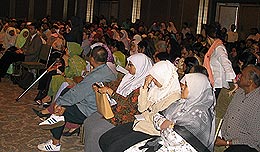 He further raised the issue of definitions and clear knowledge of acts that fall under offences that violate public morality.
"Right now, we do not have clear definitions of what constitutes 'vice'. These are not up to interpretation by the religious authorities alone. Are laws being enforced the way they should be in a country governed by rule of law?" he said.
PAS Dewan Muslimat information chief Dr Siti Mariah Mahmud acknowledged the current weaknesses in enforcement of Syariah laws, but was careful to state that these should not be used to justify labelling them as "unfair and discriminatory".
Qualifying her statements as personal opinion, she emphasised the importance of ensuring that the public is fully informed and aware of the issues involved in this effort.
"It is easy for intellectuals to understand the issues involved, but how about the makcik in the kampung and hawkers? If the laws are to be reviewed, there must be representatives from many sectors; these representatives must be accepted by the people," she noted.
"For example, we can't just have Umno ulama making a decision, as PAS members would not accept this... the same goes the other way as well."
State of morality
Siti Mariah explained her position on the presence of public morality enforcement.
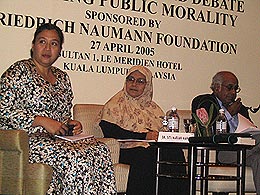 "In Islam there is an injunction for Muslims to be concerned about the state of morality. In the past, civilisations have collapsed because of immorality. We cannot assume that morality is universal in people at the grassroots and laymen."
Another concern brought up was the misunderstanding of Syariah laws and what these encompass.
"The caning of criminals for example, has specific guidelines that need to be adhered to. What we see in the newspapers, (photos of) lacerations and bruises, is not what Islam calls for.
"In the Quran, there are very detailed requirements in this matter. For example, the distance that the cane is held from the body is clearly explained."
A participant, identified only as Nik Elin, commented that Islam is now misunderstood and misinterpreted, leading to division even within the Muslim community.
"You have people asking that they don't want to be buried next to those they perceive as sinners. They openly say this because in their opinion there will be 'terrible noise' and 'activity' in the other's grave due to the judgement passed on them for sins (committed)."
Responding to the point, the panelists were careful to point out that such beliefs were not inherent in Islam.
 "We must not misconstrue personal judgements as consensus of the ulama. It is not for us to say who is a good Muslim or not. We are not to be judgmental. All issues must be discussed without sensitivities and pointing of fingers," said Siti Mariah.
Commented Zainah: "We cannot ignore the reality of others concerned in this issue - the Muslims who disagree with us and also non-Muslims. Accusing Muslims who question our decisions and actions is wrong, and we need to wake up to the reality that we do not live under a coconut shell."


