



Marina: Religious-based professional groups more worrying than political parties
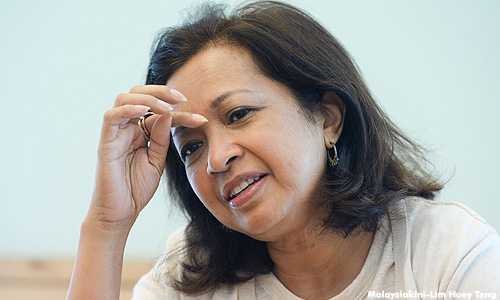
Religious-based professional organisations should be a matter of concern, and more so than religious-based political parties, said activist Marina Mahathir.
She questioned whether the members of such organisations would prioritise their professional obligations and their client’s interests first, or their own religious convictions.
“That affects how they do their work. That is what I’m more concerned about because, say, when you go to a doctor, you’d expect certain services,” Marina said today at a Facebook Live session.
Religious-based professional organisations should be a matter of concern, and more so than religious-based political parties, said activist Marina Mahathir.
She questioned whether the members of such organisations would prioritise their professional obligations and their clients’ interests first, or their own religious convictions.
“That affects how they do their work. That is what I’m more concerned about because, say, when you go to a doctor, you’d expect certain services.
“And then, you are not going to get it because the doctor has a religious objection towards it. What are you supposed to do? You don’t always have the means to go to another doctor,” Marina said today.
She was speaking at a Facebook Live session hosted by the National Human Rights Society (Hakam) this afternoon. It was themed ‘Just Ask Marina Mahathir’.
She was asked to comment on her previous statement that religious departments ought to be banned, and whether religious-based political parties such as PAS should likewise be banned.
She replied, “Well, I don’t know whether you can ban it completely because we have the freedom of association. People can get together on whatever platform that they want.
“It’s just what they do with it. You can be a religious-based party if you want, but as long as you are not putting down other religions at the same time.
“I also have a bit of an issue with professional associations that also have religion... It makes you wonder which one do they prioritise – their professionalism, or their religion,” she said.
As for religious departments, she said these departments are extremely well-funded for the promotion of only one religion – Islam. This, in turn, causes unease for adherents of other religions.
On the other hand, she said, it would be ‘terrific’ if there is a government department for the promotion of interfaith relations and cooperation in its place.
'Don't despair over growing extremism'
During the programme, Marina urged Malaysians not to despair despite growing religious and cultural extremism, when asked whether it would be a good idea to bring a child into this world in Malaysia, given these problems.
Instead, she said, things would only be terrible in Malaysia if Malaysians do not press for change.
“Otherwise, what are we all here for? We might as well just lie down and die, with that sort of attitude. I’m a believer in not taking things lying down.
“We cannot be so pessimistic and depressed about everything, because there is no point in that. Nothing will move.
“I think people in power are hoping we would be depressed, complacent, don’t do anything, and just accept whatever. That’s the easiest thing.
“Well, at the very least, we should make life difficult for them because we want a better future,” Marina said.
She said Malaysians should do something if they wish for a better future for their offsprings.
Moving to another country is not the solution, she said, because problems can crop up there as well.
Turning her attention on the issue of gender equality, Marina lamented that female participation in positions of power seemed to be on the decline.
She pointed out that Malaysia’s cabinet has three female ministers, which is the highest number of women ministers ever in Malaysia’s history.
However, at the same time, Malaysia’s cabinet has also greatly expanded, meaning that women now make up an even smaller proportion of the cabinet.
There are also few women in Parliament (10 percent out of 222 members) and fewer still in state legislatures. At least one state legislature has no female member at all, she said.
This is despite women taking up the bulk of university admissions.
“It is not a good situation. I am a great proponent of affirmative action to get to that 30 percent (target for female participation), and that’s what we need to do.
“But there is great reluctance on the part of political parties – not just in government but also in opposition – to implement the 30 percent (target),” Marina said.


