



Questions about that RM650m rainforest park
QUESTION TIME When I first wrote the column on this topic (it was uploaded this morning), I had assumed that the RM650 million to be spent will be on the existing park, Perdana Botanical Gardens, previously called the Lake Gardens or Taman Tasik. Most of the column was premised on that assumption.
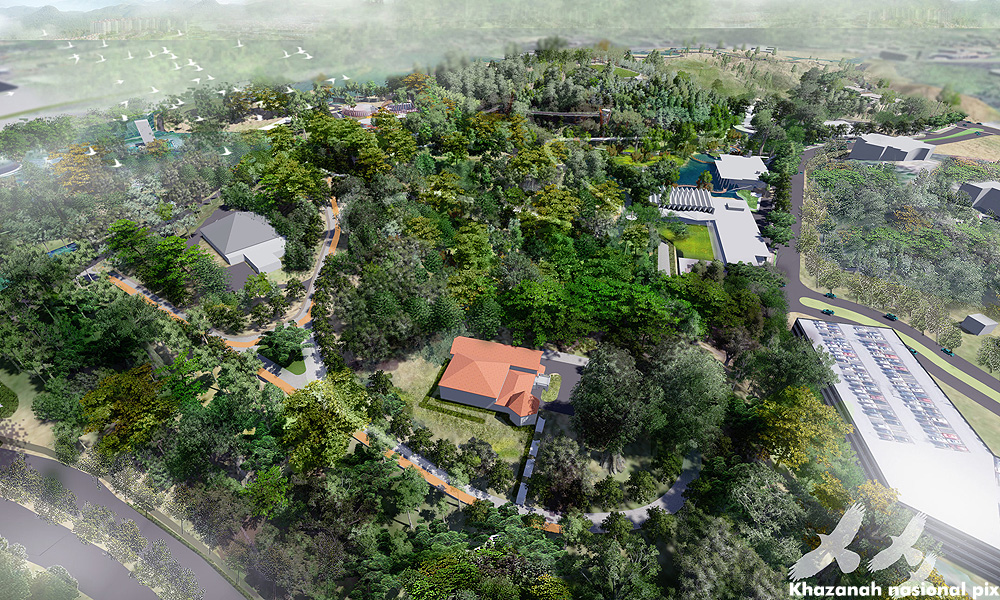
However, Khazanah Nasional officials have confirmed that the money is to be spent on a new park surrounding the existing National Monument (Tugu Negara) and does not involve the Lake Gardens except for connectivity projects.
My apologies to Khazanah Nasional and readers for that error. That information means many of the old arguments, premised on money being spent on Lake Gardens don’t hold, and therefore a new comment has to be written. The old one has been taken down.
QUESTION TIME When I first wrote the column on this topic (it was uploaded this morning), I had assumed that the RM650 million to be spent will be on the existing park, Perdana Botanical Gardens, previously called the Lake Gardens or Taman Tasik. Most of the column was premised on that assumption.
However, Khazanah Nasional officials have confirmed that the money is to be spent on a new park surrounding the existing National Monument (Tugu Negara) and does not involve the Lake Gardens except for connectivity projects.
My apologies to Khazanah Nasional and readers for that error. That information means many of the old arguments, premised on money being spent on Lake Gardens don’t hold, and therefore a new comment has to be written. The old one has been taken down.
Regular visitors to the Lake Gardens associate the area around the large lake, the Tugu Negara area, Parliament, the Institute of Strategic and International Studies (ISIS) building, Bukit Aman, the Bird Park, the Butterfly Park and the Islamic Arts Museum, amongst others as being in the general area of the park.
However, the areas around Tugu Negara, the ISIS building and other adjacent areas comprise about 66 acres of land which are not part of the Perdana Botanical Gardens which in itself totals about 225 acres. While the two parks, totalling 291 acres, are contiguous they will remain separate.
Still the question remains as to why it will cost RM650 million to develop Taman Tugu, of which RM500 million will come from government-owned Khazanah and the remaining RM150 million from Kuala Lumpur City Hall, a partner in the project.
Khazanah officials said that the a lot of money will be spent on connectivity to the park and facilities besides planting of additional trees in the area and other developments.
The new Taman Tugu will have a community and family-focused area comprising Malaysian food and beverage outlets and stalls, play areas for children, and indoor and outdoor event spaces. There will also be learning and education facilities comprising a Rainforest Education Centre, education trails, and a learning and innovation centre open to public use. In addition there will be outdoor activity areas such as campsites and running and hiking trails.
It also involves enhancing connectivity between Taman Tugu and surrounding places, via a walkway from Bank Negara Komuter Station to Taman Tugu, an underpass from Taman Tugu to the Lake Gardens, an overhead bridge from KL Sentral to Muzium Negara, and a pedestrian deck from KL Sentral to the Lake Gardens via Muzium Negara.
“The pedestrian deck to KL Sentral will be developed with the support of Muzium Negara, CIMB, MRCB and other stakeholders in the KL Sentral vicinity. The connectors, targeted for completion by 2019, are part of a collective effort to stitch the urban fabric of the city for the convenience of residents and visitors alike.
“Overall, the cost of the project, including regenerating the urban rainforest park, facilities including the Rainforest Education Centre and learning and innovation centre, various connecters and public infrastructure improvements, amounts up to an estimated RM650 million, of which up to RM500 million or approximately 75% would be borne by Khazanah as part of its ongoing Corporate Responsibility (“CR”) efforts,” Khazanah said in its press release.
The RM650 million will be spent over the next four years and yes, there will be a tendering system, Khazanah said. US giant, AECOM, noted for its work on environmental engineering, is project manager, and it will be tender out of the various portions of the contract, Khazanah officials said.
Substantial planting to be done
It will be a while before the forest park becomes a full-blown reality. The Taman Tugu project currently has an estimated 1,000 trees. Only 54 trees had a diameter of more than 1 metre, Khazanah officials said. Thus substantial planting - of over 5,000 trees - has to be done and as many big trees as possible before a rainforest-like park emerges after many years - it’s a work in progress.
Here’s what Prime Minister Najib Abdul Razak said, according to The Star: “If Hyde Park is synonymous with London, and Central Park is synonymous with New York, I hope one day, Taman Tugu will be synonymous with KL as a global city. I don’t see this as something impossible because we can already see it happening.”
The report goes on: Expressing his own excitement about the project, Najib said that when the first phase of the project is ready in the middle of 2018, the area will be a place where the people can come and enjoy its facilities and surroundings.
“Can you imagine - the people will have their very own mini tropical forest in the middle of the city,” Najib said.
But the people already have a park there - a sort of a mini forest park which they had for more than a hundred years. And it was synonymous with Kuala Lumpur from before we gained independence when everyone called it the Lake Gardens. My brother got lost in the park during the 1957 independence day celebration when thousands of Malaysians congregated there to celebrate. The police found him and took good care of him until his parents arrived.
If it is the prime minister’s intention to give KL an equivalent of New York’s Central Park or London’s Hyde Park, much more needs to be done. The new Tugu Park is just 69 acres compared to Central Park’s 843 acres and Hyde Park’s 350 (including adjoining Kensington Park’s 275 acres takes it up to 625 acres). We have some way to go in terms of area. Even if we include adjoining Lake Gardens, the park area comes up to just 291 acres.
And then we need to protect it for eternity. The problem with the Lake Gardens was this - it’s care and upkeep was rather sporadic, depending on who was mayor of Kuala Lumpur. It has very old trees, it is beautiful, if offers a very nice walk but it was repeatedly spoilt over the years by ‘renovations’.
Whoever heard of a park being renovated? Did Hyde Park or Central Park ever get renovated? Or did these two iconic parks do everything possible to keep away encroaching development and to do as little as possible to alter the appearance and structure of the park?
It is great to learn that the Tugu Park will eventually come under a public trust much like the UK’s National Trust. Khazanah officials envisage a board of trustees drawn up from the public and private sector groups and civil society groups.
Making the park self-funding
The trustees will entrust running the park to professionals and it is envisaged that recurrent income from rentals and car park fees (entry to the park will be free) can be supplemented by public donations to make the park self-funding.
Lake Gardens however was repeatedly brutalised by those renovations, incompetence and patronage/corruption. One renovation involved pouring coloured concrete (a bright orange) on walkways which were perfectly okay. Par fitness circuit tracks were uprooted for others whose value was dubious. Massive waterfalls and other structures were constructed.
Why not put the entire area, including Tugu Park, Lake Gardens, the Bird Park, the Butterfly Park and other adjoining areas under one designated contiguous park and call it Lake Gardens like it was in those days, and make that name an icon once more?
It may take the park size to a more respectable 400-500 acres and offer more opportunities for an integrated park development which cannot be encroached upon because of the public trust arrangement which may help prevent annexation of park land for future development.
And it may stop the periodic ‘vandalisation’ of Lake Gardens from those who are currently assigned to protect, preserve and conserve it.
P GUNASEGARAM was a regular visitor to the Lake Gardens. He can’t wait to see the new Taman Tugu and hopes it will be integrated with the Lake Gardens. Contact: t.p.guna@gmail.com


