


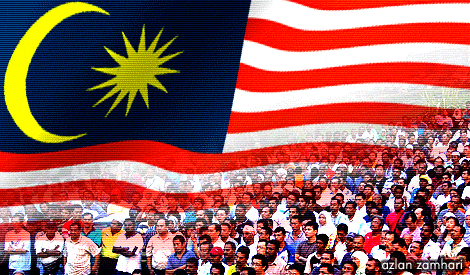

Two minutes at midnight
“When I discover who I am, I’ll be free.”
- Ralph Ellison, ‘Invisible Man’
I have never had much time for patriotism. It seems to me the people who advocate it vociferously are the ones who lack any kind of empathy for their fellow citizens. Around this time, the various media in this country transmit propaganda messages of how we are all Malaysians and that 'Merdeka' is the time to remember that.
Having said that, I do think that Astro’s ‘Unity Runs in Our Blood’ ad and the #kitasama blood donation drive are something that we should all get behind. They are clever bits of bridge-building that incorporate much needed corporate activism and address very serious issues that could help Malaysians.
I am one of those types who always - always - reads letters or opinion pieces about what it means to be 'Malaysian'. I always try to get a sense of what people think it means. Most times, it is about wanting to be treated the same. Equality before the law. Most often, it is about how the establishment divides us. I have gone down that route too; however, I have not drunk the kool aid.
Three years ago in the ‘Naive and sentimental Malaysian patriot’, I wrote, “Ever since the ascendance of Pakatan Rakyat as a credible alternative to BN, and the total dominance the alternative alliance has over the online discourse, dissenting voices have been marginalised or vilified. From issues such as the Lynas debate and issues of race, both alliances have sought to control the discourse through hate speech or through the 1Malaysia or Bangsa Malaysia propaganda. This is something any right-thinking Malaysian should be cognisant of.”
I do not have a definition of what it means to be 'Malaysian' but I do know what it means to act like Malaysians. Unfortunately, most often many of us do not act like Malaysians. Our reactions are based on our partisan instincts.
I have always respected the dissidents, the outliers and malcontents who operate far from the political and social mainstream. I may not agree with their ideologies but their grassroots level activism and their attempts to make a better Malaysia is perhaps evidence of what it means to be Malaysian while being divided along racial, religious and class lines...
“When I discover who I am, I’ll be free.”
- Ralph Ellison, ‘Invisible Man’
I have never had much time for patriotism. It seems to me the people who advocate it vociferously are the ones who lack any kind of empathy for their fellow citizens. Around this time, the various media in this country transmit propaganda messages of how we are all Malaysians and that 'Merdeka' is the time to remember that.
Having said that, I do think that Astro’s ‘Unity Runs in Our Blood’ ad and the #kitasama blood donation drive are something that we should all get behind. They are clever bits of bridge-building that incorporate much needed corporate activism and address very serious issues that could help Malaysians.
I am one of those types who always - always - reads letters or opinion pieces about what it means to be 'Malaysian'. I always try to get a sense of what people think it means. Most times, it is about wanting to be treated the same. Equality before the law. Most often, it is about how the establishment divides us. I have gone down that route too; however, I have not drunk the kool aid.
Three years ago in the ‘Naive and sentimental Malaysian patriot’, I wrote, “Ever since the ascendance of Pakatan Rakyat as a credible alternative to BN, and the total dominance the alternative alliance has over the online discourse, dissenting voices have been marginalised or vilified. From issues such as the Lynas debate and issues of race, both alliances have sought to control the discourse through hate speech or through the 1Malaysia or Bangsa Malaysia propaganda. This is something any right-thinking Malaysian should be cognisant of.”
I do not have a definition of what it means to be 'Malaysian' but I do know what it means to act like Malaysians. Unfortunately, most often many of us do not act like Malaysians. Our reactions are based on our partisan instincts.
I have always respected the dissidents, the outliers and malcontents who operate far from the political and social mainstream. I may not agree with their ideologies but their grassroots level activism and their attempts to make a better Malaysia is perhaps evidence of what it means to be Malaysian while being divided along racial, religious and class lines.
One of the first interviews I did for Malaysiakini was with PSM’s Dr Jeyakumar Devaraj. His description of the construction of the Kg Perje bridge with the aid of PAS is an example of “acting like Malaysians” that I described above.
There is this idea that helping people is some sort of noble endeavour and that the gratitude of marginalised communities will sustain one’s efforts. In the interview, Jeyakumar makes it clear that it is far more complicated than that. He says:
“So, in this game, timing is crucial. Sometimes we have to give them room to explore the options offered by the other side, and not try to hold them back by threats or ‘emotional blackmail’. But we must maintain contact so that we know when there is a need to mobilise them to protest some blatantly unfair decision of the government.”
But more importantly, he said that racial and religious “sensitivities” was not a hindrance, only political ones - “All religions have a ‘socialist’ core. Politics does hinder though. Sometimes people are afraid to come and participate as they are afraid that they will be spotted by the BN and then denied the bits of aid that they are getting.”
That may be true but the sad fact is that religious bigotry does effect specific communities in ways that go beyond the Muslim/non-Muslim dialectic that dominates the mainstream and alternative press.
Marginalised groups
I am always supportive whenever Malaysiakini highlights marginalised groups like the LGBT (lesbian, gay, bisexual and transgender) community. Well, to be clear, a specific class of these communities where money and position does not shield them from the excess of the state or mainstream organised religion.
Too often, people who profess grand ideals about goodwill and equality dismiss groups based on their religious dogma or cultural norms. These same people will tell you of how oppressed they are in Malaysia because of the state-sanctioned racism and bigotry.
The reality is that their conception of what it means to be 'Malaysian' does not encompass the diversity that exists within our society. Things are hidden beneath sub rosa racial, religious or cultural bigotry that determines the discourse and those who participates in it.
Responding to activist Pang Kee Teik's letter published in Malaysiakini, I wrote, “People often ask how they can stem the tide of religious bigotry that seems pervasive in this country. How can they stem the tide of racial bigotry that seems so overwhelming?
“My answer is simple, by showing support for causes such as these. By reminding communities such as these that they are a part of the wider mainstream polity who believe in equality and justice even at the expense of their own sometimes prejudiced religious dogma.”
And maybe, that is it. What makes us Malaysian is how we empathise with our brethren or maybe that is not it at all. Maybe it is pointless defining what it means to be Malaysian. After all, I know far more people who do good for their compatriots living the Thomas Paine dictum - “The world is my country, all mankind are my brethren, and to do good is my religion” - than many who profess solidarity with the numerous political parties that infest Malaysia.
As someone reminded me the other day when the discussion moved to our Merdeka day celebrations, I have written some of the more divisive pieces about the racial dialectic in this country, not to mention Christian evangelism, giving prominence to so-called “racist” people like P Uthayakumar and being “unfair to the DAP”.
I get it. Someone like me who is always talking about race should not be pontificating on what it means to be Malaysian. No doubt, there are many others who could articulate the concept better than I could.
The BBC online had this passage on its ‘On This Day’ page about Malaysia’s independence:
“Thousands of young members of the Malay, Chinese and Indian parties, which form the government, stood in darkness for two minutes at midnight to mark the official handover.”
For many people in Malaysia, those two minutes have stretched to decades and they are still standing in the darkness while those who formed the government stepped into the light. The brutal fact is that Umno cannot be blamed for all of it. The reality is that we contributed to the darkness. Maybe being Malaysian means coming to terms with the fact that we created this country.
S THAYAPARAN is Commander (Rtd) of the Royal Malaysian Navy.


