


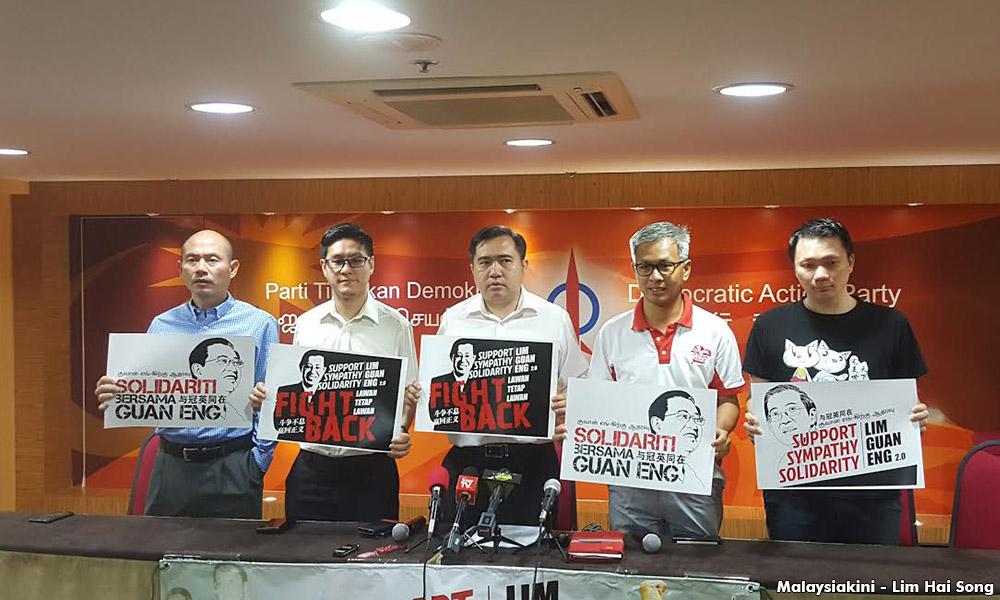

Will snap polls be slapping Najib, or slapping ourselves?
COMMENT Another day, another article about snap polls.
I realise that this week has been dominated by this debate (of course I acknowledge my own complicity in that).
Can you believe it, though? We gave Najib Abdul Razak the thing he wanted most, at a time he needed it most: a distraction from the US Department of Justice investigations.
Imagine if instead of fighting one another, all the anti-Najib factions focused public attention on what is a groundbreaking international scandal?
COMMENT Another day, another article about snap polls.
I realise that this week has been dominated by this debate (of course I acknowledge my own complicity in that).
Can you believe it, though? We gave Najib Abdul Razak the thing he wanted most, at a time he needed it most: a distraction from the US Department of Justice investigations.
Imagine if instead of fighting one another, all the anti-Najib factions focused public attention on what is a groundbreaking international scandal?
Instead, I imagine the PM is laughing all the way to the bank (to make some quick withdrawals one might presume), watching those who could hurt him the most hurt each other instead.
This article asks a number of questions about snap polls in Penang. What other ways might it play into Najib’s hands? Will it achieve the goals DAP has stated? Is DAP truly united behind this idea, or is there an ominous silence from other major party leaders?
A slap in whose face?
A major sentiment regarding snap polls in Penang is that this is an opportunity for the rakyat to put Najib in his place - a show of strength and a slap in the face to Najib, as it were.
This popular idea bears some thinking through though.
I will be the first to agree, DAP will win a resounding victory in all Chinese majority seats - surpassing their already perfect 19 for 19 (seats) record in 2013. Achieving that ‘slap’ goes without saying.
How will the opposition do in the other seats?
Amidst all the speculation and opinions, the one set of hard data we can refer to is the Kuala Kangsar and Sungai Besar elections.
In both seats, Barisan Nasional (BN) increased their majorities by double digit percentage points.
Whatever electoral gains may be had from the scandals surrounding Najib may be offset by DAP’s own problems, as well as the sentiment of wanting some balance of power in Penang to counteract what may be perceived as DAP’s growing dominance and arrogance.
Exposing our flank to BN
If BN loses Malay ground, then yes, the decision to call snap elections will definitely be vindicated.
If BN gains Malay ground however, what have the snap elections demonstrated?
They will demonstrate that BN can call national snap polls and win by following a very simple formula - ignore the urban and non-Malay seats, shore up Malay and rural seats (especially in Borneo), and retain a simple majority at least in Parliament, and a two-thirds majority at best.
By all means, accuse me of bias, but the facts and figures do seem to me to strongly suggest this outcome. I would be more than happy to consider and analyse any possible alternative data or interpretations.
If the above view is more likely however, then what have we achieved?
In our blind, desperate fury to try and win an easy battle on one front, we expose a flank that the enemy can exploit to deliver a killing blow and win the war.
Put another way, we swing hard to slap Najib, miss completely, and end up slapping ourselves.
Feeling the burn
It’s undeniable, some of the attention grabbing debate surrounding snap elections in Penang has been nothing short of hilarious.
It’s been a long time since Latheefa Koya’s political views resonated with my own, but the points she raised certainly made sense to me - especially the ones where no one is innocent of unilateralism.
I couldn’t help but enjoy the stripping analogy too - some feeling the burn for those of us no longer able to enjoy feeling the Bern.
Anyway, I can’t top that kind of funny, so I’ll turn to the boring stuff.
Conspicuously missing voices within DAP
One thing I noticed that may be relevant. We have had some very vocal proponents of snap elections in Penang within DAP. The most prominent probably being Tony Pua, Anthony Loke, Liew Chin Tong, Chow Kon Yeow and P. Ramasamy.
A burning question - where are the rest?
My apologies if I overlooked anything, but where are the views of Teresa Kok, Gobind Singh Deo, Ong Kian Ming, Teng Chang Khim, Nga Kor Ming, Chong Chieng Jen and other DAP heavyweights?
For that matter, what are Lim Kit Siang’s real views?
Are they all truly behind this idea? What are the internal political dynamics that we’re not seeing?
A closer look at the reasons given
Now for the really boring stuff that truly no one pays attention to (because sentiment is usually formed by emotive connection and not objective reason) - the reasons given by DAP for having snap polls.
Since academic P Ramasamy has laudably taken the time to present his arguments in a structured, cogent (by which I mostly mean numbered) fashion, those arguments definitely deserve careful consideration.
Anthony Loke, for whom I have a lot of respect and goodwill, also put forth some reasoning which deserves attention.
Loke says that having snap polls now capitalises on momentum, and creates more momentum for general elections.
As argued at the beginning of the article however, the likely loss of ground in Malay seats (due to three-cornered fights or what have you), may well achieve the opposite effect - creating momentum for BN, as happened in Kuala Kangsar and Sungai Besar.
You can create all the momentum in the world for Chinese and urban seats, but by exacerbating opposition disunity instead of healing it, you still risk losing not only the general elections, but giving BN a two-thirds majority.
Contradictory arguments
Let’s look at Ramasamy’s four reasons why snap polls are necessary.
First, because the charges against Lim Guan Eng and against Najib both work in the favour of Pakatan Harapan.
This is certainly an acceptable argument as to why we might expect bigger majorities for DAP in Chinese majority seats (there is little to no guarantee for the other seats; if rural folk did not care about 1MDB before, some FBI investigation is not likely to make them care now).
I find it harder to accept this however, as a reason as to why polls are ‘necessary’. Unless of course, DAP really expects us to believe fear-mongering that odds of retaining Penang in the future will be lower. If DAP is confident in its governance of Penang, then there should be no rush.
“Second, snap polls are not about saving Guan Eng from prosecution or from being convicted, it is about saving and strengthening Harapan as an alternative political formula to BN in the coming general election.”
I am not sure how something that is tearing Harapan apart (think naked discourse) saves or strengthens Harapan. As I recall, PKR tried to sell the Kajang Move as an opportunity to unify Pakatan Rakyat as well. We all know how that turned out.
The qualifier to this line of reasoning is also confusing, because “Loke said the main reason to call a state polls was to fight the prosecution of Penang Chief Minister Lim Guan Eng.”
So which is it? A main reason, or not a reason at all?
“Third, it is believed that snap polls might be the necessary recipe for injecting the much-needed political confidence amongst Malaysians who are tired about the dirty politics.”
My reservations about whether snap poll is a symptom of rather than cure to dirty politics aside, winning Chinese seats while losing Malay ones will only inspire confidence in the short-sighted and the parochial. The long-sighted will know the impending defeat at a national level such a result truly indicates.
Similarities to the Kajang Move
“Fourth, currently without an effective mechanism to revitalise the opposition front at the national level, Harapan has taken on a feeble defensive posture. What is needed at the present political juncture is for the Harapan as a whole to take an offensive line towards BN.”
I agree that the best defence is often a good offence.
Does this apply here and now? On one hand, we have BN that is beleaguered by scandal, but for all means and purposes BN is still united behind Najib (what choice do they have, after all?).
On the other, we have the opposition. DAP can win Penang on its own, but PKR is reluctant to join the fray. Amanah is a token party, and PAS is in too deep to give way in Penang.
The Mahathir Mohamad/Muhyiddin Yassin team would love to be a factor, but with their setup looking to be Malay-only, and with opportunity-seeking hotheads like Zaid Ibrahim already declaring that Muhyiddin should be the opposition’s candidate for PM (demonstrating once again his poor understanding and appreciation of those in the opposition), it’s far too soon for them to matter.
So, the opposition has the choice of taking time to unify somehow, or to attack a superior, better organised force with uncoordinated, bickering battalions.
Most recently, Chow Kon Yeow seems to be saying, let’s shoot first, and ask questions later.
Ultimately, the reasons given by DAP sound all too much like the reasons PKR gave to justify the Kajang Move - contradictory and hollow, and sounding all too much like cover ups for other motives.
Equally reminiscent of Kajang is this “Just trust us, come along, everything will be all right” reasoning, that flies in the face of available facts.
All this suggest that just like the Kajang Move, there will be a short-term victory, followed by a disastrous backfire in the longer run, creating the exact opposite of the end result envisioned by the move’s proponents.
Truth to power
Ramasamy ends by saying “It is still not too late, but a decision has to be made soon.”
While much of his tone is admirably conciliatory, the last sentence simply echoes Guan Eng’s true message - the decision has already been made, and there will be no changing it. In other words, we can do this the easy way, or we can do it the hard way - but we are doing it.
Azmin Ali seems to understand this, and seems to already be trying to make the best of the inevitable situation.
As discussed in my two previous articles, perhaps the real motivations for the snap polls are financial gain and internal political consolidation.
Hopefully the thus far relatively silent voices of reason within DAP - voices of people that command respect for good reason - will soon be heard.
Many find it easy to speak truth to power when ‘power’ means ‘enemy’. It takes much more courage to speak truth to your boss. I hope we all find that courage soon.
NATHANIEL TAN is tickled by comments which focus on the messenger, while having clearly not bothered with the message. He welcomes constructive engagement all the time.


