




Abu Samah - the ex-British child soldier
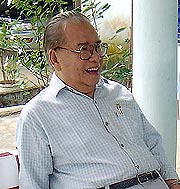
Although Abu Samah, 79, is usually a reticent man but his life has been extraordinary, epitomising the evolving nationhood.
 For a start, he was sent to fight the Japanese invasion in December 1941 in Kota Baru, Kelantan at the age of 14, as a soldier of the British-sponsored Federated Malay States Volunteers Force.
But after his force lost grounds and morale, he went to Singapore and ended up in the Heiho, a reserve unit of the Japanese troops. However, in March 1945, he escaped to return to Malaya where he contacted the Malayan People's Anti-Japanese Army (MPAJA) led by the Communist Party of Malaya (CPM).
Since March 1948, Abu Samah has been loyal, through thick and thin, to CPM - and was made a member of the central committee of the party since 1975 - although he joined Umno between 1946 and 1948 and was a committee member of Temerloh's Umno Youth division.
After the proclamation of the 'Emergency' on June 20, 1948, Abu Samah led a group of left-wing Malay youths into the jungle and to take up arms against British colonialism. They joined Abdullah CD's 10th Regiment.
Abu Samah was born in February 1926 in the Semantan district of Temerloh, Pahang. His full name is Abu Samah Mohamad Kassim and is the fourth child in a family of six.
He is a distant descendant of a 19th-century anti-colonial Malay hero, Dato' Bahaman @ Abdul Rahman of Semantan, Pahang. According to Abu Samah, since at a very young age, he had been told stories about the heroism of Bahaman who resisted the attempt by British colonialists to control Pahang.
Although Abu Samah, 79, is usually a reticent man but his life has been extraordinary, epitomising the evolving nationhood.
 For a start, he was sent to fight the Japanese invasion in December 1941 in Kota Baru, Kelantan at the age of 14, as a soldier of the British-sponsored Federated Malay States Volunteers Force.
But after his force lost grounds and morale, he went to Singapore and ended up in the Heiho, a reserve unit of the Japanese troops. However, in March 1945, he escaped to return to Malaya where he contacted the Malayan People's Anti-Japanese Army (MPAJA) led by the Communist Party of Malaya (CPM).
Since March 1948, Abu Samah has been loyal, through thick and thin, to CPM - and was made a member of the central committee of the party since 1975 - although he joined Umno between 1946 and 1948 and was a committee member of Temerloh's Umno Youth division.
After the proclamation of the 'Emergency' on June 20, 1948, Abu Samah led a group of left-wing Malay youths into the jungle and to take up arms against British colonialism. They joined Abdullah CD's 10th Regiment.
Abu Samah was born in February 1926 in the Semantan district of Temerloh, Pahang. His full name is Abu Samah Mohamad Kassim and is the fourth child in a family of six.
He is a distant descendant of a 19th-century anti-colonial Malay hero, Dato' Bahaman @ Abdul Rahman of Semantan, Pahang. According to Abu Samah, since at a very young age, he had been told stories about the heroism of Bahaman who resisted the attempt by British colonialists to control Pahang.
Teen soldier
After five years of primary schooling, Abu Samah enrolled in an Islamic school as well as Arabic classes for three years, but, like so many other Malayans at that time, his education was cut short by the outbreak of the Pacific War.
"I joined the Federated Malay States Volunteers Force at the age of 14. I was sent to fight the Japanese landing at Kota Baru, Kelantan, but just before I reached the battleground, orders were given to halt our advance as the Japanese troops had already landed... I heard the sounds of bombing and machine gunning... I saw Japanese soldiers landing ashore... I also saw many drunken soldiers in the midst of the British troops trying to fight back...
"My unit later retreated to Kuala Krai, and when Japanese troops occupied Kuala Krai, we retreated further and further until we reached a rubber estate in Negeri Sembilan... The quick advance of Japanese troops were covered by their air forces," he recalled.
According to now established accounts, Japanese troops reached the Sabak-Badang beach of Kota Baru, Kelantan, and began to attempt amphibious assaults 10 minutes before their counterparts first struck Pearl Harbour in Hawaii. The first Sabak-Badang landings occurred at 2.15am on Dec 8, 1941.
After 70 days of continuous retreat from the north to the south, the British troops finally surrendered to Imperial Japan in Singapore on Feb 15, 1942. The scandalous and ignominious defeat of the British troops shocked not only the people of Peninsular Malaya and Singapore but also the world, especially Australia who felt betrayed by London and then prime minister Winston Churchill.
"When we were in the rubber estate in Negeri Sembilan, our British commanding officer gave us two options: either to go home without pay or to go to Singapore with pay... I chose to go home to Semantan without pay... I set up a shop with some relatives selling rice we supplied rice to Japanese troops but also donated some amounts secretly to MPAJA...
"One day, it was reported to the Japanese that we had contacts with MPAJA and the oldest relative of mine, together with some other people, were arrested and tortured ... some died ... I had no choice but to escape to Singapore and established contact with Ibrahim Yaacob who worked for the Japanese. It was him who advice me to join the Heiho for temporary self-protection," Abu Samah said.
"After staying with Heiho for about two years, I befriended a Chinese from Johor and I could sense that he hated the Japanese very much. Later, I also discovered that he was a member of MPAJA ... he asked me for bullets and to join MPAJA to fight for the freedom for all races...
 "After about two weeks, I made up my mind to join him and he transported me first to Batu Pahat, and then to Malacca, from Malacca I took a train back to Temerloh in Pahang. There, MPAJAs welcome me back in a public ceremony held deep inside the jungle. I was then tasked to be the quartermaster in charge of food logistic ... Not too long after that, the Japanese announced their surrender."
The MPAJA unit Abu Samah joined in Temerloh was the 6th Independent Regiment operating in Lipis, Raub, Bentong and Temerloh. According to its regimental history published in 1991 in Hong Kong, the regiment also consisted of many Orang Asli, some Indians and also a British straggler from an artillery unit who is only remembered only by his Chinese pseudonym 'Ah Yang'.
The regiment also saved and protected six American special operations personnel, namely J Bithos who - together with another two Chinese Americans - parachuted into a Chinese farm in Jerantut on the evening of Dec 7, 1944, and a Humphrey, a Sahzman and a Duffy whose B29 bomber crashed in Negeri Sembilan.
Son died in lock-up
After the war ended, Abu Samah did not give up politics. He joined the Angkatan Pemuda Insaf (API) as well as the Malayan Malay National Party (MNP), which was founded a few months earlier than Umno. However, he also joined Umno and became a youth wing leader in Temerloh. His main aim was to fight for independence.
In March, 1948, Abu Samah formally joined the CPM. Three months later, when the 'Emergency' was proclaimed, Abu Samah escaped into the jungle together with his many Malay comrades. After his escape, his first wife and a very young son were 'kept' by the colonial authorities in a police station and the young son soon died inside the lock-up.
Immediately before the 'Emergency' was proclaimed, the CPM and many other Malay nationalist organisations like AWAS (women), API (youth) and MNP as well as the Pan-Malayan Federation of Trade Unions (PMFTU) were banned and hundreds of Malay, Chinese and Indian leaders, members and supporters of those organisations were detained, banished, convicted on dubious charges and even hanged (such as SA Ganapathy, president of PMFTU) by the colonial authorities.
Since then, Abu Samah had been an active soldier and commander of the 10th Regiment which participated into many engagements. He personally led three 10th Regiment's southward advances into Peninsular Malaysia in 1969, 1970 and 1973 from its base in southern Thailand. In 1975, Abu Samah was elected for the first time a member of CPM's central committee.
Today, Abu Samah, who has put on quite a few pounds around his waist, is thankful that there is now peace in Malaysia.
However, he also wants to tell his story to younger Malaysians so that they would never forget the horror of wars and the hardship he and his generation of Malayan nationalists and communists had endured in the struggle against British colonialism and Japanese fascism.
He hopes the new generation would forever live together harmoniously in peace and prosperity. This, after all, was what he, like Chin Peng, Abdullah CD, Rashid Maidin, Suriani Abdullah had been struggling for many years.
JAMES WONG WING ON is chief analyst of Strategic Analysis Malaysia. He is a former DAP member of parliament for Kampar (1990-1995) and a former columnist for the Sin Chew Jit Poh Chinese daily (now Sin Chew Daily). He read political science and economics at Monash University in Melbourne, Australia.


