




Post-tremor building inspection crucial
The Fire and Rescue Department (FRD) has advised people to inspect their homes and buildings for any structural damage following the earthquake tremors of early Tuesday morning.
The Fire and Rescue Department (FRD) has advised people to inspect their homes and buildings for any structural damage following the earthquake tremors of early Tuesday morning.
 Senior assistant superintendent S Kobalakrishnan said after that tremor, the department had inspected high-rise buildings in areas which felt it the most such as Kuala Lumpur.
"The inspections were conducted as a standard precautionary measure. We also checked with the meteorological services department for possible aftershocks," he told malaysiakini during a recent interview in Putrajaya.
"After a preliminary check on the fire equipment in the buildings, we call in the structural engineers from either the Public Works Department, local authorities, independently or from the Institute of Engineers Malaysia."
Early Tuesday morning, tremors shocked people and shook buildings in parts of Peninsular Malaysia, prompting panic among high-rise apartment dwellers most of whom fled to the streets in their bedtime clothes.
Noting the absence of laws on emergency evacuation procedures for high-rise residential buildings, Kobalakrishnan said that individual and community response systems were more necessary than laws.
Precautionary measures
Explaining the precautionary measures in an earthquake situation which forms the standard practice in China, Japan and the US, Kobalakrishnan advised people to conduct checks inside their homes.
"Firstly, check for gas leaks. Modern high-rise buildings nowadays have piped gas, so people have to be very careful or it will become another disaster waiting to happen.
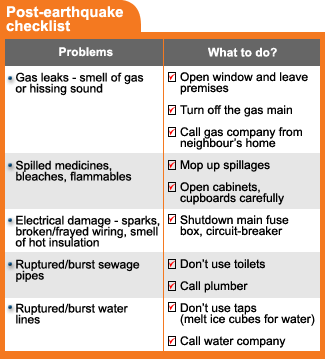 "If you smell gas or hear hissing sound, open a window and quickly evacuate. If you turn off the gas main for any reason, it must be turned back on by a professional," he said.
He also cited possible damage to electrical systems, as well as water, power and sewerage lines if the tremors had been strong enough.
"Conducting checks in our homes after tremors, for example, actually mitigates an emergency by reducing the occurrence of an emergency or the damaging effects of unavoidable situations.
"It is good to start investing in preventive mitigation steps such as repairing deep plaster cracks in ceilings and foundations, anchoring overhead lighting fixtures to the ceiling and following local seismic building standards."
Crisis management
At present, said Kobalakrishnan, buildings in Malaysia are not equipped to withstand the horizontal force of earthquakes although tremors are much smaller in magnitude.
He said that improving on building designs, construction standards and material will help reduce the impact of earthquakes, if Malaysia was to experience one in the future.
Asked about crisis management on the ground, he said, the National Security Council Directive No 20 would kick in immediately in the event of a calamity with massive casualties and major destruction.
"This provides for an inter-agency disaster management and relief committee at various levels, starting at the district and moving on to state and national depending on the gravity of the disaster," he added.


