


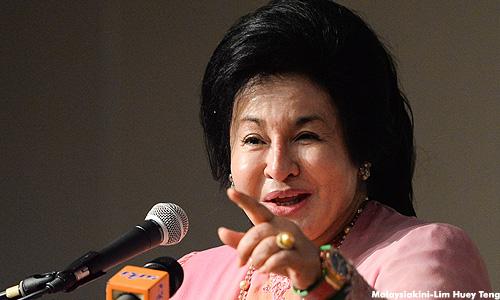

Rosmah defends Permata, brushes off critics
The prime minister’s wife, Rosmah Mansor, today admitted that the path of her brainchild, the Permata programme, has not been without resistance.
In her keynote address at the second regional early childhood education and care (ECEC) policy forum in Putrajaya, Rosmah advised the audience not to be daunted by adversity.
“Some people did not understand while some are sceptical and even politicise the issue.
The prime minister’s wife, Rosmah Mansor, today admitted that the path of her brainchild, the Permata programme, has not been without resistance.
However, in her keynote address at the second regional early childhood education and care (ECEC) policy forum in Putrajaya, Rosmah advised the audience not to be daunted by adversity.
“Some people did not understand while some are sceptical and even politicise the issue.
“But, we continue to pursue the cause relentlessly and persevere because we believe and are firmly committed towards ECEC and talent development for a better future of our nation, Malaysia,” Rosmah said.
Towards the end of her lengthy speech, Rosmah jokingly reprimanded the audience which did not appear to be giving their full attention.
“Are all of you listening? Wake up, wake up.
“I know it's 3 (or) 3.30pm, very good time to sleep,” said Rosmah, drawing laughter from the some 400 audience members.
Earlier, Rosmah, the Permata programme patron, said she first convened a meeting in August 2005 with professional women and academicians, among others, to address issues such as the increase in social ills.
“Our meetings often lasted till late at night, prompting Prime Minister Najib (Abdul Razak) to tease us that our meetings were even longer than his cabinet meetings."
After studying ECEC programmes, Rosmah said she and the group resolved to bring ECEC issues to policy-makers.
“Strike while the iron is hot. This is where I helped open doors to new ideas to be presented to policy-makers," she said.
'Pillow talk'
On Feb 21, 2006, the group presented its findings and recommendations to Najib, who was then deputy prime minister, and to the ministries of education, housing and local government and regional development as well as women, family and community development.
Rosmah denied that there was any “pillow talk” involved in the matter.
“Don’t think that I talked to my husband when he was about to sleep. It was all very formal,” she said.
Meanwhile, Rosmah said she believed it is the collective responsibility of parents, guardians, NGOs, governments and citizens to develop and nurture children from the earliest age possible.
“We should not underestimate the importance of ECEC, particularly when rapid societal changes have affected family units."
Investing in ECEC would help working mothers enter the job market and earn a living with peace of mind, she added.
More work-based ECEC centres will lower absenteeism, increase productivity and ultimately boost the gross domestic product (GDP), she said.
She added that hope is brightest for the inculcation of values, ethics and roles in childhood education.
“There is no point building and leaving behind beautiful infrastructure and country if we don't impart the right values for ethical conduct to the next generation.
“In fact, it is easier to fix a broken road or to build it than to fix broken individuals,” she said.


